Women's Power in Iroquois Society — Reading Comprehension
Rate this
Premium Resource
Present
Present in classroom. No work saved
Assign
Classroom with student accounts, Track progress
Quick Play
No student accounts, assign with a link
Grades
6
7
8
Standards
D2.HIS.2.3-5
D2.HIS.3.3-5
RI.4.3
RI.4.4
W.4.2
PRINT+DIGITAL RESOURCE
This learning resource is available in interactive and printable formats. The interactive worksheet can be played online and assigned to students. The Printable PDF version can be downloaded and printed for completion by hand.
This passage explores women's power and influence in Iroquois society, focusing on their roles in government, family, and culture. Students will analyze the causes and consequences of matrilineal descent and women's participation in decision-making, and examine multiple perspectives and the complexities of Iroquois life. The passage integrates a primary source quote, a glossary of key academic terms, and a timeline of important events. Activities include a reading comprehension quiz, writing prompts, and a graphic organizer. Audio read-aloud and a Spanish translation support accessibility. This resource aligns with C3 Framework standards D2.His.2.3-5 and D2.His.3.3-5, and ELA standards RI.4.3, RI.4.4, and W.4.2, making it ideal for building history and literacy skills.
CONTENT PREVIEW
Expand content preview
The consequences of women's power in Iroquois society were far-reaching. The structure helped maintain peace and stability over centuries.
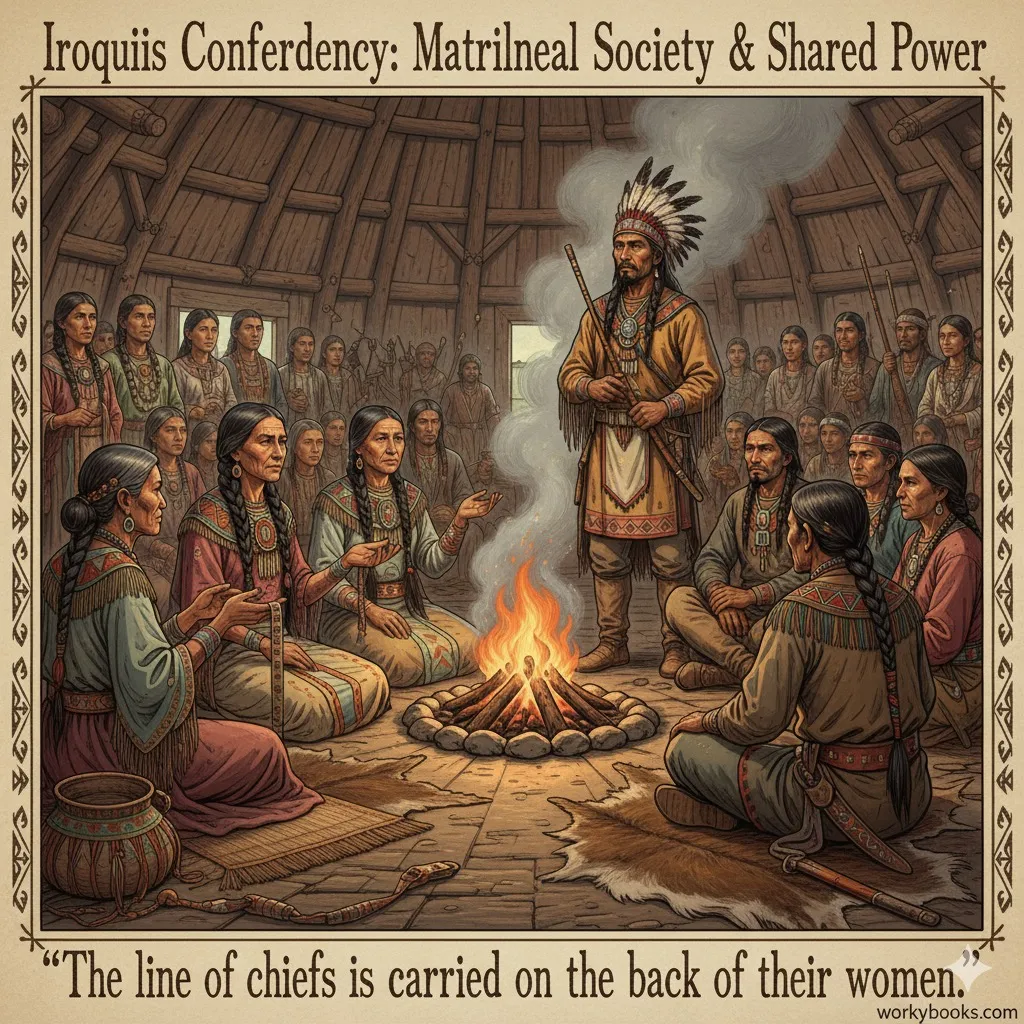
The Haudenosaunee, also known as the Iroquois Confederacy, included six powerful Native American nations in what is now the northeastern United States. In their society, women held significant authority over both family and community life. Unlike in many European societies of the same period, Iroquois society was matrilineal, meaning that family identity, property, and clan membership were passed down through mothers rather than fathers.
One of the most important roles in Iroquois society was that of the clan mother. Each clan, or extended family group, was led by a respected woman. The clan mothers were responsible for choosing the male leaders, known as sachems, who would represent their clans at the Grand Council of the confederacy. Clan mothers could also remove sachems who did not serve the people's interests. This power to select and remove leaders was unusual and even shocking to European visitors.
Women also managed the longhouse, the communal home shared by several related families within a clan. They organized the daily life inside the longhouse, controlled the food supply, and ensured the well-being of children and elders. Ownership of the longhouse, the land around it, and the crops grown there belonged to the women of the clan. This economic power allowed women to influence important decisions about trade, resources, and survival.
The Iroquois political system was based on consensus and cooperation. Although men spoke at the Grand Council, the advice and opinions of the clan mothers were highly respected. Decisions about war, peace, and treaties could not be made without their approval. In this way, women shaped both the internal and external policies of the confederacy.
However, the influence of women was not absolute or without conflict. Clan mothers sometimes faced resistance from male leaders, especially as European contact brought new ideas about gender roles. Over time, pressures from colonization and changing economies challenged traditional Haudenosaunee structures. Despite these challenges, the central role of women persisted in many Haudenosaunee communities.
When European colonists arrived, they were surprised by the authority and respect given to Iroquois women. Some early American suffragists, such as Elizabeth Cady Stanton, even cited the Haudenosaunee as a model for women's rights. The contrast between Native and European gender roles encouraged discussion and debate about justice and equality in both societies.
Today, many Haudenosaunee people continue to honor the wisdom of the clan mothers and the importance of matrilineal traditions. The Iroquois example shows how different cultures have recognized women's leadership and the value of diverse voices in decision-making.
Interesting Fact: The Great Law of Peace, the founding document of the Haudenosaunee Confederacy, specifically included women’s rights to select leaders and maintain the well-being of their people.
What is a clan mother?
A female clan leaderA male council speakerA European settlerA type of longhouse
How did Iroquois women influence politics?
They selected male leadersThey signed treaties aloneThey fought in warsThey built all houses
What did women own in Iroquois society?
Land and longhousesOnly weaponsOnly clothingNothing
Why did European visitors feel surprised?
Women had much authorityMen worked in fieldsThere were no clansNo one lived in longhouses
How did colonization affect Iroquois women?
It brought new gender rolesIt made them clan mothersNo changes happenedThey became European leaders
Why are clan mothers important today?
They maintain traditionsThey end the confederacyThey build longhousesThey write English laws
Iroquois society was matrilineal. True or false?
TrueFalse
What does 'consensus' mean?
Everyone agrees on a decisionOnly leaders decideWomen decide aloneNo one decides
Perfect For:
👩🏫 Teachers
• Reading comprehension practice
• Auto-graded assessments
• Literacy skill development
👨👩👧👦 Parents
• Reading practice at home
• Comprehension improvement
• Educational reading time
🏠 Homeschoolers
• Reading curriculum support
• Independent reading practice
• Progress monitoring
Reading Features:
📖
Reading Passage
Engaging fiction or nonfiction text
❓
Comprehension Quiz
Auto-graded questions
📊
Instant Feedback
Immediate results and scoring
📄
Printable Version
Download for offline reading
🔊
Read Aloud
Voice-over with word highlighting
Reviews & Ratings
No reviews yet. Be the first to share your experience!
Related Content
Native American Tribes Across America
This engaging history reading passage introduces students to Native American tribes across America, focusing on their da...
D2.HIS.1.3-5D2.HIS.2.3-5RI.4.1RI.4.2
Teepees: Homes on the Great Plains
This engaging history reading passage introduces students to teepees, the unique homes of Native American tribes on the ...
D2.HIS.2.3-5D2.HIS.14.3-5RI.4.1RI.4.2RI.4.4
Traditional Native American Clothing
This engaging history passage explores traditional Native American clothing and how it reflected the environment, values...
D2.HIS.2.3-5D2.HIS.3.3-5RI.4.3RI.4.4
The Iroquois Confederacy: A System of Peace
This engaging U.S. History reading passage introduces students to the Iroquois Confederacy, a powerful alliance of Nativ...
D2.HIS.2.3-5D2.HIS.3.3-5RI.4.3RI.4.4
The Cherokee Nation: History and Culture
This reading passage explores the rich history and culture of the Cherokee Nation, one of the largest Native American tr...
D2.HIS.2.3-5D2.HIS.14.3-5RI.4.3RI.4.4RI.4.10
The Sioux: Warriors and Tribal Leaders
This history reading passage explores the Sioux Nation, focusing on their roles as warriors and tribal leaders. Students...
D2.HIS.1.3-5D2.HIS.2.3-5RI.4.1RI.4.3
Native American Respect for Nature
This engaging history reading passage explores Native American respect for nature, emphasizing the close relationship be...
D2.HIS.2.3-5D2.HIS.3.3-5RI.4.3RI.4.4
Jamestown: The First Permanent English Colony
This engaging history passage explores the founding of Jamestown, the first permanent English colony in America. Aligned...
D2.HIS.1.3-5D2.HIS.2.3-5RI.4.3RI.4.4
Pocahontas and the Powhatan People
This engaging reading passage explores the life of Pocahontas and the Powhatan people and their important role in early ...
D2.HIS.1.3-5D2.HIS.2.3-5RI.4.1RI.4.3
Colonial Children: School and Chores
This reading passage explores the daily lives of colonial children, focusing on their experiences at school and their ma...
D2.HIS.2.3-5D2.HIS.3.3-5RI.4.1RI.4.2RI.4.4
Colonial Clothing and Homemade Goods
This engaging U.S. history passage explores the daily life of early American colonists with a focus on colonial clothing...
D2.HIS.2.3-5RI.4.3RI.4.4
Colonial Jobs: Blacksmiths, Bakers, and Craftsmen
This engaging history reading passage explores the vital roles of blacksmiths, bakers, and craftsmen in colonial America...
D2.HIS.2.3-5D2.HIS.3.3-5RI.4.3RI.4.4
Colonial Towns and Village Life
This engaging history reading passage explores the daily life, work, and unity found in colonial towns and villages. Ali...
D2.HIS.1.3-5D2.HIS.2.3-5RI.4.3RI.4.4
Colonial Trade with England and Africa
This history reading passage explores colonial trade between the American colonies, England, and Africa, focusing on the...
D2.HIS.2.3-5D2.HIS.14.3-5RI.4.3RI.4.4
Benjamin Franklin: Printer, Inventor, and Leader
This history reading passage explores the life and achievements of Benjamin Franklin, one of America's most important ea...
D2.HIS.2.3-5D2.HIS.3.3-5RI.4.1RI.4.3
George Washington Leads the Army
This engaging history reading passage explores how George Washington bravely led the Continental Army during the America...
D2.HIS.1.3-5D2.HIS.2.3-5RI.4.3RI.4.4
Women and Children During the Revolutionary War
This reading passage explores the important roles women and children played during the Revolutionary War. Students will ...
D2.HIS.2.3-5RI.4.3RI.5.3
African Americans Fight for Freedom
This educational passage explores the brave and inspiring story of how African Americans fought for freedom in the Unite...
D2.HIS.2.3-5D2.HIS.3.3-5RI.4.3RI.4.4
The Battle of Yorktown Ends War
This engaging U.S. history reading passage explores the Battle of Yorktown, a key event that ended the American Revoluti...
D2.HIS.1.3-5D2.HIS.2.3-5RI.4.1RI.4.3
Loyalists vs. Patriots: Divided Families
This engaging U.S. history reading passage explores the division between Loyalists and Patriots during the American Revo...