Woodrow Wilson New Freedom
Interactive passage with audio narration, comprehension questions, and printable PDF.
By completing this purchase you agree to our Terms of Use and Privacy Policy. Your subscription renews automatically until you cancel. You can cancel anytime from your account settings. All sales are final and non-refundable. Digital content is available for download in your account immediately upon purchase.
What's included
Woodrow Wilson New Freedom preview and details
About this printable Woodrow Wilson New Freedom reading passage (Grades 6-8)
Sample passage and quiz from Woodrow Wilson New Freedom
Reading passage and comprehension quiz preview
Woodrow Wilson's New Freedom
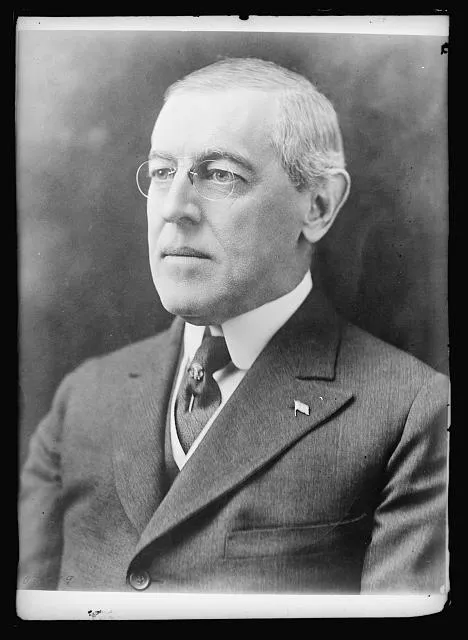
Source: Library of Congress
President Woodrow Wilson introduced the New Freedom to address major challenges in the United States during the early twentieth century. After his election in 1912, Wilson believed that government should help create fair economic opportunities for all Americans. The nation was experiencing rapid industrial growth, but this progress also allowed large monopolies to form. These powerful companies reduced competition and sometimes harmed consumers and workers.
Wilson saw monopolies as a threat to both democracy and free markets. He argued that antitrust laws needed to be strengthened to break up these large companies. Unlike Theodore Roosevelt, who believed in regulating large businesses, Wilson wanted to dismantle them. The Clayton Antitrust Act of 1914 was passed to limit unfair business practices and protect labor unions. This law made it harder for companies to form secret agreements that limited competition.
Another problem was high tariffs, or taxes on imported goods. High tariffs protected American industries but also led to higher prices for consumers. Wilson supported the Underwood Tariff Act, which significantly lowered tariff rates. By reducing these taxes, Wilson hoped to encourage more competition and lower prices for everyday goods.
The American banking system was also unstable. Banks could fail easily, making it hard for people to get loans or keep their money safe. Wilson worked with Congress to create the Federal Reserve Act in 1913. This act established a central bank, called the Federal Reserve, to better regulate the economy and keep banks safe. The Federal Reserve could control how much money was in circulation, which helped prevent economic crises.
Despite these reforms, not everyone benefited equally. African Americans and some immigrant groups continued to face discrimination and had limited access to the new opportunities. Wilson’s administration even allowed some forms of segregation in federal offices. This shows that, while the New Freedom brought progress, it also had limitations and left some Americans behind.
The New Freedom is significant because it marked a shift in how the federal government intervened in the economy. Wilson’s policies aimed to restore competition, protect consumers, and stabilize the banking system. However, the ongoing struggle for equality reminds us that progress can be uneven and complex.
Interesting Fact: Woodrow Wilson was the first president to deliver his State of the Union address in person to Congress since Thomas Jefferson, changing an old tradition.
Comprehension quiz (8 questions)
1. Who introduced the New Freedom?
2. What was the main goal of the New Freedom?
3. Which act created the Federal Reserve?
4. Why did Wilson want lower tariffs?
5. How did the Clayton Antitrust Act help workers?
6. What was a limitation of the New Freedom?
7. Wilson was the first in person to deliver the State of the Union since Jefferson. True or false?
8. What is a monopoly?
Common Core standards for Woodrow Wilson New Freedom
Explain events, procedures, ideas, or concepts in a historical, scientific, or technical text, including what happened and why, based on specific information in the text.
Determine the meaning of general academic and domain-specific words or phrases in a text relevant to a grade 4 topic or subject area.
Write informative/explanatory texts to examine a topic and convey ideas and information clearly.
Perfect for the way you teach
- Build comprehension skills
- Auto-graded quiz
- Differentiated reading
- Read together at home
- Improve fluency
- Quiet reading time
- Reading curriculum support
- Independent practice
- Track Lexile growth