This learning resource is available in interactive and printable formats. The interactive worksheet can be played online and assigned to students. The Printable PDF version can be downloaded and printed for completion by hand.
This engaging history reading passage explores the fact that more Africans than Europeans arrived in the Americas during the colonial period, focusing on the Atlantic Slave Trade and its profound effects on society, economy, and daily life in Colonial America. Students will analyze primary sources, understand cause-and-effect relationships, and examine the human impact of forced migration. The passage is aligned to HSS 8.7 and RH.6-8.1 standards, supporting both history and ELA learning goals. Activities include a vocabulary glossary, multiple-choice and writing questions, graphic organizers, and a timeline, as well as a Spanish translation and read aloud audio. This resource provides a rigorous yet accessible approach to studying this critical topic in US and world history, deepening students' understanding of how geography, economics, and human actions shaped early America.
CONTENT PREVIEW
Expand content preview
[Frontispiece and title page from: The interesting narrative of the life of Olaudah Equiano]. Source: Library of Congress
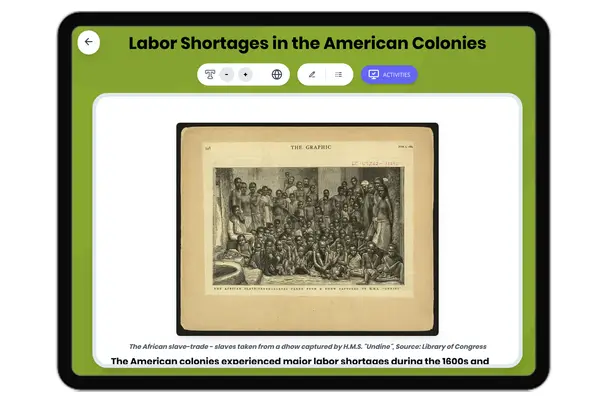
The Atlantic Slave Trade was one of the largest forced migrations in world history. Between the 1500s and the late 1800s, millions of people were taken from Africa and transported across the Atlantic Ocean to the Americas. In fact, during the colonial period, more Africans than Europeans arrived in the Americas. This movement of people changed societies, economies, and daily life across three continents.
The majority of Africans who arrived in the Americas were forcibly brought as enslaved people. European traders, mainly from Portugal, Britain, Spain, and the Netherlands, exchanged goods such as guns, cloth, and rum for people in West and Central Africa. According to shipping records, historians estimate that over 12 million Africans were transported across the Atlantic between 1501 and 1867. In comparison, only about 2.5 million Europeans migrated to the Americas during the same period. Primary sources, such as ship logs from the slave ship Brookes, show that ships were packed tightly with people, leading to terrible conditions and high death rates during the journey known as the Middle Passage.
The arrival of so many Africans had a major impact on the development of Colonial America. Enslaved Africans worked on plantations growing crops like sugar, tobacco, and rice, especially in the Southern colonies and the Caribbean. Their labor made these regions wealthy but created a society with a harsh social hierarchy based on race and legal status. Archaeological excavations at sites like Jamestown, Virginia, reveal African tools and pottery, showing how enslaved people kept parts of their culture alive. Despite harsh conditions, African traditions, languages, and religions influenced daily life, music, and food in the Americas.
The Atlantic Slave Trade was part of the larger triangular trade system. Ships sailed from Europe to Africa with goods, from Africa to the Americas with enslaved people, and then from the Americas back to Europe with crops and resources. This trade shaped the economies and histories of all three continents for centuries. The forced migration of Africans brought lasting cultural changes and set the stage for later struggles for freedom and equality in the United States and beyond.
Understanding the scale of African arrival in the Americas helps us see the global impact of the slave trade and its lasting effects on society, culture, and identity. It connects to broader themes of migration, human rights, and the complex history of race in the Americas.
Interesting Fact: Olaudah Equiano, an African who survived the Middle Passage, wrote an autobiography in 1789 describing the horrors of the journey and life as an enslaved person. His book became an important primary source for historians.
Which group was largest in arrival to Americas?
AfricansEuropeansAsiansNative Americans
What was the Middle Passage?
Sea journey for enslaved AfricansA trade route to AsiaA path across North AmericaA road in Europe