Labor Shortages in the American Colonies β Reading Comprehension
Rate this
Premium Resource
Present
Present in classroom. No work saved
Assign
Classroom with student accounts, Track progress
Quick Play
No student accounts, assign with a link
Grades
5
6
7
8
PRINT+DIGITAL RESOURCE
This learning resource is available in interactive and printable formats. The interactive worksheet can be played online and assigned to students. The Printable PDF version can be downloaded and printed for completion by hand.
This passage examines the causes and effects of labor shortages in the American colonies, focusing on the economic and social impact of the Atlantic Slave Trade, European involvement, and changing labor systems. Students will read about the development of trade networks, the roles of indentured servants and enslaved Africans, and how these changes shaped daily life and social hierarchies. The passage aligns with CA HSS 8.1.2 and TEKS 8.2A, and supports ELA.RI.6.3 and ELA.RI.7.3 standards. Activities include a glossary, multiple-choice quiz, writing prompts, graphic organizers, and a timeline. This resource is designed for history classrooms and includes a Spanish translation and read-aloud audio for accessibility.
CONTENT PREVIEW
Expand content preview
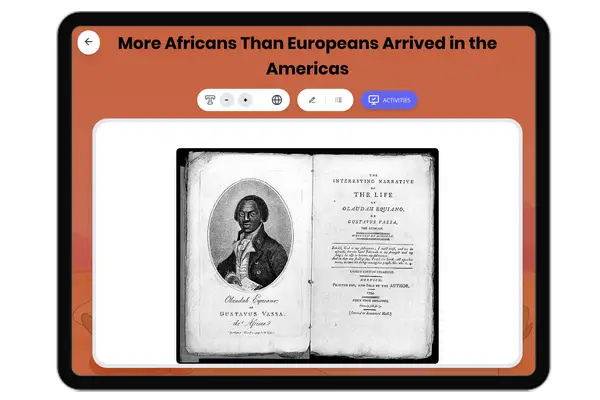
The African slave-trade - slaves taken from a dhow captured by H.M.S. "Undine", Source: Library of Congress
The American colonies experienced major labor shortages during the 1600s and 1700s. The arrival of European settlers in North America required large numbers of workers to build settlements, harvest crops, and develop new towns. However, the population of willing workers was small, and colonists struggled to find enough people to meet their growing economic needs.
One major solution to the labor shortages was the use of indentured servants. Indentured servants were people, often from Europe, who agreed to work for a set number of years in exchange for passage to the colonies. For example, in Virginia in 1619, primary records show that about 1,000 Englishmen arrived as indentured servants. Even so, this system could not provide enough labor for the expanding colonies, especially as the demand for cash crops like tobacco and rice grew in the southern regions.
To solve this ongoing problem, colonists and European traders began to rely more heavily on the Atlantic Slave Trade. Beginning in the early 1600s, enslaved Africans were forcibly transported across the Atlantic Ocean to the American colonies. Archaeological evidence and shipping records reveal that by 1750, nearly 250,000 Africans had been brought to British North America. The majority were forced to work on large plantations, especially in colonies like South Carolina and Virginia. The use of enslaved labor became a central part of the colonial economy, supporting the production of tobacco, rice, and indigo for export.
The development of the Atlantic Slave Trade was influenced by European economic interests. European nations, especially England, Portugal, and Spain, profited from trading enslaved people, raw materials, and manufactured goods. These trade networks, sometimes called the Triangular Trade, connected Europe, Africa, and the Americas. European companies and colonial governments controlled much of this trade, shaping colonial society and deepening social divisions. Enslaved Africans and indentured servants formed the lowest ranks of the colonial social hierarchy. Primary source diaries and plantation records describe how enslaved people faced harsh conditions, with little hope of freedom, while many indentured servants struggled but eventually gained their liberty.
The reliance on African slave labor changed the economy, daily life, and demographics of the American colonies. Over time, the institution of slavery became deeply embedded in colonial law and culture, especially in the South. The labor shortage thus led to the creation of a system with long-lasting consequences, including the growth of racial inequality and resistance from enslaved communities. These changes shaped the early history of the United States and had effects that lasted for centuries.
This topic connects to the broader study of how geography, economics, and social systems influenced the development of civilizations and trade networks across the world.
Interesting Fact: The first enslaved Africans arrived in Jamestown, Virginia, in 1619, marking the beginning of a system that would shape the future of America for generations.
Why did colonists need workers?
To build towns and grow cropsTo explore the ArcticTo fight European warsTo make laws in Europe
What did indentured servants receive?
LandFreedom immediatelyPassage to coloniesGold coins
Where did most enslaved Africans work?
On plantationsIn gold minesAs ship captainsIn European parliaments
How did the Atlantic Slave Trade affect the colonies?
It provided needed laborIt ended all tradeIt made colonies independentIt stopped crop growing
Why did colonists turn to slavery?
To replace failing cropsLabor shortage continuedEurope demanded itTo end plantations
What was the Triangular Trade?
Trade between Europe, Africa, AmericasTrade only within the coloniesA new ship designA political alliance
Enslaved Africans arrived in Jamestown in 1619. True or false?
TrueFalse
What does 'social hierarchy' mean?
A system of ranking peopleA place to grow cropsA type of shipA trade item