Alexander Hamilton Early Life — Reading Comprehension
Rate this
Premium Resource
Present
Present in classroom. No work saved
Assign
Classroom with student accounts, Track progress
Quick Play
No student accounts, assign with a link
Grades
6
7
8
PRINT+DIGITAL RESOURCE
This learning resource is available in interactive and printable formats. The interactive worksheet can be played online and assigned to students. The Printable PDF version can be downloaded and printed for completion by hand.
This passage explores the inspiring yet complex journey of Alexander Hamilton, tracing his rise from a Caribbean-born orphan to a crucial Founding Father of the United States. Students will analyze the historical context, challenges, and opportunities that shaped Hamilton's role in American independence and government. The text models historical reasoning, integrates academic vocabulary, and aligns with HSS 8.3.4 and CCSS RI.6-8.1, RI.6-8.6. Activities include a glossary, comprehension quiz, writing prompts, graphic organizers, and a timeline to deepen understanding. The passage is available with read aloud audio, Spanish translation, and a differentiated version for accessibility, making it ideal for developing historical literacy and critical thinking.
CONTENT PREVIEW
Expand content preview
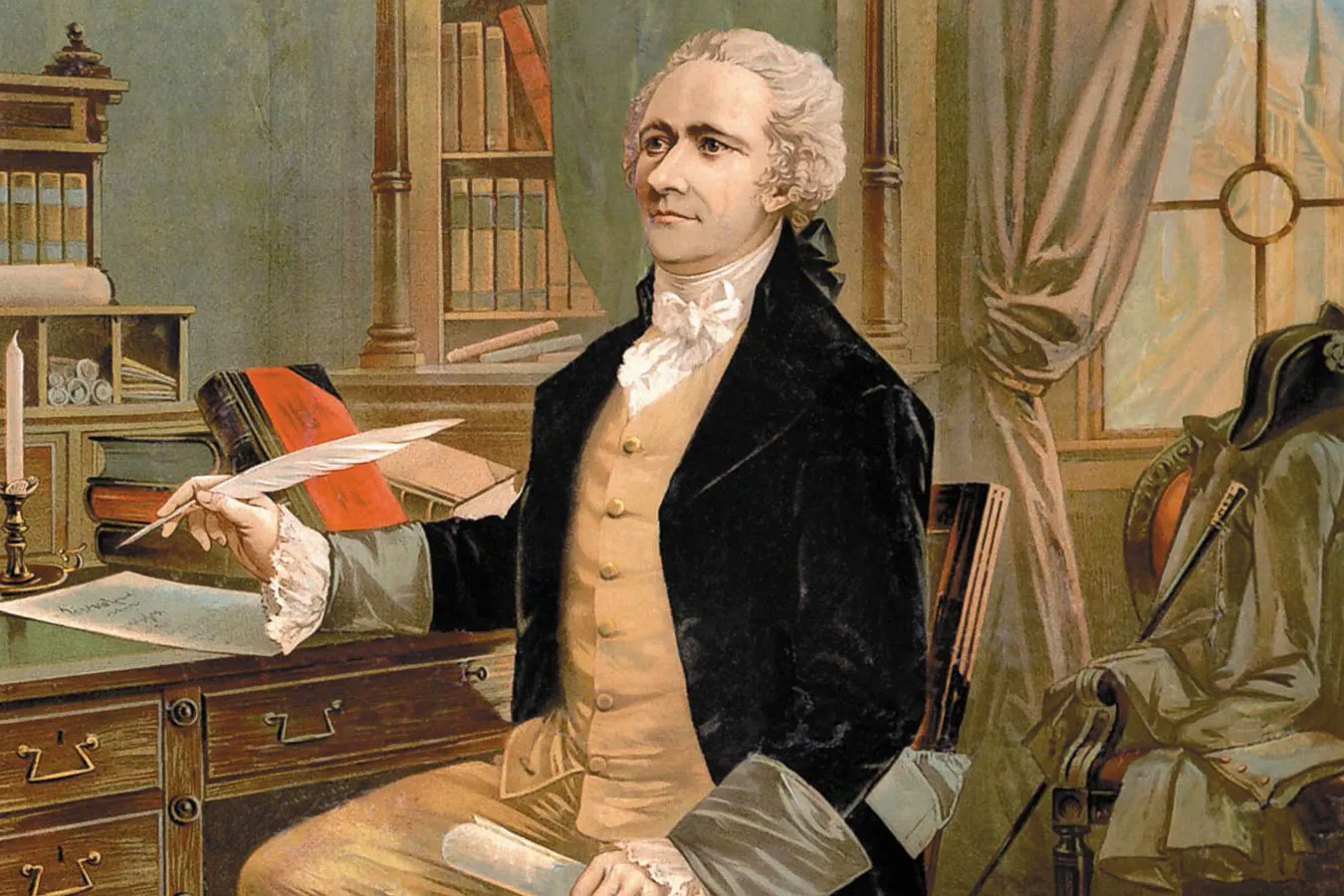
"Alexander Hamilton 2020" by Hamilton Buggy Company/ Source: Wikimedia Commons (Public domain).
Alexander Hamilton was born in the Caribbean on the island of Nevis in 1755 or 1757. As a child, he faced many hardships, including the loss of both parents. Yet, Hamilton's intelligence and ambition set him apart. At the age of sixteen, he left his homeland and traveled to the American colonies, seeking new opportunity in a place that promised freedom and growth for those willing to work hard. Hamilton's story is a powerful example of how an immigrant could shape the future of a nation.
When Hamilton arrived in New York, the colonies were on the brink of revolution. The struggle for independence from Britain presented both challenges and possibilities. Hamilton quickly became involved in the Patriot cause, joining the Continental Army. Thanks to his skills in writing and leadership, General George Washington made him an aide. This role gave Hamilton direct experience with the problems facing the army and the new nation. He saw, for example, that the government lacked the power to tax and supply its soldiers, which was a major weakness.
After the war, Hamilton became a key advocate for a stronger central government. He argued that the original Articles of Confederation, which loosely connected the states, were not effective. Hamilton believed only a unified government could solve the country's economic and security problems. He worked with other Founding Fathers, such as James Madison and John Jay, to write the Federalist Papers. These essays used persuasive argument and evidence to support the new Constitution.
Hamilton's efforts paid off. The Constitution was adopted, creating a stronger federal government. As the first Secretary of the Treasury, Hamilton faced another set of problems: the young nation was in debt and had no clear financial system. Hamilton designed plans for a national bank, a stable currency, and a system to repay debts. These bold solutions helped stabilize the economy and gave the United States a solid foundation for growth. However, not everyone agreed with his ideas. Some leaders, like Thomas Jefferson, argued that Hamilton’s plans gave too much power to the central government, leading to debates that shaped American politics.
Despite facing opposition, Hamilton’s legacy endures. He helped build important institutions and set examples for future leaders. Hamilton's life shows the complex challenges of creating a new nation. His journey from an orphaned immigrant to a principal architect of American government reminds us that the United States was shaped by diverse people and ideas. Hamilton’s story also illustrates the difficulties and opportunities that come with change, debate, and compromise.
Interesting Fact: Alexander Hamilton is the only Founding Father featured on U.S. currency (the $10 bill) who was not ever president.
Where was Hamilton born?
Nevis, CaribbeanLondon, EnglandBoston, MassachusettsParis, France
What did Hamilton help write?
The Declaration of IndependenceThe Federalist PapersThe Bill of RightsEmancipation Proclamation
Who was Hamilton's famous military leader?
Abraham LincolnThomas JeffersonGeorge WashingtonJohn Adams
Why did Hamilton support a strong central government?
To connect the states betterTo keep British ruleTo fight FranceTo become president
How did Hamilton help the economy?
Invented new machinesCreated a national bankDiscovered goldBuilt railroads
Why did some leaders disagree with Hamilton?
They wanted more state powerThey disliked banksThey did not like immigrantsThey wanted war
Hamilton was a Founding Father. True or false?
TrueFalse
What does 'legacy' mean in this passage?
A law made by CongressMoney earned in businessWhat someone leaves behindA type of government
Perfect For:
👩🏫 Teachers
• Reading comprehension practice
• Auto-graded assessments
• Literacy skill development
👨👩👧👦 Parents
• Reading practice at home
• Comprehension improvement
• Educational reading time
🏠 Homeschoolers
• Reading curriculum support
• Independent reading practice
• Progress monitoring
Reading Features:
📖
Reading Passage
Engaging fiction or nonfiction text
❓
Comprehension Quiz
Auto-graded questions
📊
Instant Feedback
Immediate results and scoring
📄
Printable Version
Download for offline reading
🔊
Read Aloud
Voice-over with word highlighting
Reviews & Ratings
No reviews yet. Be the first to share your experience!
Related Content
New Nation America
This history reading passage, 'New Nation America,' covers how the United States struggled to become a united country af...
HSS 5.6.1RI.4.2
The Cherokee Nation: History and Culture
This reading passage explores the rich history and culture of the Cherokee Nation, one of the largest Native American tr...
D2.HIS.2.3-5D2.HIS.14.3-5RI.4.3RI.4.4RI.4.10
New Orleans: An Important Port
This engaging U.S. history reading passage explores the crucial role of New Orleans and the Louisiana Purchase in shapin...
D2.HIS.3.3-5D2.HIS.14.3-5RI.4.3RI.4.4
American Indians and U.S. Citizenship
This reading passage explores the complex history of American Indians and U.S. citizenship, focusing on the period after...
Battle of New Orleans 1815
This passage explores the pivotal Battle of New Orleans in 1815, focusing on Andrew Jackson’s leadership and the complex...
D2.HIS.2.3-5D2.HIS.3.3-5RI.4.3RI.4.4
Hamilton vs Jefferson
This engaging U.S. history reading passage explores the contrasting visions of Alexander Hamilton and Thomas Jefferson, ...
National Bank Debate
This engaging U.S. history passage explores the National Bank Debate and the constitutional disagreement between Alexand...
D2.HIS.2.3-5D2.HIS.3.3-5RI.4.3RI.4.4
Leaders Call for a New Constitution
This reading passage explores the pivotal moment in U.S. history when American leaders recognized the weaknesses of the ...
Lewis and Clark Expedition
This comprehensive U.S. History reading passage explores the Lewis and Clark Expedition (1804-1806), a pivotal journey l...
HSS 8.4.18.8.2RI.6-8.1RI.6-8.3
The Iroquois Influence on the Constitution
This comprehensive U.S. history reading passage investigates the possible influence of the Iroquois Confederacy’s Great ...
James Madison Early Life
This passage explores the formative years of James Madison—his upbringing in Virginia, his education, and his early expe...
The Louisiana Purchase Deal of 1803
This engaging U.S. history reading passage explores the Louisiana Purchase of 1803, when the United States doubled in si...
D2.HIS.1.3-5D2.HIS.3.3-5RI.4.3RI.4.4
Star-Spangled Banner Origins
This passage explores the complex history of the Star-Spangled Banner, focusing on its origins during the War of 1812, t...
D2.HIS.2.3-5D2.HIS.3.3-5RI.4.3RI.4.4
New Immigrants and New Jobs
This engaging reading passage explores the experiences of new immigrants and the rise of new jobs during the Progressive...
D2.HIS.2.3-5D2.HIS.3.3-5RI.4.3RI.4.4
Enslaved People Had No Citizenship Rights
This passage explores the realities faced by approximately four million enslaved people in the United States during the ...
Thomas Jefferson Biography
This engaging history reading passage provides a detailed look at Thomas Jefferson, one of America's most influential fo...
HSS 5.6.2RI.4.2
George Washington First President
This passage explores how George Washington became the first President of the United States in 1789 and the crucial prec...
The First Political Parties Form
This engaging passage explores the formation of America's first political parties, highlighting the Federalists and Demo...
D2.HIS.1-4.3-5RI.4.3RI.4.4
James Monroe and the Monroe Doctrine
This engaging U.S. history reading passage introduces students to President James Monroe and the Monroe Doctrine, a key ...