George Washington First President — Reading Comprehension
Rate this
Premium Resource
Present
Present in classroom. No work saved
Assign
Classroom with student accounts, Track progress
Quick Play
No student accounts, assign with a link
Grades
6
7
8
PRINT+DIGITAL RESOURCE
This learning resource is available in interactive and printable formats. The interactive worksheet can be played online and assigned to students. The Printable PDF version can be downloaded and printed for completion by hand.
This passage explores how George Washington became the first President of the United States in 1789 and the crucial precedents he set for both the office and the nation. Students will analyze how Washington's decisions regarding titles, the creation of a presidential cabinet, and the peaceful transfer of power influenced future presidents and the development of American democracy. The passage includes disciplinary academic vocabulary such as 'precedent,' 'inauguration,' 'cabinet,' and 'administration.' Differentiated versions and a Spanish translation are available to support diverse learners. The passage and its activities align with HSS 5.7 and 8.3.4 for history standards, as well as Common Core RI.6-8.1 and RI.6-8.2. Supplemental resources include a multiple-choice quiz, writing prompts, graphic organizers, and a timeline. Additionally, read aloud audio and coloring page activities are provided to further engage students in understanding the legacy of George Washington's presidency.
CONTENT PREVIEW
Expand content preview
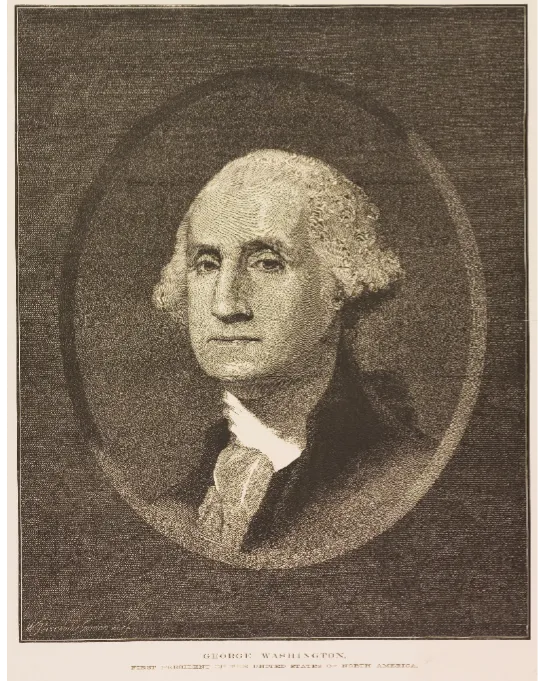
"George Washington" / Europeana (Public domain).
In 1789, George Washington became the first President of the United States. This historic moment marked the beginning of a new era for the country, only a few years after the end of the Revolutionary War. The new nation faced uncertainty about how its government should operate. Americans looked to Washington for leadership and guidance during this important transition.
One of Washington’s first challenges was deciding on the powers and responsibilities of the presidency. Since the United States had never had a president before, there were no clear rules. Washington understood that his choices would create precedents—examples for future presidents to follow. Instead of acting like a king, he wanted to show that the president was a servant of the people, not a ruler above them.
Washington’s inauguration took place in New York City, the temporary capital. The ceremony was simple, but its significance was enormous. He took an oath to "preserve, protect, and defend the Constitution of the United States." This moment established the peaceful transfer of power, a concept that was rare in the world at that time.
Another major decision was what to call the president. Some leaders suggested grand titles, such as "His Highness" or "Protector of the Liberties." Washington rejected these ideas, believing they sounded too much like royalty. He chose the simple title "Mr. President," which set an important standard for American democracy and equality.
To help him govern, Washington formed the first presidential cabinet. He selected trusted advisors, including Thomas Jefferson as Secretary of State and Alexander Hamilton as Secretary of the Treasury. The cabinet provided advice on key issues, helping Washington make difficult decisions. This practice became a permanent part of the executive branch and is still used today.
Washington also set a precedent by serving only two terms in office. He refused to run for a third term, believing that a peaceful change in leadership was essential for democracy. This tradition lasted until the 1940s, when the Constitution was amended to limit presidents to two terms.
During his administration, Washington faced challenges such as conflicts with foreign nations, disagreements over how to interpret the Constitution, and debates about the power of the federal government. Despite these struggles, he worked to keep the nation united and stable. Washington’s actions helped define the presidency and established patterns for future leaders.
Washington’s legacy is not without controversy. He owned enslaved people and made choices that reflected the beliefs and limitations of his time. Yet, his efforts to shape a government based on laws and peaceful transitions remain influential today.
Interesting Fact: Washington is the only U.S. president to have received every electoral vote, making his election unanimous.
Who was the first U.S. president?
George WashingtonJohn AdamsThomas JeffersonAlexander Hamilton
In what city was Washington inaugurated?
PhiladelphiaNew York CityBostonWashington, D.C.
How many terms did Washington serve?
OneTwoThreeFour
Why did Washington reject royal titles?
He liked simple rulesHe wanted to act like a kingHe believed in democracy and equalityHe thought they were too short
What was the purpose of the cabinet?
To collect taxesTo advise the presidentTo make lawsTo run elections
How did Washington set a peaceful transfer of power?
By resigning suddenlyBy refusing electionsBy serving only two termsBy choosing his son
Washington was the only president elected unanimously. True or false?
TrueFalse
What is a 'precedent'?
A type of lawA government jobAn example for others to followA political party
Perfect For:
👩🏫 Teachers
• Reading comprehension practice
• Auto-graded assessments
• Literacy skill development
👨👩👧👦 Parents
• Reading practice at home
• Comprehension improvement
• Educational reading time
🏠 Homeschoolers
• Reading curriculum support
• Independent reading practice
• Progress monitoring
Reading Features:
📖
Reading Passage
Engaging fiction or nonfiction text
❓
Comprehension Quiz
Auto-graded questions
📊
Instant Feedback
Immediate results and scoring
📄
Printable Version
Download for offline reading
🔊
Read Aloud
Voice-over with word highlighting
Reviews & Ratings
No reviews yet. Be the first to share your experience!
Related Content
New Nation America
This history reading passage, 'New Nation America,' covers how the United States struggled to become a united country af...
HSS 5.6.1RI.4.2
The Cherokee Nation: History and Culture
This reading passage explores the rich history and culture of the Cherokee Nation, one of the largest Native American tr...
D2.HIS.2.3-5D2.HIS.14.3-5RI.4.3RI.4.4RI.4.10
New Orleans: An Important Port
This engaging U.S. history reading passage explores the crucial role of New Orleans and the Louisiana Purchase in shapin...
D2.HIS.3.3-5D2.HIS.14.3-5RI.4.3RI.4.4
American Indians and U.S. Citizenship
This reading passage explores the complex history of American Indians and U.S. citizenship, focusing on the period after...
Battle of New Orleans 1815
This passage explores the pivotal Battle of New Orleans in 1815, focusing on Andrew Jackson’s leadership and the complex...
D2.HIS.2.3-5D2.HIS.3.3-5RI.4.3RI.4.4
Hamilton vs Jefferson
This engaging U.S. history reading passage explores the contrasting visions of Alexander Hamilton and Thomas Jefferson, ...
National Bank Debate
This engaging U.S. history passage explores the National Bank Debate and the constitutional disagreement between Alexand...
D2.HIS.2.3-5D2.HIS.3.3-5RI.4.3RI.4.4
Leaders Call for a New Constitution
This reading passage explores the pivotal moment in U.S. history when American leaders recognized the weaknesses of the ...
Lewis and Clark Expedition
This comprehensive U.S. History reading passage explores the Lewis and Clark Expedition (1804-1806), a pivotal journey l...
HSS 8.4.18.8.2RI.6-8.1RI.6-8.3
The Iroquois Influence on the Constitution
This comprehensive U.S. history reading passage investigates the possible influence of the Iroquois Confederacy’s Great ...
James Madison Early Life
This passage explores the formative years of James Madison—his upbringing in Virginia, his education, and his early expe...
The Louisiana Purchase Deal of 1803
This engaging U.S. history reading passage explores the Louisiana Purchase of 1803, when the United States doubled in si...
D2.HIS.1.3-5D2.HIS.3.3-5RI.4.3RI.4.4
Star-Spangled Banner Origins
This passage explores the complex history of the Star-Spangled Banner, focusing on its origins during the War of 1812, t...
D2.HIS.2.3-5D2.HIS.3.3-5RI.4.3RI.4.4
New Immigrants and New Jobs
This engaging reading passage explores the experiences of new immigrants and the rise of new jobs during the Progressive...
D2.HIS.2.3-5D2.HIS.3.3-5RI.4.3RI.4.4
Enslaved People Had No Citizenship Rights
This passage explores the realities faced by approximately four million enslaved people in the United States during the ...
Thomas Jefferson Biography
This engaging history reading passage provides a detailed look at Thomas Jefferson, one of America's most influential fo...
HSS 5.6.2RI.4.2
The First Political Parties Form
This engaging passage explores the formation of America's first political parties, highlighting the Federalists and Demo...
D2.HIS.1-4.3-5RI.4.3RI.4.4
Alexander Hamilton Early Life
This passage explores the inspiring yet complex journey of Alexander Hamilton, tracing his rise from a Caribbean-born or...
James Monroe and the Monroe Doctrine
This engaging U.S. history reading passage introduces students to President James Monroe and the Monroe Doctrine, a key ...