American Indians and U.S. Citizenship — Reading Comprehension
Rate this
Premium Resource
Present
Present in classroom. No work saved
Assign
Classroom with student accounts, Track progress
Quick Play
No student accounts, assign with a link
Grades
6
7
8
PRINT+DIGITAL RESOURCE
This learning resource is available in interactive and printable formats. The interactive worksheet can be played online and assigned to students. The Printable PDF version can be downloaded and printed for completion by hand.
This reading passage explores the complex history of American Indians and U.S. citizenship, focusing on the period after the United States became a nation. Students will analyze how Native nations were regarded as foreign entities, the challenges faced by Native peoples in gaining individual citizenship rights, and the changing perspectives over time. The passage incorporates primary source evidence, disciplinary vocabulary, and multiple viewpoints to help students develop historical reasoning skills. It aligns with CA HSS 8.8.2 and Common Core RI.6.3, RI.6.4, and W.6.2 standards. Also included are a quiz, writing activities, graphic organizers, timeline, and a glossary to support diverse learners. The content is available in English and Spanish, with both standard and differentiated versions. Read aloud audio is also provided for accessibility and engagement.
CONTENT PREVIEW
Expand content preview
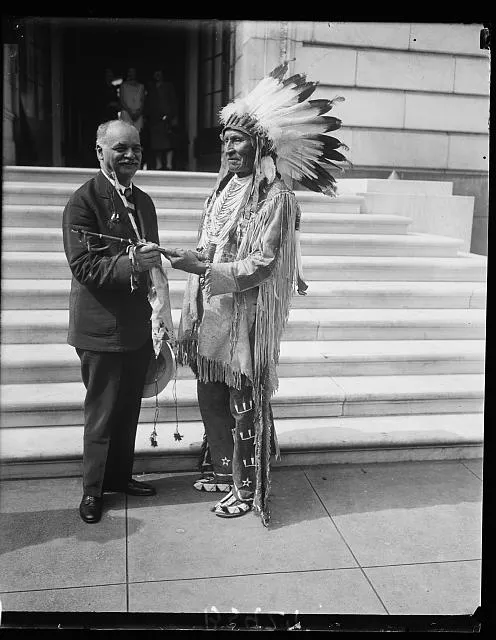
"Vice President Curtis receives peace pipe from Chief Red Tomahawk, slayer of Sitting Bull. Chief Red Tomahawk, leader of the Sioux Nation and credited with having killed Sitting Bull, presented Vice President Curtis with a peace pipe at the United States Capitol today. Chief Red Tomahawk, who is 80 years old, is in the National Capital repaying the visit of Chief of Staff Charles P. Summerall, who last year was a guest of the Chief in his Western home" by Harris & Ewing / Library of Congress.
The relationship between American Indians and U.S. citizenship has a complex history. When the United States became a nation, most Native peoples were not considered U.S. citizens. Instead, they were seen as members of separate, sovereign nations with their own governments and cultures. This unique legal status created challenges for both Native communities and the U.S. government.
At first, the U.S. government signed treaties with American Indian nations, recognizing their sovereignty. Treaties are formal agreements between nations. These treaties often addressed land, resources, and the rights of Native peoples. However, as settlers moved west, the U.S. government began to break these agreements. Native sovereignty was increasingly threatened as the government passed laws and established reservations. Reservations were areas of land set aside for American Indian nations, but these lands were usually much smaller than traditional territories.
The question of citizenship became more important as the United States expanded. Many American Indians wanted to keep their nationhood and self-government, fearing that becoming citizens would mean losing their cultural identity and rights. Others believed that citizenship could provide new protections and opportunities. U.S. lawmakers debated how to include Native peoples in American society. For most of the 19th century, American Indians could only become citizens in certain situations, such as through military service or marriage to a U.S. citizen.
Major changes came with the Indian Citizenship Act of 1924. This law granted U.S. citizenship to all American Indians born in the United States. While this seemed like progress, it did not automatically give Native peoples full equality. Many states still denied them the right to vote or limited their participation in government. In addition, the federal government continued to make decisions for tribes without their consent. The struggle for full recognition of rights and respect for sovereignty continued throughout the 20th century.
Today, American Indians are both citizens of the United States and members of their own nations. This dual status is unique. It allows Native peoples to participate in American society while preserving their distinct cultures and governments. However, issues of sovereignty and legal status still matter. Many Native communities continue to fight for the protection of their lands, languages, and treaty rights. Understanding this history helps us see the importance of respecting tribal sovereignty and the ongoing challenges faced by Native peoples.
Interesting Fact: Charles Curtis, a member of the Kaw Nation, became the first American Indian to serve as Vice President of the United States in 1929.
Who are American Indians?
Indigenous peoples of North AmericaEuropean settlersSouth American citizensU.S. Presidents
What are treaties?
Formal agreements between nationsTypes of reservationsCitizenship documentsVoting rights
When was the Indian Citizenship Act passed?
1924177618651965
Why did some Native peoples hesitate to become citizens?
Fear of losing identityThey disliked votingNeeded more landWanted to move west
What was one effect of the Indian Citizenship Act?
Citizenship for all Native AmericansImmediate voting rights everywhereEnd of tribal nationsCreation of new reservations
How did reservations impact Native nations?
Reduced traditional landsGave more independenceExpanded their territoryAllowed voting
American Indians are only U.S. citizens today.
TrueFalse
What does sovereignty mean?
Power to govern oneselfOwning landHaving a reservationBeing a citizen
Perfect For:
👩🏫 Teachers
• Reading comprehension practice
• Auto-graded assessments
• Literacy skill development
👨👩👧👦 Parents
• Reading practice at home
• Comprehension improvement
• Educational reading time
🏠 Homeschoolers
• Reading curriculum support
• Independent reading practice
• Progress monitoring
Reading Features:
📖
Reading Passage
Engaging fiction or nonfiction text
❓
Comprehension Quiz
Auto-graded questions
📊
Instant Feedback
Immediate results and scoring
📄
Printable Version
Download for offline reading
🔊
Read Aloud
Voice-over with word highlighting
Reviews & Ratings
No reviews yet. Be the first to share your experience!
Related Content
New Nation America
This history reading passage, 'New Nation America,' covers how the United States struggled to become a united country af...
HSS 5.6.1RI.4.2
The Cherokee Nation: History and Culture
This reading passage explores the rich history and culture of the Cherokee Nation, one of the largest Native American tr...
D2.HIS.2.3-5D2.HIS.14.3-5RI.4.3RI.4.4RI.4.10
New Orleans: An Important Port
This engaging U.S. history reading passage explores the crucial role of New Orleans and the Louisiana Purchase in shapin...
D2.HIS.3.3-5D2.HIS.14.3-5RI.4.3RI.4.4
Battle of New Orleans 1815
This passage explores the pivotal Battle of New Orleans in 1815, focusing on Andrew Jackson’s leadership and the complex...
D2.HIS.2.3-5D2.HIS.3.3-5RI.4.3RI.4.4
Hamilton vs Jefferson
This engaging U.S. history reading passage explores the contrasting visions of Alexander Hamilton and Thomas Jefferson, ...
National Bank Debate
This engaging U.S. history passage explores the National Bank Debate and the constitutional disagreement between Alexand...
D2.HIS.2.3-5D2.HIS.3.3-5RI.4.3RI.4.4
Leaders Call for a New Constitution
This reading passage explores the pivotal moment in U.S. history when American leaders recognized the weaknesses of the ...
Lewis and Clark Expedition
This comprehensive U.S. History reading passage explores the Lewis and Clark Expedition (1804-1806), a pivotal journey l...
HSS 8.4.18.8.2RI.6-8.1RI.6-8.3
The Iroquois Influence on the Constitution
This comprehensive U.S. history reading passage investigates the possible influence of the Iroquois Confederacy’s Great ...
James Madison Early Life
This passage explores the formative years of James Madison—his upbringing in Virginia, his education, and his early expe...
The Louisiana Purchase Deal of 1803
This engaging U.S. history reading passage explores the Louisiana Purchase of 1803, when the United States doubled in si...
D2.HIS.1.3-5D2.HIS.3.3-5RI.4.3RI.4.4
Star-Spangled Banner Origins
This passage explores the complex history of the Star-Spangled Banner, focusing on its origins during the War of 1812, t...
D2.HIS.2.3-5D2.HIS.3.3-5RI.4.3RI.4.4
New Immigrants and New Jobs
This engaging reading passage explores the experiences of new immigrants and the rise of new jobs during the Progressive...
D2.HIS.2.3-5D2.HIS.3.3-5RI.4.3RI.4.4
Enslaved People Had No Citizenship Rights
This passage explores the realities faced by approximately four million enslaved people in the United States during the ...
Thomas Jefferson Biography
This engaging history reading passage provides a detailed look at Thomas Jefferson, one of America's most influential fo...
HSS 5.6.2RI.4.2
The First Political Parties Form
This engaging passage explores the formation of America's first political parties, highlighting the Federalists and Demo...
D2.HIS.1-4.3-5RI.4.3RI.4.4
George Washington First President
This passage explores how George Washington became the first President of the United States in 1789 and the crucial prec...
Cherokee Nation v Georgia
This detailed reading passage explores the pivotal Supreme Court case Cherokee Nation v Georgia (1831), a turning point ...
D2.HIS.2.3-5D2.HIS.3.3-5RI.4.3RI.4.4
James Monroe and the Monroe Doctrine
This engaging U.S. history reading passage introduces students to President James Monroe and the Monroe Doctrine, a key ...