Enslaved People Had No Citizenship Rights — Reading Comprehension
Rate this
Premium Resource
Present
Present in classroom. No work saved
Assign
Classroom with student accounts, Track progress
Quick Play
No student accounts, assign with a link
Grades
6
7
8
PRINT+DIGITAL RESOURCE
This learning resource is available in interactive and printable formats. The interactive worksheet can be played online and assigned to students. The Printable PDF version can be downloaded and printed for completion by hand.
This passage explores the realities faced by approximately four million enslaved people in the United States during the early years of the new nation. Despite the creation of the Constitution and the promise of rights for some, enslaved people were legally defined as property and denied citizenship. The reading passage integrates historical evidence and a primary source quote, and addresses the perspectives of enslaved people, lawmakers, and free citizens. The resource includes a glossary, multiple-choice quiz, writing activities, graphic organizers, timeline, and Spanish translations. It is aligned with D2.His.2.6-8, D2.His.3.6-8, RI.6.3, RI.6.4, W.6.2, and is designed for rigorous historical thinking and ELA skill-building. The resource also features a read-aloud audio version, differentiated reading levels for accessibility, and a relevant public domain image to support visual learning.
CONTENT PREVIEW
Expand content preview
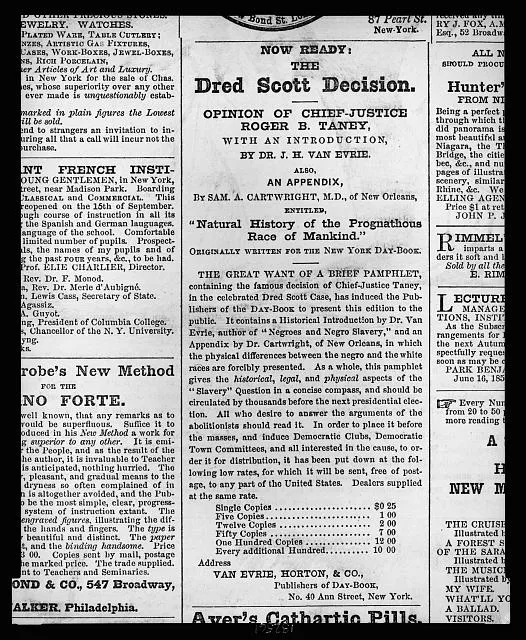
"Now ready: the Dred Scott decision--Opinion of Chief-Justice Roger B. Taney ..." / Library of Congress.
The question of citizenship was a central issue in the early years of the United States. After the American Revolution, leaders created a new government based on a written Constitution. However, the Constitution did not give citizenship rights to everyone living in the country. Instead, access to citizenship, and the rights that came with it, depended on many factors, including race, gender, and legal status.
In the early republic, most states limited full political rights—such as voting and holding office—to free white men. These men were considered the primary members of the political community. Women, Native Americans, and enslaved people were largely excluded. Many women, while considered citizens in some ways, had no right to vote or participate in government. Native Americans were viewed as members of separate nations and not granted U.S. citizenship. This created major differences in who could influence the new government's decisions.
The legal status of enslaved people was especially harsh. Under the Constitution, enslaved people had no citizenship rights at all. They could not vote, own property, or appear in court as legal individuals. Instead, they were treated as property by law. This denied them basic freedoms and made it impossible for them to claim rights or protections.
The Constitution introduced the concept of equal protection under the law, but in practice, this protection was not available to everyone. While the language of the Constitution spoke of liberty, the reality was that different groups experienced very different rights. Laws and statutes in each state further shaped who was included and who was left out. Some states granted limited voting rights to free Black men for a short time, but these rights were often taken away by new laws in the 1800s.
These issues created conflicts and debates across society. Some leaders argued that the nation should expand rights to more people, while others wanted to keep power in the hands of a few. Over time, activists began to challenge laws that excluded people based on race or gender. They used petitions, speeches, and peaceful protests to demand change. These early struggles laid the groundwork for future movements for equality and civil rights.
Understanding the history of citizenship in the early republic requires comparing the experiences of different groups and examining the legal changes over time. Historians look for evidence in laws, court cases, and personal stories to understand how Americans defined belonging and rights. This history shows that the meaning of citizenship has always been debated, and that the struggle for equal rights is a continuing story in the United States.
Interesting Fact: The Constitution counted enslaved people as "three-fifths" of a person for purposes of representation, but this did not give them any rights or citizenship.
Who had full political rights?
Free white menAll womenNative AmericansAll enslaved people
What document set up U.S. government?
The ConstitutionThe Declaration of IndependenceThe Bill of RightsThe Emancipation Proclamation
Who was counted as three-fifths for representation?
Enslaved peopleWomenNative AmericansAll citizens
Why were Native Americans excluded from citizenship?
Seen as separate nationsWanted to be excludedCould not readAll had citizenship
How did activists try to change unfair laws?
Petitions and protestsBy votingBy writing the ConstitutionBy ignoring laws
Which group could sometimes vote in a few states?
Free Black menAll womenEnslaved peopleNative Americans
The Constitution gave citizenship rights to all. True or false?
TrueFalse
What does 'equal protection' mean?
Laws treat all fairlyOnly men voteOnly property owners have rightsEveryone owns land
Perfect For:
👩🏫 Teachers
• Reading comprehension practice
• Auto-graded assessments
• Literacy skill development
👨👩👧👦 Parents
• Reading practice at home
• Comprehension improvement
• Educational reading time
🏠 Homeschoolers
• Reading curriculum support
• Independent reading practice
• Progress monitoring
Reading Features:
📖
Reading Passage
Engaging fiction or nonfiction text
❓
Comprehension Quiz
Auto-graded questions
📊
Instant Feedback
Immediate results and scoring
📄
Printable Version
Download for offline reading
🔊
Read Aloud
Voice-over with word highlighting
Reviews & Ratings
No reviews yet. Be the first to share your experience!
Related Content
New Nation America
This history reading passage, 'New Nation America,' covers how the United States struggled to become a united country af...
HSS 5.6.1RI.4.2
The Cherokee Nation: History and Culture
This reading passage explores the rich history and culture of the Cherokee Nation, one of the largest Native American tr...
D2.HIS.2.3-5D2.HIS.14.3-5RI.4.3RI.4.4RI.4.10
New Orleans: An Important Port
This engaging U.S. history reading passage explores the crucial role of New Orleans and the Louisiana Purchase in shapin...
D2.HIS.3.3-5D2.HIS.14.3-5RI.4.3RI.4.4
American Indians and U.S. Citizenship
This reading passage explores the complex history of American Indians and U.S. citizenship, focusing on the period after...
Battle of New Orleans 1815
This passage explores the pivotal Battle of New Orleans in 1815, focusing on Andrew Jackson’s leadership and the complex...
D2.HIS.2.3-5D2.HIS.3.3-5RI.4.3RI.4.4
Hamilton vs Jefferson
This engaging U.S. history reading passage explores the contrasting visions of Alexander Hamilton and Thomas Jefferson, ...
National Bank Debate
This engaging U.S. history passage explores the National Bank Debate and the constitutional disagreement between Alexand...
D2.HIS.2.3-5D2.HIS.3.3-5RI.4.3RI.4.4
Leaders Call for a New Constitution
This reading passage explores the pivotal moment in U.S. history when American leaders recognized the weaknesses of the ...
Lewis and Clark Expedition
This comprehensive U.S. History reading passage explores the Lewis and Clark Expedition (1804-1806), a pivotal journey l...
HSS 8.4.18.8.2RI.6-8.1RI.6-8.3
The Iroquois Influence on the Constitution
This comprehensive U.S. history reading passage investigates the possible influence of the Iroquois Confederacy’s Great ...
James Madison Early Life
This passage explores the formative years of James Madison—his upbringing in Virginia, his education, and his early expe...
The Louisiana Purchase Deal of 1803
This engaging U.S. history reading passage explores the Louisiana Purchase of 1803, when the United States doubled in si...
D2.HIS.1.3-5D2.HIS.3.3-5RI.4.3RI.4.4
Star-Spangled Banner Origins
This passage explores the complex history of the Star-Spangled Banner, focusing on its origins during the War of 1812, t...
D2.HIS.2.3-5D2.HIS.3.3-5RI.4.3RI.4.4
New Immigrants and New Jobs
This engaging reading passage explores the experiences of new immigrants and the rise of new jobs during the Progressive...
D2.HIS.2.3-5D2.HIS.3.3-5RI.4.3RI.4.4
Thomas Jefferson Biography
This engaging history reading passage provides a detailed look at Thomas Jefferson, one of America's most influential fo...
HSS 5.6.2RI.4.2
George Washington First President
This passage explores how George Washington became the first President of the United States in 1789 and the crucial prec...
The First Political Parties Form
This engaging passage explores the formation of America's first political parties, highlighting the Federalists and Demo...
D2.HIS.1-4.3-5RI.4.3RI.4.4
Alexander Hamilton Early Life
This passage explores the inspiring yet complex journey of Alexander Hamilton, tracing his rise from a Caribbean-born or...
James Monroe and the Monroe Doctrine
This engaging U.S. history reading passage introduces students to President James Monroe and the Monroe Doctrine, a key ...