This learning resource is available in interactive and printable formats. The interactive worksheet can be played online and assigned to students. The Printable PDF version can be downloaded and printed for completion by hand.
This passage explores the formative years of James Madison—his upbringing in Virginia, his education, and his early experience in Virginia politics—which prepared him for his crucial role in building the new nation. Students will analyze Madison’s background, his intellectual influences, and the political challenges he faced as the United States emerged from the American Revolution. The reading incorporates primary source analysis, a glossary of academic terms, and activities aligned with CA HSS and TEKS standards. Students can access a Spanish translation, a differentiated reading level, and a read-aloud audio. Key skills targeted include historical reasoning, cause-and-effect analysis, and evidence-based writing. This engaging resource helps students understand how Madison’s personal journey and political actions shaped the future of the United States, highlighting the complexities and multiple perspectives that defined the nation’s early years.
CONTENT PREVIEW
Expand content preview
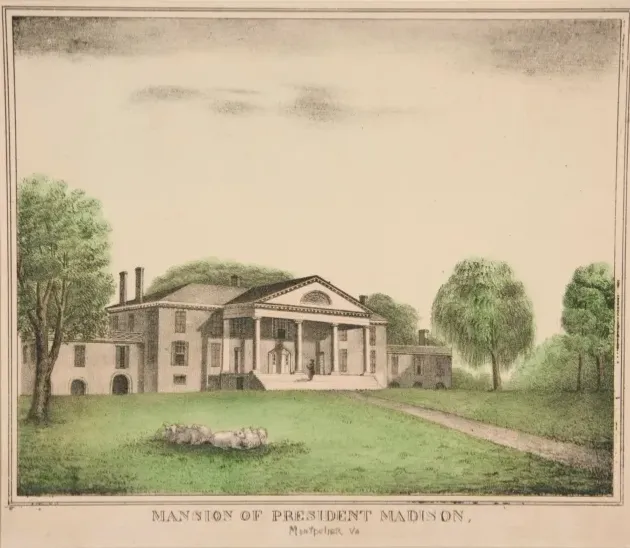
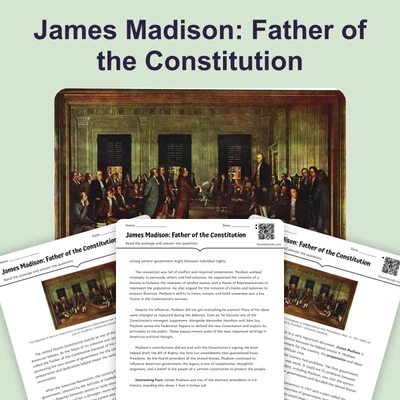
Mansion of President Madison Montpelier Va / Wikimedia Commons
James Madison was a leading figure in early American history who played a crucial role in shaping the U.S. Constitution. Known as a scholar, Madison devoted himself to intense research about different forms of government. He believed that understanding the strengths and weaknesses of past societies was essential preparation for building a new nation.
Before attending the Constitutional Convention in 1787, Madison studied the political systems of ancient Greece and Rome, as well as more recent confederacies like the Swiss and Dutch. He compared these systems, identifying which features helped maintain stability and which led to failure. This careful preparation allowed Madison to bring well-reasoned ideas to the meeting in Philadelphia.
At the time, the United States faced several major challenges. The original national government, created by the Articles of Confederation, was weak and often ineffective. States acted independently, and there was no reliable way to solve disputes or raise funds. Madison recognized that these problems threatened the unity and survival of the new country. His extensive research helped him propose solutions that balanced state and national powers.
Madison's most famous plan was called the Virginia Plan. It suggested a strong central government with separate branches to prevent any one group from becoming too powerful. Some delegates feared that a strong government would reduce the rights of the states. Madison responded by using evidence from his studies, explaining how checks and balances could protect freedom. His skillful arguments influenced the debates and encouraged others to seek compromise.
Although Madison did not get everything he wanted, his ideas formed the backbone of the final Constitution. He worked with others to write the Federalist Papers, a series of essays defending the new plan of government. Madison’s preparation, research, and willingness to analyze past mistakes made him one of the most important Founders.
In the years after the Constitution was adopted, Madison continued to serve the nation as Secretary of State and later as President. His scholarly approach and commitment to careful preparation set an example for future leaders, showing that history and evidence are powerful tools for solving complex problems.
Interesting Fact: James Madison was also known as the “Father of the Constitution” because of his key role in its creation and design.
Who is called the 'Father of the Constitution'?
James MadisonGeorge WashingtonAlexander HamiltonThomas Jefferson
What was Madison's famous plan called?
The Virginia PlanThe New Jersey PlanThe Great CompromiseThe Bill of Rights
What document did Madison help write after the Convention?
Federalist PapersDeclaration of IndependenceMayflower CompactEmancipation Proclamation
Why did Madison study past governments?
To prepare for nation buildingTo travel abroadTo become a kingTo make new laws for Europe
What problem did the Articles of Confederation cause?
Weak national governmentToo many warsNo state governmentsHigh taxes
How did Madison convince others at the Convention?
He used evidence from his researchHe threatened themHe bribed themHe left the meeting
Madison believed in careful preparation. True or false?
TrueFalse
What is a 'scholar'?
Someone who studies deeplySomeone who fights warsA government leaderA person who votes
Perfect For:
👩🏫 Teachers
• Reading comprehension practice
• Auto-graded assessments
• Literacy skill development
👨👩👧👦 Parents
• Reading practice at home
• Comprehension improvement
• Educational reading time
🏠 Homeschoolers
• Reading curriculum support
• Independent reading practice
• Progress monitoring
Reading Features:
📖
Reading Passage
Engaging fiction or nonfiction text
❓
Comprehension Quiz
Auto-graded questions
📊
Instant Feedback
Immediate results and scoring
📄
Printable Version
Download for offline reading
🔊
Read Aloud
Voice-over with word highlighting
Reviews & Ratings
No reviews yet. Be the first to share your experience!
Related Content
Presidential Precedents George Washington
This comprehensive history reading passage examines George Washington’s presidency and how his leadership set key nation...
New Nation America
This history reading passage, 'New Nation America,' covers how the United States struggled to become a united country af...
HSS 5.6.1RI.4.2
George Washington First President
This passage explores how George Washington became the first President of the United States in 1789 and the crucial prec...
The Cherokee Nation: History and Culture
This reading passage explores the rich history and culture of the Cherokee Nation, one of the largest Native American tr...
D2.HIS.2.3-5D2.HIS.14.3-5RI.4.3RI.4.4RI.4.10
American Indians and U.S. Citizenship
This reading passage explores the complex history of American Indians and U.S. citizenship, focusing on the period after...
John Adams: Second President
This engaging U.S. history reading passage introduces students to John Adams, the second President of the United States....
D2.HIS.2.3-5D2.HIS.14.3-5RI.4.3RI.4.4
George Washington: Our First President
This engaging U.S. history reading passage introduces students to George Washington, America’s first president, through ...
D2.HIS.2.3-5D2.HIS.3.3-5RI.4.3RI.4.4
George Washington Early Life
This reading passage explores George Washington’s remarkable journey from Virginia plantation farmer to the first presid...
New Orleans: An Important Port
This engaging U.S. history reading passage explores the crucial role of New Orleans and the Louisiana Purchase in shapin...
D2.HIS.3.3-5D2.HIS.14.3-5RI.4.3RI.4.4
John Adams Presidency
This passage explores the complex presidency of John Adams, the second president of the United States, focusing on the p...
D2.HIS.2.3-5D2.HIS.3.3-5RI.4.3RI.4.4
George Washington Whiskey Rebellion
This engaging U.S. History reading passage examines George Washington and the Whiskey Rebellion, a crucial moment that t...
Modern American Presidents
This engaging reading passage introduces students to Modern American Presidents, focusing on the leadership, challenges,...
D2.HIS.1-4.3-5RI.4.3RI.4.4
Hamilton vs Jefferson
This engaging U.S. history reading passage explores the contrasting visions of Alexander Hamilton and Thomas Jefferson, ...
Leaders Call for a New Constitution
This reading passage explores the pivotal moment in U.S. history when American leaders recognized the weaknesses of the ...
Madison War of 1812
This engaging reading passage explores President James Madison’s 1812 war message to Congress, which played a pivotal ro...
James Madison: Father of the Constitution
This passage provides a detailed exploration of James Madison’s pivotal role in creating the U.S. Constitution, earning ...
Battle of New Orleans 1815
This passage explores the pivotal Battle of New Orleans in 1815, focusing on Andrew Jackson’s leadership and the complex...
D2.HIS.2.3-5D2.HIS.3.3-5RI.4.3RI.4.4
James Monroe and the Monroe Doctrine
This engaging U.S. history reading passage introduces students to President James Monroe and the Monroe Doctrine, a key ...
D2.HIS.1-4.3-5RI.4.1RI.4.2RI.4.3
Madison First Congress
This passage explores the critical period of the First Congress in 1789, focusing on James Madison's leadership and the ...