The Iroquois Influence on the Constitution — Reading Comprehension
Rate this
Premium Resource
Present
Present in classroom. No work saved
Assign
Classroom with student accounts, Track progress
Quick Play
No student accounts, assign with a link
Grades
6
7
8
PRINT+DIGITAL RESOURCE
This learning resource is available in interactive and printable formats. The interactive worksheet can be played online and assigned to students. The Printable PDF version can be downloaded and printed for completion by hand.
This comprehensive U.S. history reading passage investigates the possible influence of the Iroquois Confederacy’s Great Law of Peace on the United States Constitution. Students analyze similarities and differences between Native American governance and American democracy, exploring concepts like influence, government, and contribution. Designed to meet HSS 8.2.1 and CCSS.RI.6-8.1, RI.6-8.8 standards, this resource challenges students to think critically and use evidence to support historical claims. The passage includes a glossary of key terms, a multiple-choice quiz, and explanatory writing prompts. It also features differentiated and Spanish-translated versions for accessibility, a timeline, and graphic organizers to support comprehension. Read aloud audio and a relevant public domain image further enrich the learning experience.
CONTENT PREVIEW
Expand content preview
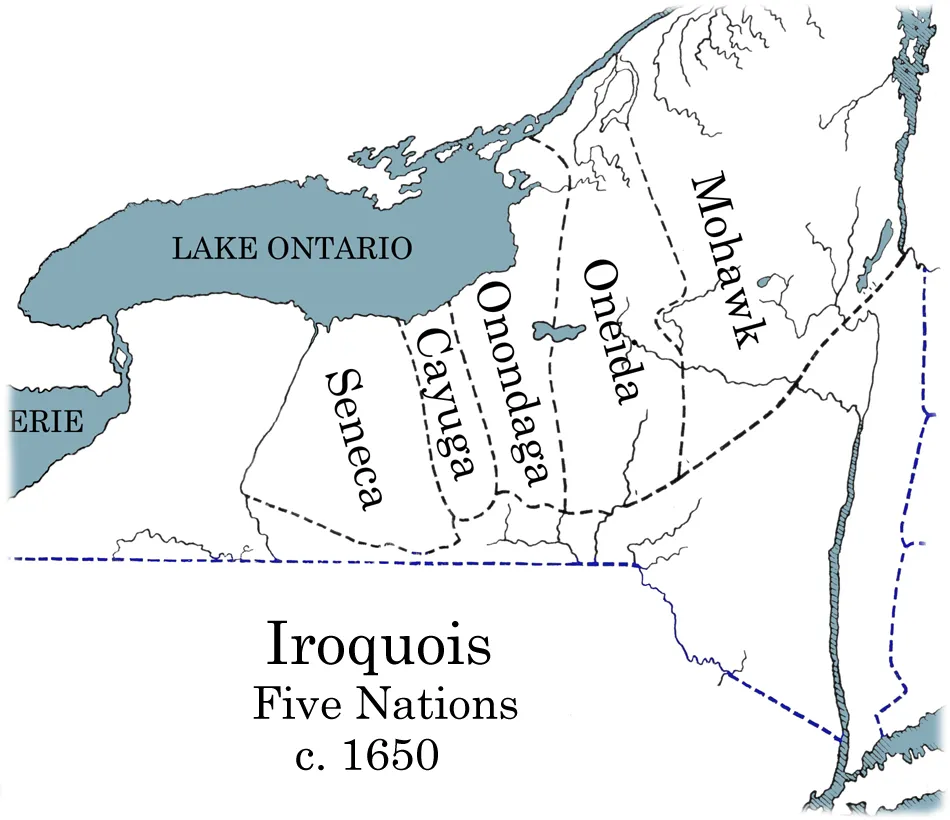
"Iroquois 5 Nation Map c1650" by R. A. Nonenmacher / Wikimedia Commons (Public domain).
The Iroquois Confederacy, also known as the Haudenosaunee, was a powerful alliance of Native American nations in the northeastern part of North America. The member nations—Mohawk, Oneida, Onondaga, Cayuga, Seneca, and later Tuscarora—created a system of government known as the Great Law of Peace. Some historians believe that this system had an influence on the creation of the United States Constitution.
The Great Law of Peace established a council where representatives from each nation made decisions together. This council system allowed for shared leadership, debate, and checks on power. The idea of a confederacy—a group of states or nations joined together for a common purpose—was central to both the Iroquois and the future United States. The Iroquois used a process of consensus, meaning all members agreed before making a major decision. This idea was similar to the American Founders' search for a democracy where people had a voice in their government.
When American leaders met at the Constitutional Convention in 1787, they faced challenges in uniting the thirteen colonies. The colonies needed a system that balanced the rights of large and small states. Some scholars argue that the Iroquois model provided an example of how separate groups could cooperate while maintaining their own identities. Benjamin Franklin, an important American leader, met with Iroquois leaders and admired their methods of decision-making. Franklin even wrote about the Great Law of Peace and suggested that the colonies could learn from the Iroquois confederacy.
However, historians continue to debate how much the Iroquois Confederacy directly shaped the U.S. Constitution. While there are similarities, such as representative councils and checks on power, there are also important differences. For example, the Iroquois emphasized consensus, while the Constitution allows for majority rule. The U.S. system also developed within the context of European political ideas, like those from England and France. Some critics argue that the influence of the Iroquois has been overstated, while others believe it is an important example of Native American contribution to American democracy.
Despite the debate, studying the Iroquois Confederacy helps us understand the diversity of ideas that shaped the American system. It reminds us that democracy in the United States was not created in isolation. Instead, it developed through the exchange of ideas among different cultures. Recognizing Native American contributions encourages us to look for evidence and appreciate the complexity of history.
Interesting Fact: In 1988, the U.S. Congress passed a resolution recognizing the influence of the Iroquois Confederacy and the Great Law of Peace on the development of the United States Constitution.
What was the Iroquois Confederacy also called?
HaudenosauneeCherokeeNavajoLakota
How many original nations were in the Iroquois Confederacy?
SixThreeTenFive
When did the Constitutional Convention take place?
1492178719881620
What is consensus?
General agreementVoting for a leaderOnly one person decidesIgnoring other opinions
Why did Benjamin Franklin admire the Iroquois?
For their decision-making methodsFor their farming techniquesFor their artFor their language
How are the Iroquois and U.S. systems similar?
Both use representative councilsBoth have kingsBoth use only consensusBoth are in Europe
The Iroquois Confederacy influenced the U.S. Constitution. True or false?
TrueFalse
What does 'contribution' mean in the passage?
Something added to helpA disagreementA type of governmentA person in charge
Perfect For:
👩🏫 Teachers
• Reading comprehension practice
• Auto-graded assessments
• Literacy skill development
👨👩👧👦 Parents
• Reading practice at home
• Comprehension improvement
• Educational reading time
🏠 Homeschoolers
• Reading curriculum support
• Independent reading practice
• Progress monitoring
Reading Features:
📖
Reading Passage
Engaging fiction or nonfiction text
❓
Comprehension Quiz
Auto-graded questions
📊
Instant Feedback
Immediate results and scoring
📄
Printable Version
Download for offline reading
🔊
Read Aloud
Voice-over with word highlighting
Reviews & Ratings
No reviews yet. Be the first to share your experience!
Related Content
New Nation America
This history reading passage, 'New Nation America,' covers how the United States struggled to become a united country af...
HSS 5.6.1RI.4.2
Native American Respect for Nature
This engaging history reading passage explores Native American respect for nature, emphasizing the close relationship be...
D2.HIS.2.3-5D2.HIS.3.3-5RI.4.3RI.4.4
Traditional Native American Clothing
This engaging history passage explores traditional Native American clothing and how it reflected the environment, values...
D2.HIS.2.3-5D2.HIS.3.3-5RI.4.3RI.4.4
Native Americans and Slavery in Early America
This comprehensive U.S. history reading passage explores the complex relationship between Native Americans and slavery d...
D2.HIS.2.3-5D2.HIS.3.3-5RI.4.3RI.4.4
Native American Tribes Across America
This engaging history reading passage introduces students to Native American tribes across America, focusing on their da...
D2.HIS.1.3-5D2.HIS.2.3-5RI.4.1RI.4.2
The Cherokee Nation: History and Culture
This reading passage explores the rich history and culture of the Cherokee Nation, one of the largest Native American tr...
D2.HIS.2.3-5D2.HIS.14.3-5RI.4.3RI.4.4RI.4.10
Native American Treaties
This passage examines early Native American treaties, agreements that were meant to establish peace and boundaries betwe...
D2.HIS.2.3-5D2.HIS.3.3-5RI.4.3RI.4.4
Disease and Native Americans
This engaging U.S. history reading passage explores the dramatic impact of European diseases on Native American populati...
D2.HIS.2.3-5D2.HIS.3.3-5RI.4.3RI.4.4
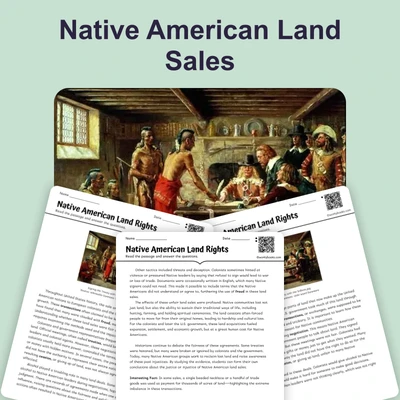
Native American Land Sales
This comprehensive history reading passage examines Native American land sales in U.S. history and asks students to cons...
D2.HIS.2.3-5D2.HIS.3.3-5RI.4.3RI.4.4
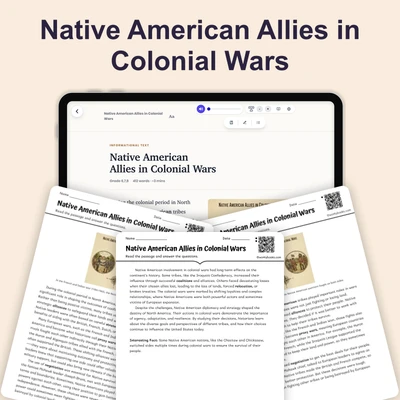
Native American Allies in Colonial Wars
This passage examines the complex role of Native American nations as allies and adversaries during the colonial wars of ...
D2.HIS.2.3-5D2.HIS.3.3-5RI.4.3RI.4.4
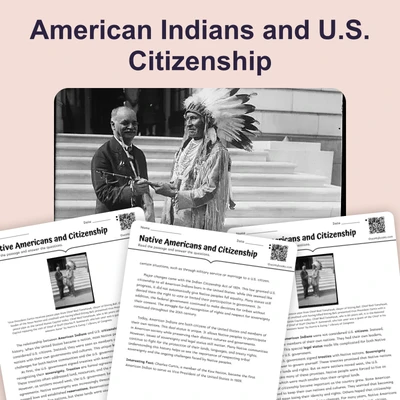
American Indians and U.S. Citizenship
This reading passage explores the complex history of American Indians and U.S. citizenship, focusing on the period after...
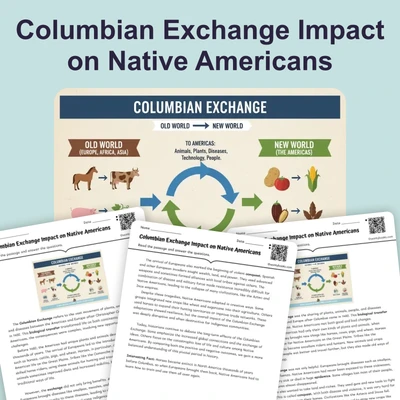
Columbian Exchange Impact on Native Americans
This passage examines the complex effects of the Columbian Exchange on Native Americans, analyzing the causes, consequen...
D2.HIS.2.3-5D2.HIS.3.3-5RI.4.3RI.4.4
Spanish Missions Impact on Native American
This reading passage explores the complex impact of Spanish missions on Native American culture in what is now the south...
D2.HIS.2.3-5D2.HIS.3.3-5RI.4.3RI.4.4
Native American Civilizations Before European Contact
This engaging U.S. History reading passage explores Native American civilizations before European contact, focusing on t...
D2.HIS.2.3-5D2.HIS.3.3-5RI.4.3RI.4.4
Native vs European Land Views
This passage examines the contrasting beliefs about land between Native American societies and European settlers, highli...
D2.HIS.2.3-5D2.HIS.3.3-5RI.4.3RI.4.4
Native Americans in Revolutionary War
This engaging U.S. history reading passage explores how Native American nations made difficult decisions during the Amer...
D2.HIS.2.3-5D2.HIS.3.3-5RI.4.3RI.4.4
Native Languages: Loss and Revival
This engaging U.S. history reading passage examines the history of Native American language loss and ongoing efforts tow...
D2.HIS.2.3-5D2.HIS.3.3-5RI.4.3RI.4.4
Native American Basket Weaving
This passage examines the historical importance of basket weaving among Indigenous Americans, highlighting how different...
The Full Moon in Native American Culture
W.4.5
The Race for Riches
This engaging U.S. history reading passage introduces students to the Age of Exploration and the intense race for riches...