Leaders Call for a New Constitution — Reading Comprehension
Rate this
Premium Resource
Present
Present in classroom. No work saved
Assign
Classroom with student accounts, Track progress
Quick Play
No student accounts, assign with a link
Grades
6
7
8
PRINT+DIGITAL RESOURCE
This learning resource is available in interactive and printable formats. The interactive worksheet can be played online and assigned to students. The Printable PDF version can be downloaded and printed for completion by hand.
This reading passage explores the pivotal moment in U.S. history when American leaders recognized the weaknesses of the Articles of Confederation and called for a convention to create a new Constitution. Covering the causes, debates, and consequences of the Constitutional Convention of 1787, the passage examines conflicts, multiple perspectives, and the reasons why a new government structure was necessary. Aligned with D2.His.2.6-8, D2.His.3.6-8, and RI.6.3, RI.6.4, it encourages students to analyze historical evidence and understand the impact of compromise and debate in shaping the United States. The resource includes a reading passage, differentiated and Spanish versions, a glossary, reading comprehension quiz, writing activities, and graphic organizers. Perfect for students and teachers seeking a comprehensive U.S. history resource with read-aloud audio and Spanish translation.
CONTENT PREVIEW
Expand content preview
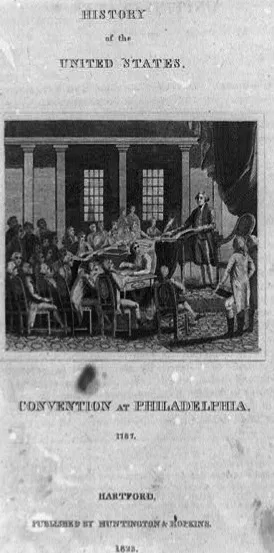
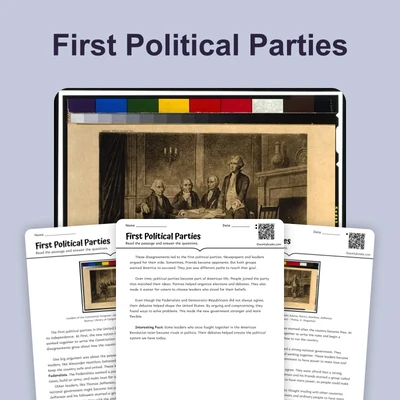
"Convention at Philadelphia, 1787" / Library of Congress.
The Constitutional Convention of 1787 was a crucial meeting that shaped the future of the United States. Delegates from twelve states gathered in Philadelphia to address the serious problems facing the country under the Articles of Confederation. The Articles, which served as America's first government, had created a national government that was too weak to solve important issues, such as collecting taxes or regulating trade.
The delegates—fifty-five men representing their states—met in secrecy at Independence Hall. Their goal was to create a stronger national government. Among them were notable leaders like George Washington, who presided over the convention, and James Madison, who became known as the "Father of the Constitution" for his detailed notes and ideas. Each delegate brought different opinions and priorities, making decision-making especially challenging.
One of the main problems they faced was finding the right balance between power for the states and power for the national government. Many small states feared losing their influence if population determined representation in Congress. Larger states wanted more say because they had more people. This conflict led to the Great Compromise, which created a two-house legislature: the Senate, where each state had equal representation, and the House of Representatives, where representation was based on population.
Another major disagreement involved slavery. Southern states wanted enslaved people counted in their populations to increase their representation, while northern states disagreed. The Three-Fifths Compromise settled this issue by counting three out of every five enslaved people for both representation and taxation. This compromise demonstrated how the delegates used negotiation to reach agreements, even on difficult subjects.
Beyond these debates, the convention produced several lasting principles. The new Constitution established a system of checks and balances so that no single branch—executive, legislative, or judicial—could become too powerful. It also included a process for amendment, allowing the Constitution to be changed as needed. The goal was to create a strong but flexible government that would endure over time.
Once the Constitution was written, it still had to be approved by the states—a process called ratification. This was not easy, as many Americans feared giving too much power to a central government. Supporters, called Federalists, wrote essays explaining why the new Constitution was necessary. Opponents, known as Anti-Federalists, worried about the lack of individual rights. To gain support, the Bill of Rights—ten amendments guaranteeing basic freedoms—was promised and added soon after ratification.
In conclusion, the Constitutional Convention of 1787 solved problems that threatened the survival of the United States through debate, compromise, and careful planning. The Constitution they created formed the basis for American government and continues to guide the nation today.
Interesting Fact: George Washington was so respected that his presence at the Convention helped persuade others to attend and support the final Constitution.
Where did the Convention take place?
PhiladelphiaNew YorkBostonRichmond
Who presided over the Convention?
George WashingtonBenjamin FranklinJames MadisonThomas Jefferson
What was the main goal of the Convention?
Strengthen national governmentDeclare independenceStart a warElect a president
Why did small states worry about representation?
Larger states might control CongressTaxes were too highThey wanted to end slaveryThey disliked compromise
What did the Three-Fifths Compromise decide?
Counted enslaved people for representationEnded slaveryCreated the Supreme CourtGave states equal votes
How did the Bill of Rights help ratification?
Promised basic freedomsBanned all taxesCreated the SenateSupported Anti-Federalists
The Constitution was approved by ratification.
TrueFalse
What does 'compromise' mean?
Each side gives up somethingOnly one side winsA kind of lawElection of president
Perfect For:
👩🏫 Teachers
• Reading comprehension practice
• Auto-graded assessments
• Literacy skill development
👨👩👧👦 Parents
• Reading practice at home
• Comprehension improvement
• Educational reading time
🏠 Homeschoolers
• Reading curriculum support
• Independent reading practice
• Progress monitoring
Reading Features:
📖
Reading Passage
Engaging fiction or nonfiction text
❓
Comprehension Quiz
Auto-graded questions
📊
Instant Feedback
Immediate results and scoring
📄
Printable Version
Download for offline reading
🔊
Read Aloud
Voice-over with word highlighting
Reviews & Ratings
No reviews yet. Be the first to share your experience!
Related Content
New Nation America
This history reading passage, 'New Nation America,' covers how the United States struggled to become a united country af...
HSS 5.6.1RI.4.2
The Cherokee Nation: History and Culture
This reading passage explores the rich history and culture of the Cherokee Nation, one of the largest Native American tr...
D2.HIS.2.3-5D2.HIS.14.3-5RI.4.3RI.4.4RI.4.10
New Orleans: An Important Port
This engaging U.S. history reading passage explores the crucial role of New Orleans and the Louisiana Purchase in shapin...
D2.HIS.3.3-5D2.HIS.14.3-5RI.4.3RI.4.4
American Indians and U.S. Citizenship
This reading passage explores the complex history of American Indians and U.S. citizenship, focusing on the period after...
Battle of New Orleans 1815
This passage explores the pivotal Battle of New Orleans in 1815, focusing on Andrew Jackson’s leadership and the complex...
D2.HIS.2.3-5D2.HIS.3.3-5RI.4.3RI.4.4
Hamilton vs Jefferson
This engaging U.S. history reading passage explores the contrasting visions of Alexander Hamilton and Thomas Jefferson, ...
National Bank Debate
This engaging U.S. history passage explores the National Bank Debate and the constitutional disagreement between Alexand...
D2.HIS.2.3-5D2.HIS.3.3-5RI.4.3RI.4.4
Lewis and Clark Expedition
This comprehensive U.S. History reading passage explores the Lewis and Clark Expedition (1804-1806), a pivotal journey l...
HSS 8.4.18.8.2RI.6-8.1RI.6-8.3
The Iroquois Influence on the Constitution
This comprehensive U.S. history reading passage investigates the possible influence of the Iroquois Confederacy’s Great ...
James Madison Early Life
This passage explores the formative years of James Madison—his upbringing in Virginia, his education, and his early expe...
The Louisiana Purchase Deal of 1803
This engaging U.S. history reading passage explores the Louisiana Purchase of 1803, when the United States doubled in si...
D2.HIS.1.3-5D2.HIS.3.3-5RI.4.3RI.4.4
Star-Spangled Banner Origins
This passage explores the complex history of the Star-Spangled Banner, focusing on its origins during the War of 1812, t...
D2.HIS.2.3-5D2.HIS.3.3-5RI.4.3RI.4.4
New Immigrants and New Jobs
This engaging reading passage explores the experiences of new immigrants and the rise of new jobs during the Progressive...
D2.HIS.2.3-5D2.HIS.3.3-5RI.4.3RI.4.4
Enslaved People Had No Citizenship Rights
This passage explores the realities faced by approximately four million enslaved people in the United States during the ...
Thomas Jefferson Biography
This engaging history reading passage provides a detailed look at Thomas Jefferson, one of America's most influential fo...
HSS 5.6.2RI.4.2
The First Political Parties Form
This engaging passage explores the formation of America's first political parties, highlighting the Federalists and Demo...
D2.HIS.1-4.3-5RI.4.3RI.4.4
George Washington First President
This passage explores how George Washington became the first President of the United States in 1789 and the crucial prec...
Cherokee Nation v Georgia
This detailed reading passage explores the pivotal Supreme Court case Cherokee Nation v Georgia (1831), a turning point ...
D2.HIS.2.3-5D2.HIS.3.3-5RI.4.3RI.4.4
James Monroe and the Monroe Doctrine
This engaging U.S. history reading passage introduces students to President James Monroe and the Monroe Doctrine, a key ...