This learning resource is available in interactive and printable formats. The interactive worksheet can be played online and assigned to students. The Printable PDF version can be downloaded and printed for completion by hand.
This engaging U.S. history reading passage explores the contrasting visions of Alexander Hamilton and Thomas Jefferson, two influential leaders in the early days of the United States. Hamilton advocated for a strong central government, industry, and banking, while Jefferson supported agriculture and states' rights. Students will learn how their debates shaped the nation's economy and political structure, and how their disagreements continue to impact American society today. The passage includes vocabulary support, a Spanish translation, and a simplified version for differentiated instruction. Activities include multiple-choice questions, writing prompts, graphic organizers, and a timeline to help students analyze and compare historical perspectives. Aligned to HSS 8.3.4 and CCSS.RI.6-8.1, RI.6-8.6, this resource also features read aloud audio and is designed to build critical thinking skills about the nation's founding.
CONTENT PREVIEW
Expand content preview
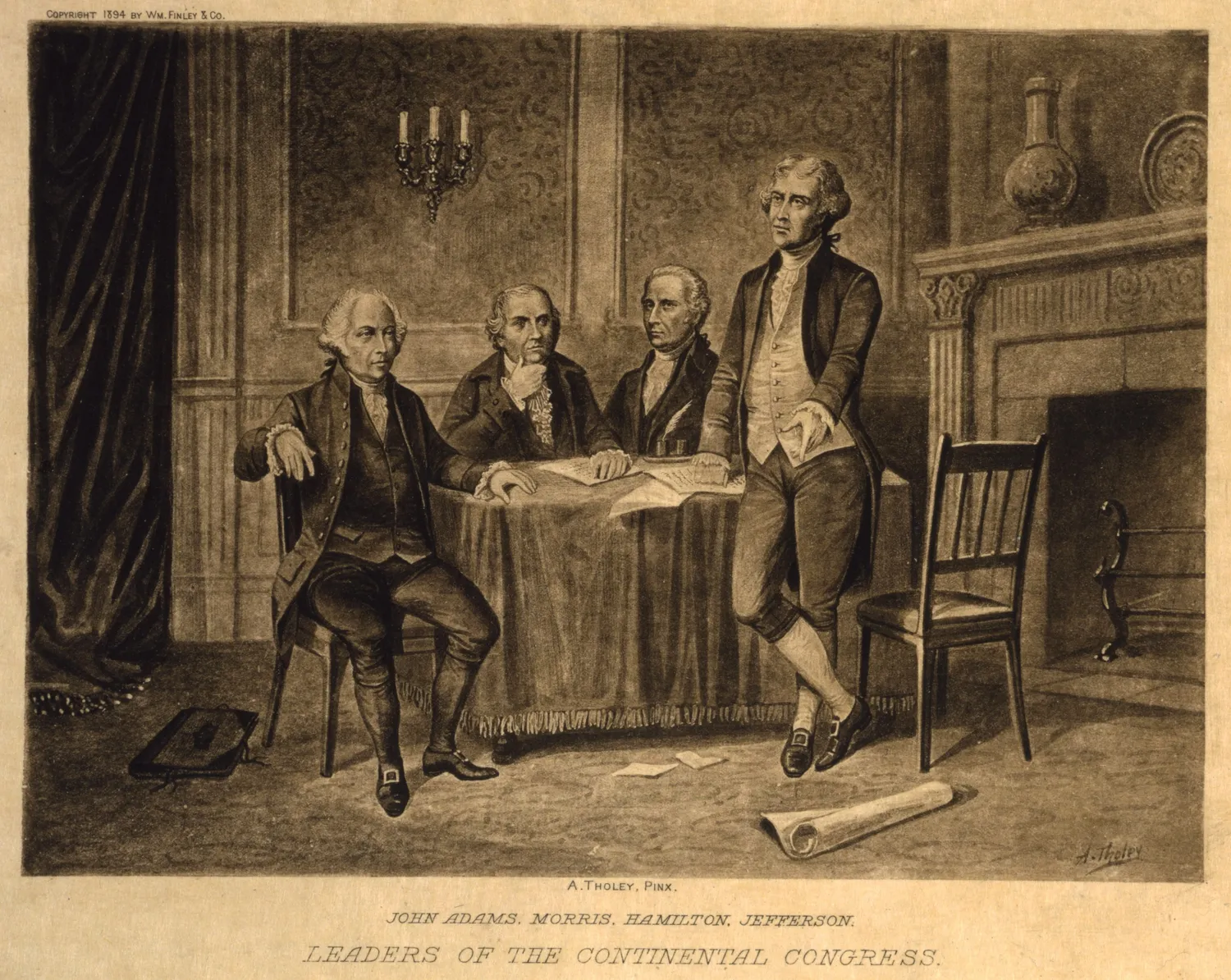
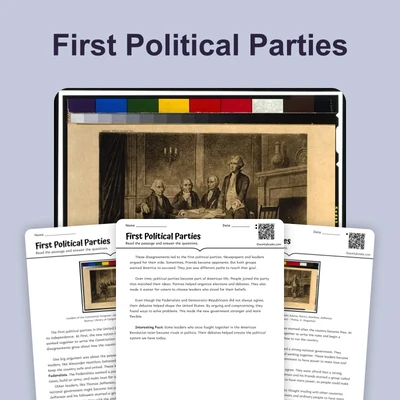
"Leaders of the Continental Congress-John Adams, Morris, Hamilton, Jefferson" / Wikimedia Commons (Public domain).
The early years of the United States were shaped by a fierce debate between two leaders: Alexander Hamilton and Thomas Jefferson. Both men played major roles in forming the new nation, but they had very different visions for America's future. Their disagreements would influence how the government and economy developed in the years after independence.
Alexander Hamilton, born in the Caribbean and later a key advisor to President George Washington, believed the United States needed a strong central government. He argued that a powerful federal government was necessary to keep the country unified and to handle national problems. Hamilton wanted to build an economy based on industry, factories, and banking. He believed that supporting manufacturing and creating a national bank would help the nation grow and compete with European powers.
In contrast, Thomas Jefferson, who wrote the Declaration of Independence and became the third president, favored a government with more states' rights. Jefferson thought that too much federal power could threaten people's freedoms. He wanted America to remain a nation of independent farmers. Jefferson believed that agriculture, not industry, was the best foundation for the country. He saw farmers as honest, self-reliant citizens who could keep democracy strong.
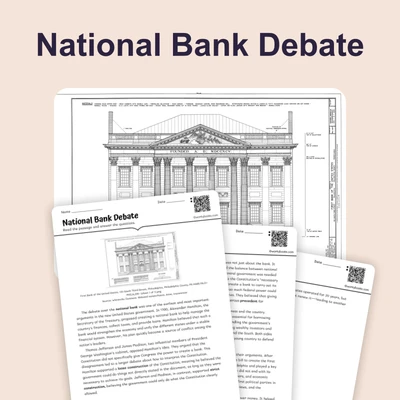
Their conflict became clear when Hamilton, as Secretary of the Treasury, proposed creating a national bank. He said this bank would help manage the country's debts and improve credit. Jefferson argued that the Constitution did not give the government the right to make such a bank. This dispute highlighted a difference in how each man interpreted the Constitution. Hamilton believed in a "loose" interpretation, allowing government to take actions not specifically forbidden. Jefferson insisted on a "strict" interpretation, limiting government to powers clearly listed in the Constitution.
These opposing viewpoints led to the first political parties in the United States. Hamilton's supporters formed the Federalist Party, which favored a strong central government and close ties with Britain. Jefferson's followers formed the Democratic-Republican Party, supporting states' rights and France. Their rivalry was not just personal, but reflected real concerns about how to build a new nation. Both men worried about threats to liberty, but they disagreed about how best to protect it.
In the end, both Hamilton and Jefferson influenced the nation's direction. The United States developed both industry and agriculture, and the debate over federal and state power continues even today. Their arguments helped set the boundaries for American government and society. By studying their debate, historians learn how conflict and compromise shaped the country.
Interesting Fact: Although they disagreed on many issues, Hamilton and Jefferson both served in President Washington's cabinet and helped establish important traditions for future leaders.
Who wanted a strong federal government?
Alexander HamiltonThomas JeffersonGeorge WashingtonJames Madison
Which leader preferred agriculture?
HamiltonJeffersonAdamsFranklin
What did Hamilton want to create?
A national bankA new armyA farming systemA foreign alliance
Why did Jefferson oppose the national bank?
It was too expensiveNot in ConstitutionIt helped farmersIt made states stronger
What was a main result of their conflict?
Civil warFirst political partiesNew states formedIndependence from Britain
Hamilton believed industry would help the country compete with whom?
European powersNative AmericansSouthern statesFrance only
The debate over federal power continues today.
TrueFalse
What is 'economy' in the passage?
Money and resources systemA type of governmentA farming toolA political party
Perfect For:
👩🏫 Teachers
• Reading comprehension practice
• Auto-graded assessments
• Literacy skill development
👨👩👧👦 Parents
• Reading practice at home
• Comprehension improvement
• Educational reading time
🏠 Homeschoolers
• Reading curriculum support
• Independent reading practice
• Progress monitoring
Reading Features:
📖
Reading Passage
Engaging fiction or nonfiction text
❓
Comprehension Quiz
Auto-graded questions
📊
Instant Feedback
Immediate results and scoring
📄
Printable Version
Download for offline reading
🔊
Read Aloud
Voice-over with word highlighting
Reviews & Ratings
No reviews yet. Be the first to share your experience!
Related Content
New Nation America
This history reading passage, 'New Nation America,' covers how the United States struggled to become a united country af...
HSS 5.6.1RI.4.2
The Cherokee Nation: History and Culture
This reading passage explores the rich history and culture of the Cherokee Nation, one of the largest Native American tr...
D2.HIS.2.3-5D2.HIS.14.3-5RI.4.3RI.4.4RI.4.10
New Orleans: An Important Port
This engaging U.S. history reading passage explores the crucial role of New Orleans and the Louisiana Purchase in shapin...
D2.HIS.3.3-5D2.HIS.14.3-5RI.4.3RI.4.4
American Indians and U.S. Citizenship
This reading passage explores the complex history of American Indians and U.S. citizenship, focusing on the period after...
Battle of New Orleans 1815
This passage explores the pivotal Battle of New Orleans in 1815, focusing on Andrew Jackson’s leadership and the complex...
D2.HIS.2.3-5D2.HIS.3.3-5RI.4.3RI.4.4
National Bank Debate
This engaging U.S. history passage explores the National Bank Debate and the constitutional disagreement between Alexand...
D2.HIS.2.3-5D2.HIS.3.3-5RI.4.3RI.4.4
Leaders Call for a New Constitution
This reading passage explores the pivotal moment in U.S. history when American leaders recognized the weaknesses of the ...
Lewis and Clark Expedition
This comprehensive U.S. History reading passage explores the Lewis and Clark Expedition (1804-1806), a pivotal journey l...
HSS 8.4.18.8.2RI.6-8.1RI.6-8.3
The Iroquois Influence on the Constitution
This comprehensive U.S. history reading passage investigates the possible influence of the Iroquois Confederacy’s Great ...
James Madison Early Life
This passage explores the formative years of James Madison—his upbringing in Virginia, his education, and his early expe...
The Louisiana Purchase Deal of 1803
This engaging U.S. history reading passage explores the Louisiana Purchase of 1803, when the United States doubled in si...
D2.HIS.1.3-5D2.HIS.3.3-5RI.4.3RI.4.4
Star-Spangled Banner Origins
This passage explores the complex history of the Star-Spangled Banner, focusing on its origins during the War of 1812, t...
D2.HIS.2.3-5D2.HIS.3.3-5RI.4.3RI.4.4
New Immigrants and New Jobs
This engaging reading passage explores the experiences of new immigrants and the rise of new jobs during the Progressive...
D2.HIS.2.3-5D2.HIS.3.3-5RI.4.3RI.4.4
Enslaved People Had No Citizenship Rights
This passage explores the realities faced by approximately four million enslaved people in the United States during the ...
Thomas Jefferson Biography
This engaging history reading passage provides a detailed look at Thomas Jefferson, one of America's most influential fo...
HSS 5.6.2RI.4.2
The First Political Parties Form
This engaging passage explores the formation of America's first political parties, highlighting the Federalists and Demo...
D2.HIS.1-4.3-5RI.4.3RI.4.4
George Washington First President
This passage explores how George Washington became the first President of the United States in 1789 and the crucial prec...
Cherokee Nation v Georgia
This detailed reading passage explores the pivotal Supreme Court case Cherokee Nation v Georgia (1831), a turning point ...
D2.HIS.2.3-5D2.HIS.3.3-5RI.4.3RI.4.4
James Monroe and the Monroe Doctrine
This engaging U.S. history reading passage introduces students to President James Monroe and the Monroe Doctrine, a key ...