This learning resource is available in interactive and printable formats. The interactive worksheet can be played online and assigned to students. The Printable PDF version can be downloaded and printed for completion by hand.
This comprehensive middle school science passage introduces students to alkaline earth metals, the elements found in Group 2 of the periodic table. Written at an accessible grade 6-8 level and aligned to NGSS MS-PS1-1, the passage explains the chemical and physical characteristics of these reactive elements, focusing on their two valence electrons and how this determines their reactivity and use in real-world contexts. Students will read about magnesium’s role in flares and plant chlorophyll, calcium’s importance in bones and chalk, and barium’s application in medical imaging. The passage emphasizes scientific reasoning, cause-and-effect, and the mechanisms behind these properties, helping students understand how structure relates to function. Also included are differentiated versions, Spanish translations, glossary, comprehension questions, writing prompts, and graphic organizers, with audio integration for accessibility. This resource is ideal for building foundational chemistry knowledge and supporting science literacy.
CONTENT PREVIEW
Expand content preview
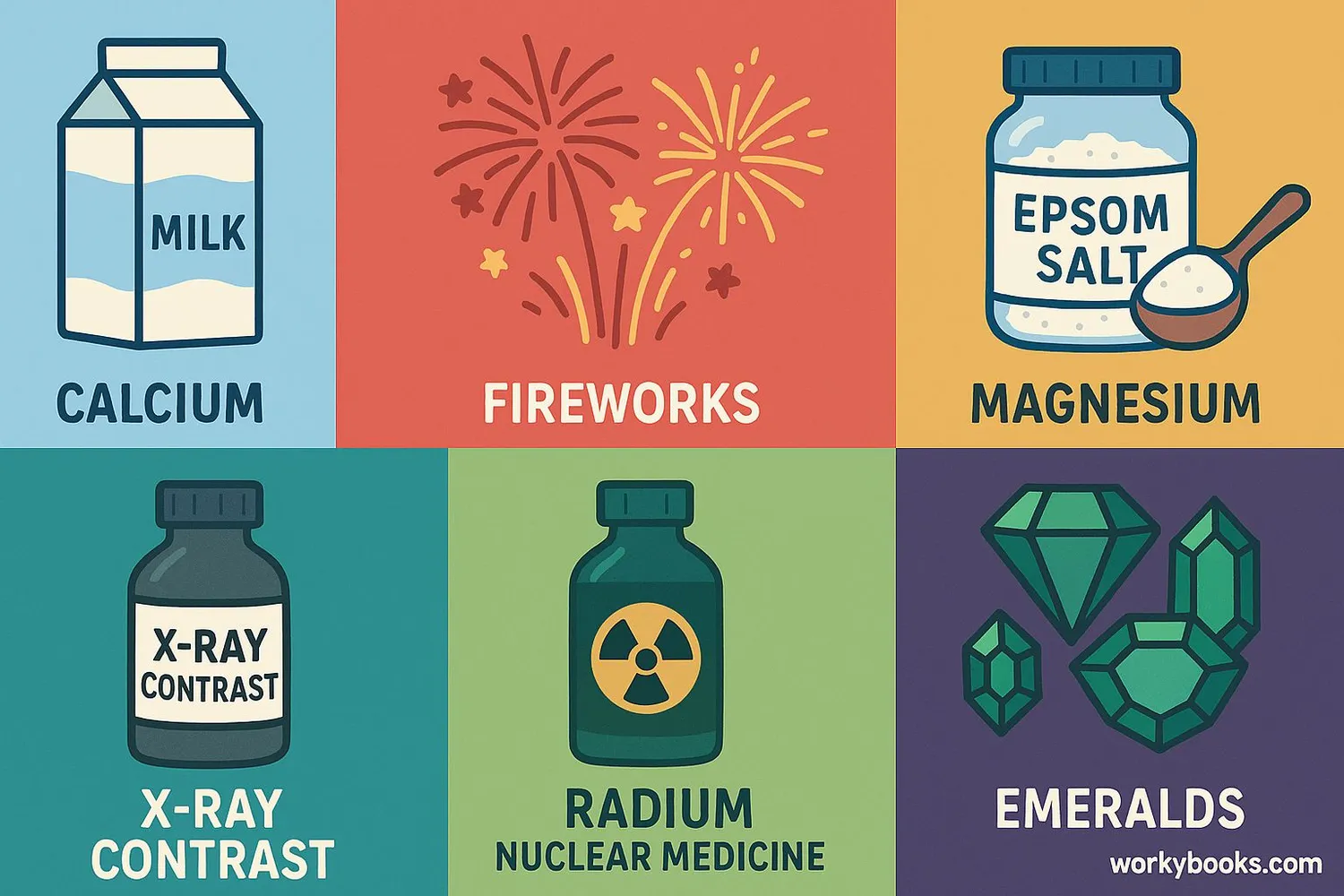
Common sources and forms of alkaline earth metals
Alkaline earth metals are a group of elements in the second column of the periodic table. These elements are not as reactive as alkali metals, but they are still very important in both nature and technology. Their unique chemical properties, such as having two valence electrons, influence how they behave and interact with other substances. Scientists have discovered that these metals are harder and denser than Group 1 elements. Because of their special characteristics, alkaline earth metals are essential for many processes in living things and in society.
The Structure and Reactivity of Alkaline Earth Metals
The position of alkaline earth metals—like magnesium, calcium, and barium—in the periodic table predicts their properties. Each of these elements has two valence electrons, which means they tend to lose two electrons during chemical reactions. This process forms ions with a +2 charge. Because it takes more energy to remove two electrons than one, alkaline earth metals are less reactive than alkali metals, but more reactive than most other elements. For example, magnesium reacts slowly with cold water but burns brightly in air. These metals are also harder and have higher melting points than alkali metals. Their reactivity and structure are key factors that determine how they interact with other elements and compounds.
Real-World Applications and Interactions
The chemical behavior of alkaline earth metals leads to many important uses. Magnesium is used in flares and fireworks because it produces an intense white light when it burns. It is also found in chlorophyll, the green pigment in plants that absorbs sunlight for photosynthesis. Calcium plays a vital role in building bones and teeth in animals, including humans. It is also a main ingredient in chalk and limestone. Barium, another alkaline earth metal, is used in medical imaging: doctors use a barium compound to help see the digestive system on X-rays. In each case, the metal's reactivity and ability to form stable compounds are crucial to its application. These examples show how structure and function work together in science.
Connections to Science and Society
Studying alkaline earth metals helps scientists understand larger scientific principles, like how the arrangement of electrons affects chemical properties. The cause-and-effect chain—from electron structure to real-world use—is clear with these elements. For example, the hardness of calcium compounds makes them ideal for building strong skeletons, while the reactivity of magnesium allows it to be used in emergency flares. These metals are also important for environmental and health reasons, such as maintaining strong bones or reducing pollution through water treatment. Ongoing research continues to reveal new ways these metals can benefit society, technology, and the environment.
Interesting Fact: Radium, another alkaline earth metal, was once used in glow-in-the-dark paints, but it was found to be dangerously radioactive.
Which group of the periodic table contains the alkaline earth metals?
Group 2Group 1Group 7Group 18
What is a key difference between alkaline earth metals and alkali metals?
Alkaline earth metals have two valence electrons; alkali metals have one.Alkaline earth metals are gases; alkali metals are solids.Alkaline earth metals are more reactive than alkali metals.Alkaline earth metals cannot form ions.
What is the main role of calcium in the human body?
Building bones and teethHelping with breathingProducing white lightForming glow-in-the-dark paints
In the passage, what does the term 'valence electrons' mean?
Electrons in the outer shell of an atomElectrons in the nucleusElectrons that have no chargeElectrons that are only found in solids
Which alkaline earth metal is used in medical imaging?
BariumMagnesiumCalciumRadium
Based on the passage, why are alkaline earth metals less reactive than alkali metals?
They have two valence electrons, which takes more energy to remove.They are heavier.They melt at lower temperatures.They have more protons.
Why is magnesium useful in flares and fireworks?
It produces a bright white light when it burns.It is a liquid at room temperature.It is not reactive at all.It is found in bones.
If a scientist wanted to study a metal that helps build strong skeletons, which would they choose?
CalciumBariumMagnesiumSodium
True or False: Alkaline earth metals are never found in living things.
TrueFalse
True or False: Radium is safe to use in glow-in-the-dark paints today.
TrueFalse
Perfect For:
👩🏫 Teachers
• Reading comprehension practice
• Auto-graded assessments
• Literacy skill development
👨👩👧👦 Parents
• Reading practice at home
• Comprehension improvement
• Educational reading time
🏠 Homeschoolers
• Reading curriculum support
• Independent reading practice
• Progress monitoring
Reading Features:
📖
Reading Passage
Engaging fiction or nonfiction text
❓
Comprehension Quiz
Auto-graded questions
📊
Instant Feedback
Immediate results and scoring
📄
Printable Version
Download for offline reading
🔊
Read Aloud
Voice-over with word highlighting
Reviews & Ratings
No reviews yet. Be the first to share your experience!
Related Content
Atomic Structure
This reading passage on Atomic Structure provides middle school students with an accessible explanation of the fundament...
MS-PS1-1RI.6.3RI.7.1
Parts of an Atom
This reading passage on Parts of an Atom provides middle school students with a structured and accessible explanation of...
MS-PS1-1RI.6.3RI.7.1
Chemical Bonds
This reading passage on Chemical Bonds provides middle school students with a clear explanation of how and why atoms con...
MS-PS1-1RI.6.3RI.7.1
The Freezing Point of Water
This science reading passage, titled 'The Freezing Point of Water', introduces students to a key physical science concep...
MS-PS1-1RI.6.3RI.7.1
Physical Properties of Matter
This comprehensive reading passage introduces grades 6-8 students to the concept of physical properties of matter, perfe...
MS-PS1-1
Mixtures and Pure Substances
This middle school science passage provides an in-depth exploration of mixtures and pure substances, directly aligned to...
MS-PS1-1
Types of Mixtures
This comprehensive science passage for grades 6-8 introduces students to the concept of mixtures, focusing on distinguis...
MS-PS1-1
Solutions, Suspensions, and Colloids
This comprehensive science passage explores the differences between solutions, suspensions, and colloids, focusing on ho...
MS-PS1-1
The Nature of Science
This passage explores the nature of science for middle school students, aligning with NGSS standards MS-ETS1-4, MS-PS1-1...
MS-ETS1-4MS-PS1-1MS-LS1-1
Scientific Theories
This reading passage for grades 6-8 introduces students to the concept of scientific theories, emphasizing that these ar...
MS-PS1-1MS-PS1-4MS-PS3-4SCIENCE AND ENGINEERING PRACTICES
Particle Model of Matter
This comprehensive science reading passage for grades 6-8 explores the particle model of matter, aligning with NGSS stan...
MS-PS1-1MS-PS1-4
Valence Electrons
This middle school science passage introduces students to the concept of valence electrons, the outermost electrons that...
MS-PS1-1
The Idea of the Atom
This informational science passage introduces middle school students (grades 6-8) to the concept that all matter is made...
MS-PS1-1
Protons, Neutrons, and Electrons
This comprehensive middle school science passage explores the roles of protons, neutrons, and electrons, the three main ...
MS-PS1-1
What are Ions
This passage introduces middle school students to the concept of ions, explaining the processes by which atoms gain or l...
MS-PS1-1
Nucleus of the Atom
This comprehensive passage for grades 6-8 introduces students to the nucleus of the atom, the dense center that contains...
MS-PS1-1
How Atoms Differ
This middle school science reading passage, aligned with NGSS standard MS-PS1-1, explores the fundamental differences am...
MS-PS1-1
Isotopes
This middle school science passage explores the concept of isotopes, which are atoms of the same element with different ...
MS-PS1-1
Compounds vs. Mixtures
This educational passage for grades 6-8 explores the fundamental differences between compounds and mixtures, aligning wi...
MS-PS1-1
Organizing the Elements
This passage for middle school science explores how scientists organized the elements as more were discovered, leading t...