American Revolution Leaders — Reading Comprehension
Rate this|
1
Premium Resource
Present
Present in classroom. No work saved
Assign
Classroom with student accounts, Track progress
Quick Play
No student accounts, assign with a link
Grades
6
7
8
Standards
HSS 5.6
8.1
RI.6-8.1
RI.6-8.2
PRINT+DIGITAL RESOURCE
This learning resource is available in interactive and printable formats. The interactive worksheet can be played online and assigned to students. The Printable PDF version can be downloaded and printed for completion by hand.
This comprehensive reading passage explores the contributions of key leaders during the American Revolution, including George Washington, John Adams, and Benjamin Franklin. Students will compare and contrast how these Founding Fathers used their unique skills as a commander, statesman, and diplomat to help the colonies achieve independence from Britain. The passage integrates rich academic vocabulary, a glossary, and a timeline to foster historical reasoning. Activities include multiple-choice questions, writing prompts, and graphic organizers to deepen understanding and support critical thinking. Differentiated and Spanish-translated versions make the content accessible for a wide range of learners. This resource is aligned with history and ELA standards HSS 5.6, 8.1, and CCSS.RI.6-8.1, RI.6-8.2, making it ideal for social studies classrooms seeking rigorous, standards-based instruction. Read aloud audio is included for additional accessibility.
CONTENT PREVIEW
Expand content preview
[Five-person drafting committee of the Declaration of Independence presenting the document to Congress on June 28, 1776] / Library of Congress.
The American Revolution was a struggle for independence against British rule, shaped by the talents and decisions of several key leaders. These Founding Fathers were not all the same; each brought unique abilities to the fight for a new nation. By comparing the roles of George Washington, John Adams, and Benjamin Franklin, we can better understand how military, political, and diplomatic leadership combined to secure American independence.
George Washington, chosen as the commander of the Continental Army, was respected for his discipline and courage. As a commander, Washington faced the difficult task of leading an inexperienced army against one of the world’s most powerful military forces. Despite early defeats and harsh conditions at places like Valley Forge, he inspired his troops to persevere. Washington’s leadership was not just about battlefield tactics; he also kept his soldiers united, demonstrating the importance of morale. His ability to adapt, even when supplies were low or battles were lost, proved crucial to the Revolutionary cause.
John Adams, meanwhile, was a fierce advocate for independence in the Continental Congress. As a skilled statesman, Adams used his persuasive writing and speeches to argue for separation from Britain. Unlike Washington, Adams fought with words and laws. He helped draft the Declaration of Independence and worked to ensure all thirteen colonies supported the revolutionary effort. Adams often clashed with others, but his commitment to principle and his ability to build alliances made him an essential leader in the political arena.
Benjamin Franklin played a different but equally important role as a diplomat. Franklin traveled to France to convince the French government to support the American cause. Using his reputation as a scientist and thinker, Franklin won over the French with his wit and wisdom. This alliance brought much-needed money, troops, and naval support to the struggling colonies. Without Franklin’s diplomatic skill, it is unlikely that France would have provided such vital assistance.
Although these leaders had different strengths, their efforts were deeply connected. Washington’s military victories encouraged France to join the war. Adams’ political arguments helped unite the colonies and justify seeking foreign help. Franklin’s success in France turned the tide of the war. Each leader faced challenges: Washington endured hardship with his army, Adams dealt with political disagreements, and Franklin navigated complex international relations. Their solutions—whether through strategy, debate, or negotiation—demonstrate the power of teamwork and persistence.
Historians also note that these men sometimes disagreed on strategy and priorities. Their ability to compromise and work together, despite personal differences, shows the complexity of the Revolutionary movement. The American Revolution was not won by one hero, but by a group of leaders who combined their skills to solve the enormous problem of achieving independence.
In summary, the American Revolution’s outcome depended on the combined contributions of military commanders like Washington, political statesmen like Adams, and diplomats like Franklin. Their leadership, vision, and willingness to face challenges together laid the foundation for the United States.
Interesting Fact: Benjamin Franklin was over seventy years old when he helped negotiate the Treaty of Paris, which officially ended the Revolutionary War.
Who led the Continental Army?
George WashingtonJohn AdamsBenjamin FranklinThomas Jefferson
Which leader worked as a diplomat in France?
WashingtonFranklinAdamsJefferson
What did John Adams help write?
Bill of RightsDeclaration of IndependenceTreaty of ParisFrench Alliance
Why was the French alliance important?
It brought money and troopsIt stopped the warIt made Adams presidentIt started the Congress
How did Washington inspire his troops?
By writing lawsBy leading battles and uniting themBy speaking in CongressBy making treaties
What did Adams do when colonies disagreed?
Ignored themBuilt alliancesQuit the CongressAsked France for help
The American Revolution was led by only one person.
TrueFalse
What is a "diplomat"?
Army leaderPolitical writerCountry representative for agreementsLocal mayor
Perfect For:
👩🏫 Teachers
• Reading comprehension practice
• Auto-graded assessments
• Literacy skill development
👨👩👧👦 Parents
• Reading practice at home
• Comprehension improvement
• Educational reading time
🏠 Homeschoolers
• Reading curriculum support
• Independent reading practice
• Progress monitoring
Reading Features:
📖
Reading Passage
Engaging fiction or nonfiction text
❓
Comprehension Quiz
Auto-graded questions
📊
Instant Feedback
Immediate results and scoring
📄
Printable Version
Download for offline reading
🔊
Read Aloud
Voice-over with word highlighting
Reviews & Ratings
No reviews yet. Be the first to share your experience!
Related Content
Benjamin Franklin in Colonial America
This U.S. History reading passage explores the life and influence of Benjamin Franklin, a key colonial leader whose idea...
HSS 5.58.1RI.6-8.1RI.6-8.3
Colonial Printing Press
This passage explores the revolutionary impact of the colonial printing press in America, examining how it enabled the s...
HSS 5.58.1RI.6-8.1RI.6-8.2
Cities in Colonial America
This engaging U.S. history reading passage explores the rise of colonial American cities such as Boston, Philadelphia, a...
HSS 5.4.68.1RI.6-8.1RI.6-8.7
Frontier Life in Colonial America
This passage examines the realities of frontier life in colonial America, highlighting both the promise and peril faced ...
HSS 5.4.68.1RI.6-8.1RI.6-8.2
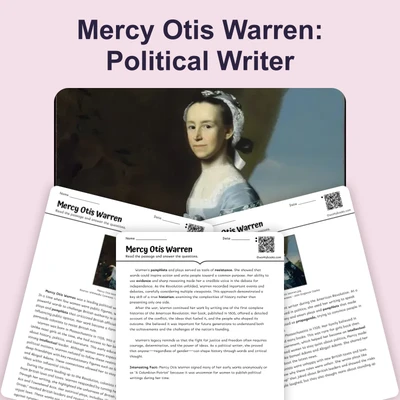
Mercy Otis Warren: Political Writer
This passage explores the life and impact of Mercy Otis Warren, a significant political writer during the American Revol...
HSS 5.6.38.1RI.6-8.1RI.6-8.6
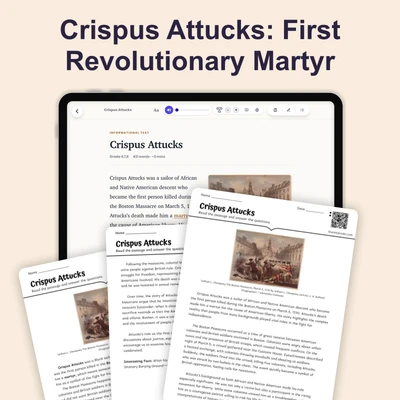
Crispus Attucks
This comprehensive U.S. History reading passage examines the life and legacy of Crispus Attucks, the first person killed...
HSS 5.5.38.1RI.6-8.1RI.6-8.3
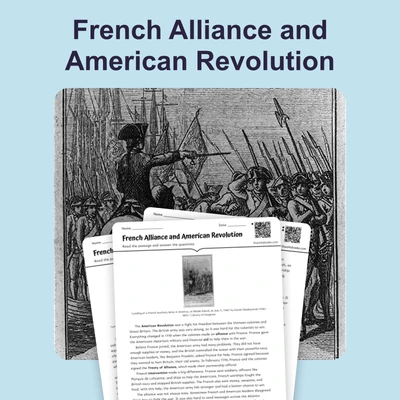
French Alliance and American Revolution
This history reading passage explores the significant role of the French alliance in the American Revolution, aligning w...
HSS 5.6.48.1RI.6-8.1RI.6-8.3
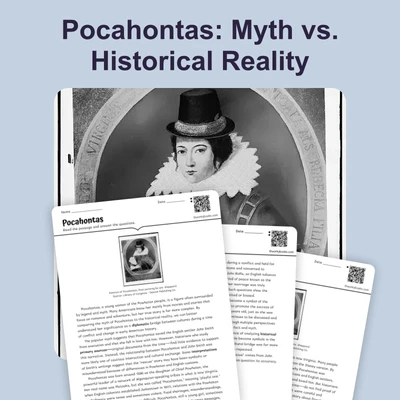
Pocahontas: Myth vs. Historical Reality
This passage explores the nuanced history of Pocahontas, moving beyond the myth made popular by movies and stories. Stud...
HSS 5.3.1RI.6-8.1RI.6-8.8
Roger Williams Religious Freedom
This passage explores the life and legacy of Roger Williams, a key figure in Colonial America who was banished from Mass...
HSS 5.4.38.2.2RI.6-8.1RI.6-8.6
Colonial Apprenticeship System
This comprehensive passage explores the Colonial Apprenticeship System and its role in education during Colonial America...
HSS 5.4.6RI.6-8.1RI.6-8.2
Declaration of Independence
This engaging reading passage examines the Declaration of Independence, highlighting its adoption on July 4, 1776, and t...
HSS 5.6.18.2.3RI.6-8.1RI.6-8.8
Lewis and Clark Expedition
This comprehensive U.S. History reading passage explores the Lewis and Clark Expedition (1804-1806), a pivotal journey l...
HSS 8.4.18.8.2RI.6-8.1RI.6-8.3
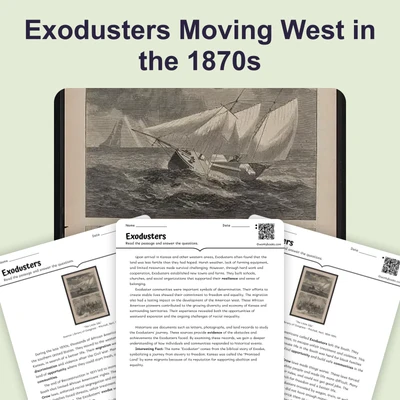
Exodusters
This passage explores the migration of Exodusters—African Americans who left the South in the 1870s to escape discrimina...
HSS 8.12.1RI.6-8.1RI.6-8.2
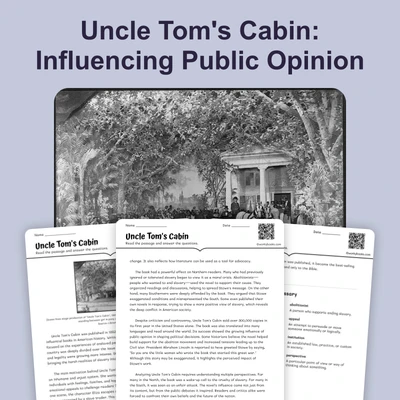
Uncle Tom's Cabin
This passage explores the impact of Harriet Beecher Stowe’s Uncle Tom’s Cabin on American society in the 1850s. It exami...
HSS 8.9.48.10.2RI.6-8.1RI.6-8.6
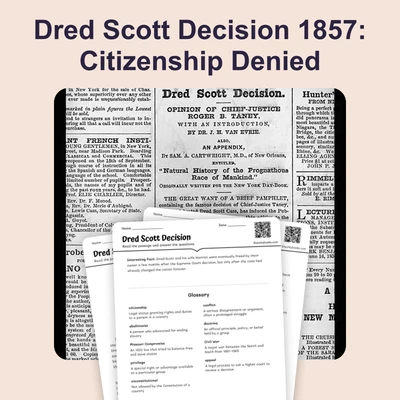
Dred Scott Decision
This rigorous history reading passage delves into the 1857 Dred Scott Decision, a pivotal moment in the lead-up to the C...
HSS 8.9.48.10.3RI.6-8.1RI.6-8.8
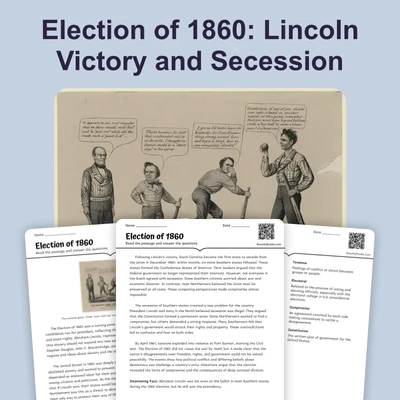
Election of 1860
This passage explores Abraham Lincoln’s election in 1860 and the critical reactions from Southern states, which set the ...
HSS 8.10.4RI.6-8.1RI.6-8.6
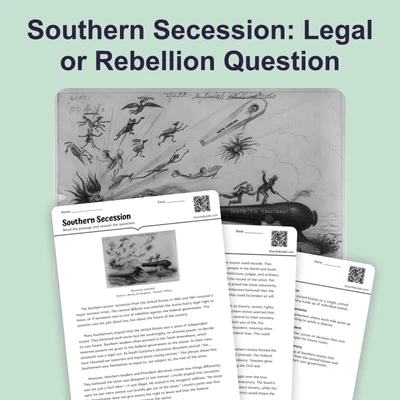
Southern Secession
This passage explores the significant moment in U.S. history when seven Southern states seceded from the Union after Abr...
HSS 8.10.4RI.6-8.1RI.6-8.2
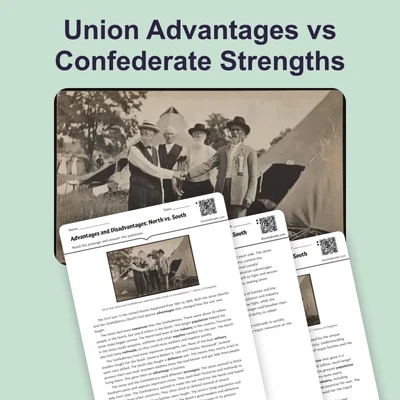
Advantages and Disadvantages: North vs. South
This history reading passage examines the contrasting strengths of the Union and Confederacy during the U.S. Civil War. ...
HSS 8.10.5RI.6-8.1RI.6-8.3
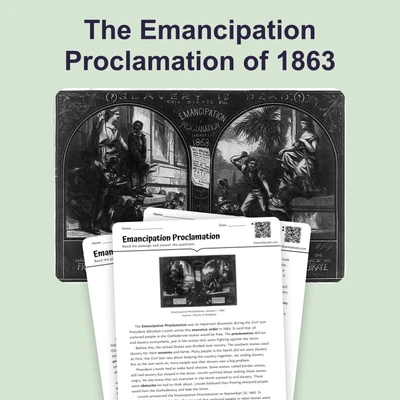
Emancipation Proclamation
This U.S. history passage explores the Emancipation Proclamation of 1863, an executive order issued by President Abraham...