Declaration of Independence — Reading Comprehension
Rate this|
1
Premium Resource
Present
Present in classroom. No work saved
Assign
Classroom with student accounts, Track progress
Quick Play
No student accounts, assign with a link
Grades
6
7
8
Standards
D2.HIS.2.3-5
D2.HIS.3.3-5
RI.4.3
RI.4.4
W.4.2
PRINT+DIGITAL RESOURCE
This learning resource is available in interactive and printable formats. The interactive worksheet can be played online and assigned to students. The Printable PDF version can be downloaded and printed for completion by hand.
This rigorous U.S. history reading passage explores the Declaration of Independence, examining whether it truly brought liberty for all Americans. Students analyze the causes, motivations, and consequences of the Declaration, considering multiple perspectives—including enslaved people, women, and Loyalists. The passage includes a close reading of a primary source quote, highlights relevant disciplinary vocabulary, and encourages students to think critically about the ideals and contradictions of the Revolution. Activities include a comprehension quiz, explanatory writing prompts, a T-Chart organizer for comparing perspectives, and a clear timeline of major events. Spanish translation and read aloud audio are included for accessibility. This lesson aligns with C3 Framework D2.His.2.3-5 and D2.His.3.3-5, as well as Common Core RI.4.3, RI.4.4, and W.4.2 standards. Perfect for helping students analyze historical evidence and master informational text skills.
CONTENT PREVIEW
Expand content preview
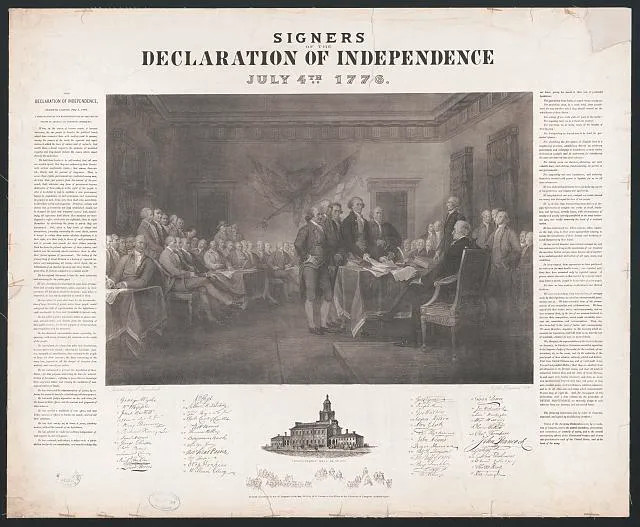
Signer of Declaration of Independence, July 4th, 1776. Source: Library of Congress
On July 4, 1776, the Second Continental Congress adopted the Declaration of Independence in Philadelphia. This document officially announced the American colonies’ decision to separate from Great Britain, changing the course of history. It was written mainly by Thomas Jefferson, who included bold ideas about human rights and government. The Declaration’s words, especially those about equality and liberty, have inspired generations around the world.
The American colonists faced many problems under British rule. The British government imposed taxes, such as the Stamp Act and Tea Act, without giving the colonists a voice in Parliament. These taxes and strict laws led to growing frustration. The grievances listed in the Declaration described these complaints, including unfair taxation, the quartering of soldiers, and the lack of self-rule. The colonists believed that the British government threatened their freedoms.
Jefferson and the other authors argued that all people are born with certain unalienable rights. These are rights that cannot be taken away, such as life, liberty, and the pursuit of happiness. The document also introduced the idea of sovereignty, meaning the authority of the people to govern themselves, rather than being ruled by a distant king.
In the Declaration, the Congress explained that when a government fails to protect people’s rights, the people have the right to change or abolish it. The colonists provided evidence and reasoning for their actions, listing examples of British violations. This approach was intended to persuade both Americans and the international community that their cause was just and reasonable.
However, not everyone in the colonies agreed with independence. Some people, called Loyalists, remained loyal to Britain, fearing chaos or loss of protection. Others worried that these new ideas about equality did not include enslaved people, women, or Native Americans. The Declaration’s promises were not fully realized for all Americans for many years. Yet, its revolutionary language set important ideals for the nation’s future.
The Declaration of Independence became a symbol of hope and justice across the world. Its influence can be seen in other nations’ struggles for freedom. Today, Americans celebrate July 4 as Independence Day, reflecting on the document’s lasting impact and ongoing challenges in achieving its ideals.
Interesting Fact: The first public reading of the Declaration took place on July 8, 1776, in Philadelphia’s Independence Square, where crowds gathered to hear its words.
When was the Declaration adopted?
July 4, 1776July 8, 1776July 4, 1789June 14, 1776
Who wrote most of the Declaration?
George WashingtonBenjamin FranklinThomas JeffersonJohn Adams
What city was the Declaration adopted in?
New YorkPhiladelphiaBostonRichmond
Why did colonists list grievances?
To praise BritainTo explain complaintsTo ask for helpTo demand new taxes
What are unalienable rights?
Rights given by the kingRights that can’t be taken awayRights only for LoyalistsVoting rights for Parliament
What did sovereignty mean in the Declaration?
King’s powerSelf-governmentBritish lawsMilitary force
All colonists supported independence.
TrueFalse
What is a grievance?
A celebrationA complaintA meetingA battle
Perfect For:
👩🏫 Teachers
• Reading comprehension practice
• Auto-graded assessments
• Literacy skill development
👨👩👧👦 Parents
• Reading practice at home
• Comprehension improvement
• Educational reading time
🏠 Homeschoolers
• Reading curriculum support
• Independent reading practice
• Progress monitoring
Reading Features:
📖
Reading Passage
Engaging fiction or nonfiction text
❓
Comprehension Quiz
Auto-graded questions
📊
Instant Feedback
Immediate results and scoring
📄
Printable Version
Download for offline reading
🔊
Read Aloud
Voice-over with word highlighting
Reviews & Ratings
No reviews yet. Be the first to share your experience!
Related Content
Native American Tribes Across America
This engaging history reading passage introduces students to Native American tribes across America, focusing on their da...
D2.HIS.1.3-5D2.HIS.2.3-5RI.4.1RI.4.2
Teepees: Homes on the Great Plains
This engaging history reading passage introduces students to teepees, the unique homes of Native American tribes on the ...
D2.HIS.2.3-5D2.HIS.14.3-5RI.4.1RI.4.2RI.4.4
Traditional Native American Clothing
This engaging history passage explores traditional Native American clothing and how it reflected the environment, values...
D2.HIS.2.3-5D2.HIS.3.3-5RI.4.3RI.4.4
The Iroquois Confederacy: A System of Peace
This engaging U.S. History reading passage introduces students to the Iroquois Confederacy, a powerful alliance of Nativ...
D2.HIS.2.3-5D2.HIS.3.3-5RI.4.3RI.4.4
The Cherokee Nation: History and Culture
This reading passage explores the rich history and culture of the Cherokee Nation, one of the largest Native American tr...
D2.HIS.2.3-5D2.HIS.14.3-5RI.4.3RI.4.4RI.4.10
The Sioux: Warriors and Tribal Leaders
This history reading passage explores the Sioux Nation, focusing on their roles as warriors and tribal leaders. Students...
D2.HIS.1.3-5D2.HIS.2.3-5RI.4.1RI.4.3
Native American Respect for Nature
This engaging history reading passage explores Native American respect for nature, emphasizing the close relationship be...
D2.HIS.2.3-5D2.HIS.3.3-5RI.4.3RI.4.4
Jamestown: The First Permanent English Colony
This engaging history passage explores the founding of Jamestown, the first permanent English colony in America. Aligned...
D2.HIS.1.3-5D2.HIS.2.3-5RI.4.3RI.4.4
Pocahontas and the Powhatan People
This engaging reading passage explores the life of Pocahontas and the Powhatan people and their important role in early ...
D2.HIS.1.3-5D2.HIS.2.3-5RI.4.1RI.4.3
Colonial Children: School and Chores
This reading passage explores the daily lives of colonial children, focusing on their experiences at school and their ma...
D2.HIS.2.3-5D2.HIS.3.3-5RI.4.1RI.4.2RI.4.4
Colonial Clothing and Homemade Goods
This engaging U.S. history passage explores the daily life of early American colonists with a focus on colonial clothing...
D2.HIS.2.3-5RI.4.3RI.4.4
Colonial Jobs: Blacksmiths, Bakers, and Craftsmen
This engaging history reading passage explores the vital roles of blacksmiths, bakers, and craftsmen in colonial America...
D2.HIS.2.3-5D2.HIS.3.3-5RI.4.3RI.4.4
Colonial Towns and Village Life
This engaging history reading passage explores the daily life, work, and unity found in colonial towns and villages. Ali...
D2.HIS.1.3-5D2.HIS.2.3-5RI.4.3RI.4.4
Colonial Trade with England and Africa
This history reading passage explores colonial trade between the American colonies, England, and Africa, focusing on the...
D2.HIS.2.3-5D2.HIS.14.3-5RI.4.3RI.4.4
Benjamin Franklin: Printer, Inventor, and Leader
This history reading passage explores the life and achievements of Benjamin Franklin, one of America's most important ea...
D2.HIS.2.3-5D2.HIS.3.3-5RI.4.1RI.4.3
George Washington Leads the Army
This engaging history reading passage explores how George Washington bravely led the Continental Army during the America...
D2.HIS.1.3-5D2.HIS.2.3-5RI.4.3RI.4.4
Women and Children During the Revolutionary War
This reading passage explores the important roles women and children played during the Revolutionary War. Students will ...
D2.HIS.2.3-5RI.4.3RI.5.3
African Americans Fight for Freedom
This educational passage explores the brave and inspiring story of how African Americans fought for freedom in the Unite...
D2.HIS.2.3-5D2.HIS.3.3-5RI.4.3RI.4.4
The Battle of Yorktown Ends War
This engaging U.S. history reading passage explores the Battle of Yorktown, a key event that ended the American Revoluti...
D2.HIS.1.3-5D2.HIS.2.3-5RI.4.1RI.4.3
Loyalists vs. Patriots: Divided Families
This engaging U.S. history reading passage explores the division between Loyalists and Patriots during the American Revo...