Anticyclone vs. Cyclone
Interactive passage with audio narration, comprehension questions, and printable PDF.
By completing this purchase you agree to our Terms of Use and Privacy Policy. Your subscription renews automatically until you cancel. You can cancel anytime from your account settings. All sales are final and non-refundable. Digital content is available for download in your account immediately upon purchase.
What's included
Anticyclone vs. Cyclone preview and details
About this printable Anticyclone vs. Cyclone science reading passage, NGSS-aligned (Grade 6)
Sample passage and quiz from Anticyclone vs. Cyclone
Reading passage and comprehension quiz preview
Anticyclone vs. Cyclone
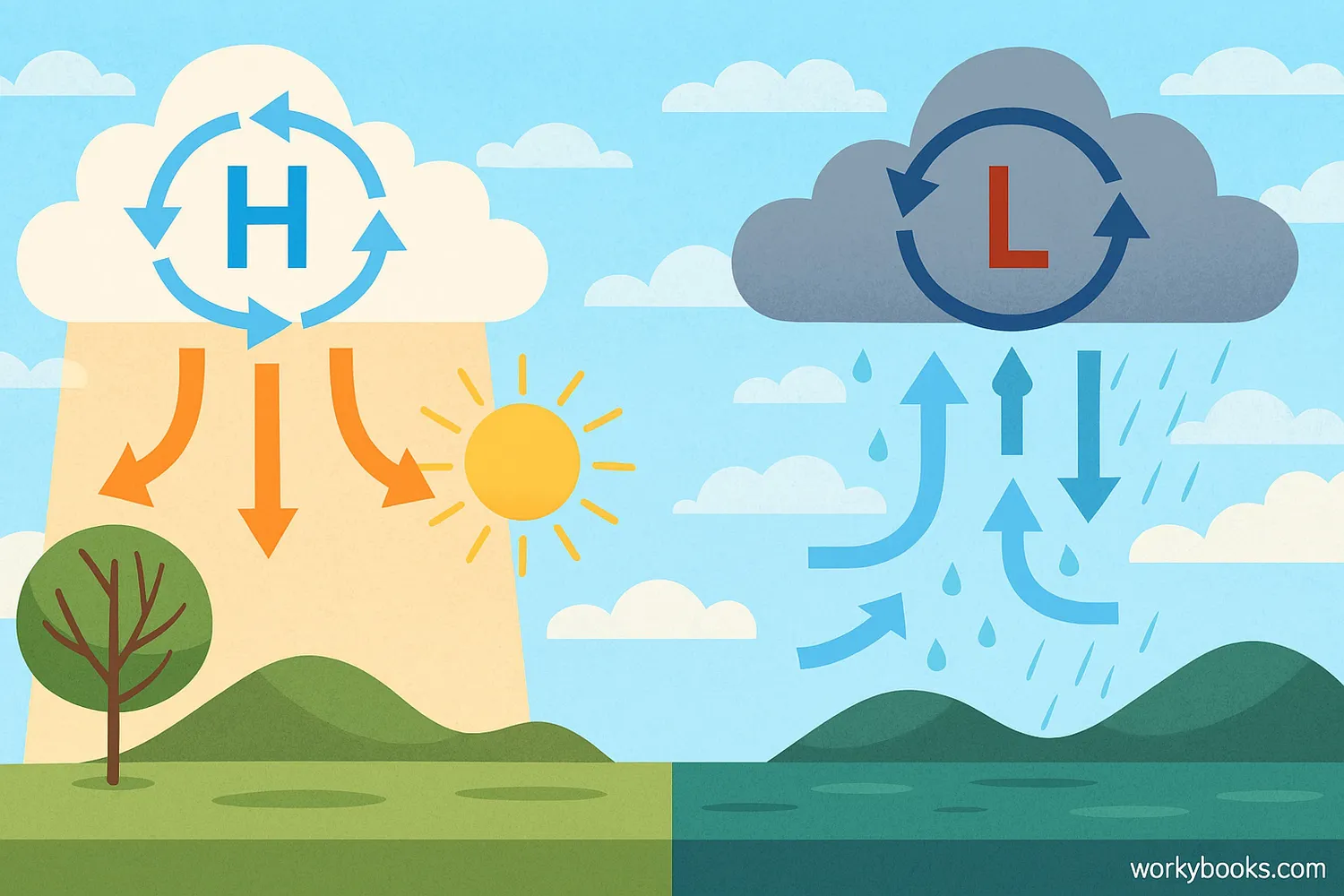
Have you ever wondered why some days are sunny and calm, while others are stormy and windy? The answer often lies in two important weather systems: anticyclones and cyclones. These systems are giant swirls of air in our atmosphere that dictate our daily weather. Understanding them helps us predict what kind of weather to expect.
Let's start with an anticyclone, also known as a high-pressure system. Imagine a huge column of air pushing down on the Earth. This creates an area of high pressure. In an anticyclone, air moves downwards from the upper atmosphere, then spreads outwards near the ground. As the air sinks, it warms up and dries out. This usually leads to clear skies, calm winds, and fair weather. Think of a beautiful, sunny day – that's often thanks to an anticyclone. In the Northern Hemisphere, the air in an anticyclone spins clockwise, while in the Southern Hemisphere, it spins counter-clockwise. These systems are crucial for understanding global atmospheric circulation.
Now, let's look at a cyclone, or a low-pressure system. Here, the air near the ground is warmer and less dense, so it rises. As this air rises, it cools and the water vapor in it condenses, forming clouds, rain, or even storms. This upward movement of air creates an area of low pressure at the surface. Air from surrounding areas with higher pressure then rushes in to fill this void, creating winds. Cyclones are often associated with cloudy, rainy, and windy weather, and they are responsible for many of the storms we experience. Unlike anticyclones, air in a cyclone spins counter-clockwise in the Northern Hemisphere and clockwise in the Southern Hemisphere. This swirling motion is a key characteristic of these weather makers.
The key difference between anticyclones and cyclones lies in their pressure, air movement, and the weather they bring. Anticyclones mean high pressure, sinking air, and good weather, while cyclones mean low pressure, rising air, and stormy weather. Both are vital parts of Earth's complex weather conditions and are constantly interacting to create the dynamic environment we live in. Studying these air masses helps meteorologists predict and explain various weather patterns.
Interesting Fact: The largest known anticyclone on Earth was measured in 2004, spanning over 10,000 kilometers and covering most of the Northern Hemisphere!
Comprehension quiz (10 questions)
1. Which system usually brings clear skies?
2. What causes air to rise in a cyclone?
3. In the Northern Hemisphere, air in a cyclone spins clockwise.
4. What is the definition of a 'cyclone' as used in the passage?
5. If you experience sunny, calm weather, what weather system is likely overhead?
6. Why do cyclones often lead to cloudy conditions?
7. What type of weather usually results from sinking air?
8. How do winds form around a low-pressure system?
9. Which scenario best describes an anticyclone's effect?
10. If a weather reporter predicts rising air, what weather might follow?
Perfect for the way you teach
- Build comprehension skills
- Auto-graded quiz
- Differentiated reading
- Read together at home
- Improve fluency
- Quiet reading time
- Reading curriculum support
- Independent practice
- Track Lexile growth