This learning resource is available in interactive and printable formats. The interactive worksheet can be played online and assigned to students. The Printable PDF version can be downloaded and printed for completion by hand.
This Grade 4 science reading passage introduces students to volcano patterns on Earth, aligned with NGSS standard 4-ESS2-2. Students learn that volcanoes are openings in Earth's surface where melted rock, ash, and gases escape. The passage explains that volcanoes are not randomly distributed but form in specific patterns, such as the Ring of Fire around the Pacific Ocean and along mid-ocean ridges. By examining world maps showing volcano locations, students discover that volcanoes cluster in certain zones, indicating that geological conditions in these areas cause volcano formation. The passage uses simple, age-appropriate language to build foundational understanding of Earth's surface processes. Audio-integrated features support diverse learners, while comprehension questions, writing activities, and graphic organizers reinforce key concepts. This resource helps fourth-grade students develop scientific thinking about patterns in nature and Earth's dynamic surface, preparing them for hands-on investigations and deeper exploration of plate tectonics and geological processes.
CONTENT PREVIEW
Expand content preview
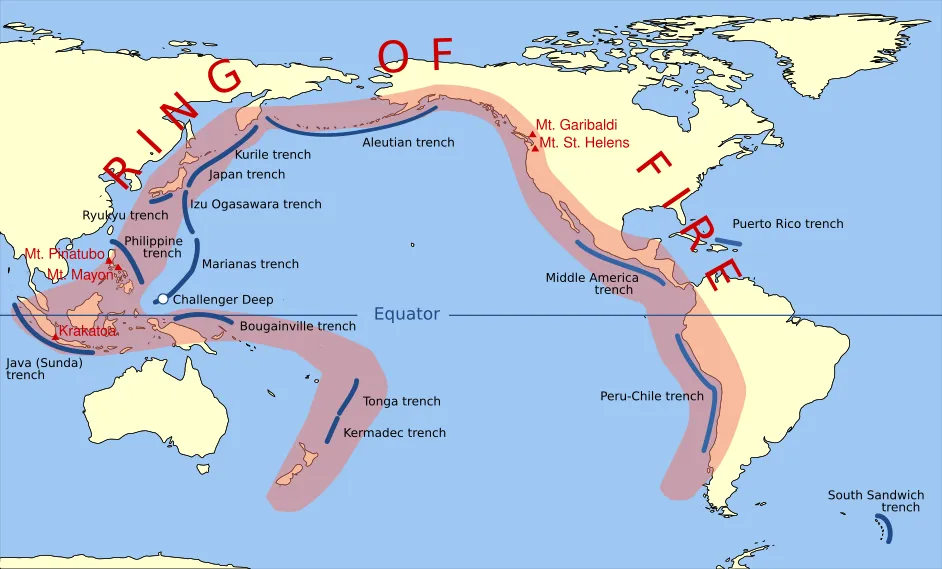
"Pacific Ring of Fire" by Gringer 23:52, 10 February 2009 (UTC) / Wikimedia Commons.
A volcano is an opening in Earth's surface where melted rock, ash, and gases escape from deep underground. Volcanoes help release heat and pressure from inside our planet, which keeps Earth's surface changing over time.
Volcanoes are not found everywhere on Earth. Instead, they form in specific patterns. If you look at a map showing all the world's volcanoes, you will notice something interesting. Many volcanoes form a ring around the Pacific Ocean. Scientists call this the Ring of Fire. This ring contains about three out of every four volcanoes on Earth. Other volcanoes are found along the middle of the ocean floor, in places most people never see.
Why do volcanoes cluster in certain zones rather than being spread randomly? The answer has to do with how Earth's surface is built. Earth's outer layer is broken into giant pieces called plates. These plates slowly move and push against each other. Where plates meet, conditions are right for melted rock, called magma, to rise up and form volcanoes. The Ring of Fire exists because many plates meet around the Pacific Ocean. Understanding these patterns helps scientists predict where volcanoes might form and keeps people safer.
Interesting Fact: Indonesia has more volcanoes than any other country—over 130! Many of them are part of the Ring of Fire.
What is a volcano?
A mountain made of iceAn opening where melted rock escapesA deep hole in oceanA type of earthquake
What is the Ring of Fire?
A ring of volcanoes around PacificA circle of fire undergroundA hot desert areaA burning forest
How many volcanoes are in Ring of Fire?
About one out of fourAbout two out of fourAbout three out of fourAll volcanoes on Earth
Why do volcanoes form in patterns?
Because of random chanceWhere Earth's plates meet togetherOnly near the oceanBecause of the weather
What happens where Earth's plates meet?
The ground becomes flatWater fills the areaMelted rock can rise upThe temperature drops
How does understanding patterns help scientists?
They can predict where volcanoes formThey can stop all volcanoesThey can make volcanoes biggerThey can move volcanoes away
Volcanoes are spread randomly across Earth.
TrueFalse
What is magma?
Solid rock on Earth's surfaceMelted rock beneath Earth's surfaceA type of ocean waterFrozen lava from volcanoes
Perfect For:
👩🏫 Teachers
• Reading comprehension practice
• Auto-graded assessments
• Literacy skill development
👨👩👧👦 Parents
• Reading practice at home
• Comprehension improvement
• Educational reading time
🏠 Homeschoolers
• Reading curriculum support
• Independent reading practice
• Progress monitoring
Reading Features:
📖
Reading Passage
Engaging fiction or nonfiction text
❓
Comprehension Quiz
Auto-graded questions
📊
Instant Feedback
Immediate results and scoring
📄
Printable Version
Download for offline reading
🔊
Read Aloud
Voice-over with word highlighting
Reviews & Ratings
No reviews yet. Be the first to share your experience!
Related Content
Map Symbols
This engaging 350-word science passage introduces Grade 4-5 students to the concept of map symbols and their importance ...
NGSS 4-ESS2-2
Compass Rose
This engaging 350-word science passage introduces Grade 4-5 students to the compass rose, a fundamental map-reading tool...
NGSS 4-ESS2-2
What Are Maps
This engaging 350-word science passage introduces Grade 4-5 students to the concept of maps as flat drawings that repres...
NGSS 4-ESS2-2
Canyons and Valleys
This engaging 350-word science passage helps Grade 4-5 students understand how canyons and valleys form through the proc...
NGSS 4-ESS2-2
What Are Topographic Maps
This engaging 250-word reading passage introduces fourth-grade students to topographic maps and how they represent Earth...
NGSS 4-ESS2-2
What Are Ocean Floor Maps
This Grade 4 science reading passage introduces students to ocean floor maps and how scientists create them using sonar ...
NGSS 4-ESS2-2
How to Read Data from Maps
This 250-word reading passage introduces fourth-grade students to the essential skill of reading data from maps, aligned...
NGSS 4-ESS2-2
Maps Show Patterns
This engaging 250-word reading passage introduces fourth-grade students to the concept of identifying patterns on maps a...
NGSS 4-ESS2-2ESS2.B
Earth's Land and Water
This 250-word reading passage introduces fourth-grade students to the fundamental concept of how land and water are dist...
NGSS 4-ESS2-2ESS2.B
What Are Mountains
This 250-word reading passage introduces fourth-grade students to mountains as one of Earth's most dramatic landforms. A...
NGSS 4-ESS2-2ESS2.B
Mountain Patterns on Earth
This 250-word reading passage introduces fourth-grade students to mountain patterns on Earth, aligned with NGSS standard...
NGSS 4-ESS2-2
Plains and Plateaus
This Grade 4 science reading passage explores plains and plateaus, two common landforms found across Earth's surface. Al...
NGSS 4-ESS2-2
Rivers and Water Features
This 250-word reading passage introduces fourth-grade students to rivers and water features as outlined in NGSS 4-ESS2-2...
NGSS 4-ESS2-2ESS2.B
Earthquake Patterns on Earth
This engaging 250-word reading passage introduces fourth-grade students to earthquake patterns on Earth, aligned with NG...
NGSS 4-ESS2-2
Ocean Trenches
This engaging 250-word reading passage introduces fourth-grade students to ocean trenches, the deepest parts of Earth's ...
NGSS 4-ESS2-2
How Earth's Features Connect
This engaging 250-word reading passage introduces fourth-grade students to the fascinating patterns connecting Earth's m...