Are sound waves longitudinal or transverse
Interactive passage with audio narration, comprehension questions, and printable PDF.
By completing this purchase you agree to our Terms of Use and Privacy Policy. Your subscription renews automatically until you cancel. You can cancel anytime from your account settings. All sales are final and non-refundable. Digital content is available for download in your account immediately upon purchase.
What's included
Are sound waves longitudinal or transverse preview and details
About this printable Are sound waves longitudinal or transverse science reading passage, NGSS-aligned (Grades 3-6)
Sample passage and quiz from Are sound waves longitudinal or transverse
Reading passage and comprehension quiz preview
Are sound waves longitudinal or transverse?
What Are Waves?
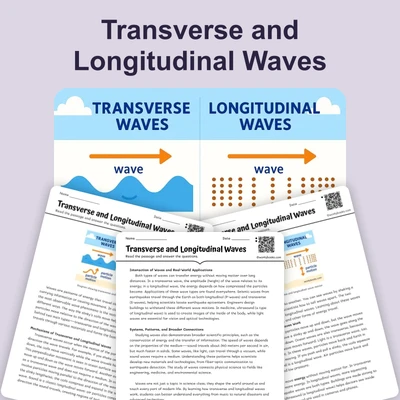
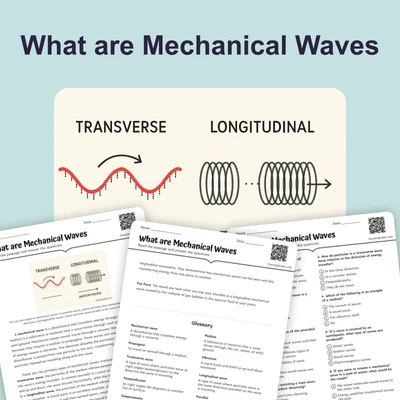
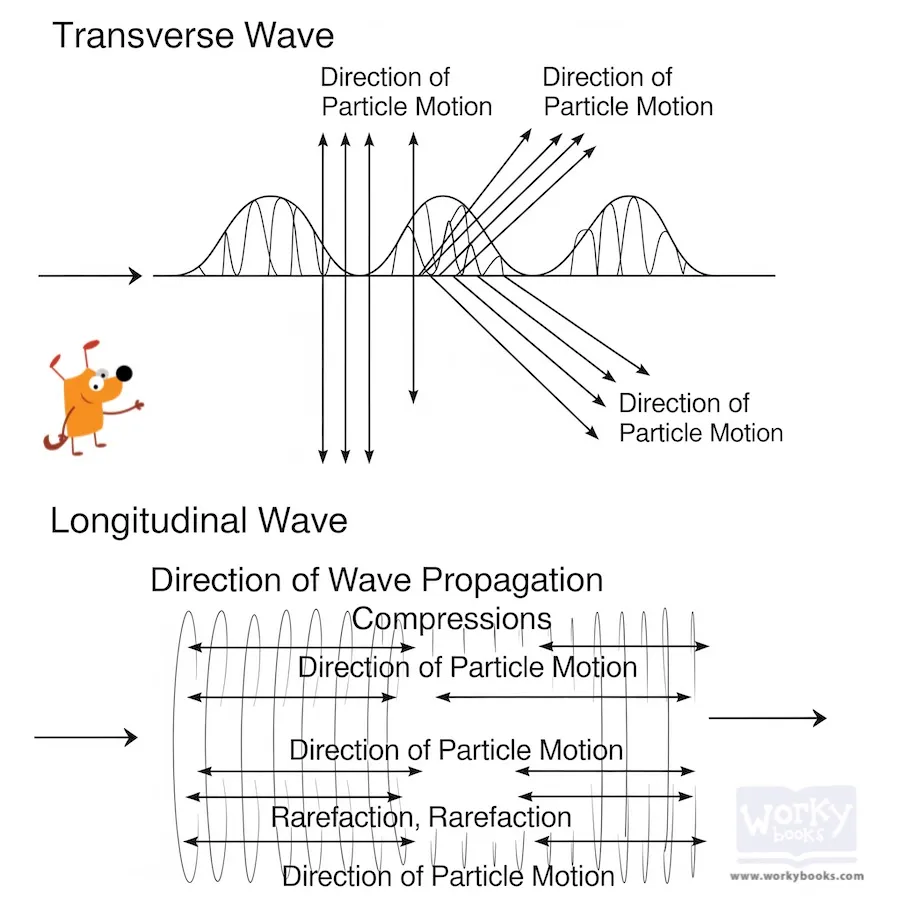
Waves are ways that energy moves from one place to another. There are two main types of waves: transverse waves and longitudinal waves.
Transverse Waves
In a transverse wave, the vibrations move up and down while the wave goes forward. Picture the ocean: the water moves up and down, but the wave travels across the sea. Another example is shaking a jump rope. The rope moves up and down, but the wave travels along its length.
Longitudinal Waves
Longitudinal waves are different. Here, the vibrations move back and forth in the same direction as the wave. Sound waves are a perfect example. When you speak, your voice makes air molecules bump into each other in a line, passing energy from one to the next. This is called a compression (where air molecules are squeezed together) and a rarefaction (where molecules are spread apart). These compressions and rarefactions travel through the air to your ears.
Slinky Demonstration
Using a slinky is a great way to see the difference. If you shake a slinky side to side, you make a transverse wave. If you push one end forward and pull it back, you create a longitudinal wave. The coils bunch up (compression) and spread out (rarefaction), just like sound waves in air.
Other Examples
Earthquake P-waves are longitudinal, moving energy in the same direction as the wave. S-waves are transverse, moving up and down. In music, drums and speakers create sound by making the air vibrate in longitudinal waves.
How Sound Travels
Remember, sound waves travel by pushing air molecules in a straight line, like a row of bumper cars bumping each other. They do not move up and down like ocean waves. That’s what makes sound waves longitudinal!
Interesting Fact: Some animals, like elephants, use low-pitched longitudinal sound waves to communicate over long distances—sometimes several miles!
Comprehension quiz (8 questions)
1. What type of wave is sound?
2. What happens in compression?
3. Which wave moves up and down?
4. What do you see in a slinky longitudinal wave?
5. If you shake a rope side to side, what wave forms?
6. Why is sound like bumper cars?
7. Sound waves are transverse waves.
8. What does rarefaction mean?
Perfect for the way you teach
- Build comprehension skills
- Auto-graded quiz
- Differentiated reading
- Read together at home
- Improve fluency
- Quiet reading time
- Reading curriculum support
- Independent practice
- Track Lexile growth