This learning resource is available in interactive and printable formats. The interactive worksheet can be played online and assigned to students. The Printable PDF version can be downloaded and printed for completion by hand.
This engaging U.S. history reading passage examines the Black Codes—laws passed by Southern states after the Civil War to restrict the rights and freedoms of African Americans. It explains how these laws limited where Black people could live, work, and travel, and how they were a response to the abolition of slavery. The passage challenges students to analyze the cause and effect of this legislation, its impact on the lives of freedmen, and the resistance it provoked. Aligned to history standard HSS 8.11.2 and Common Core standards RI.6-8.1 and RI.6-8.6, this resource includes a glossary, differentiated versions for accessibility, a Spanish translation, read aloud audio, multiple-choice quiz, writing prompts, graphic organizers, and timeline activities. It is designed to help students build historical thinking skills while mastering academic vocabulary and understanding the complexities of Reconstruction.
CONTENT PREVIEW
Expand content preview
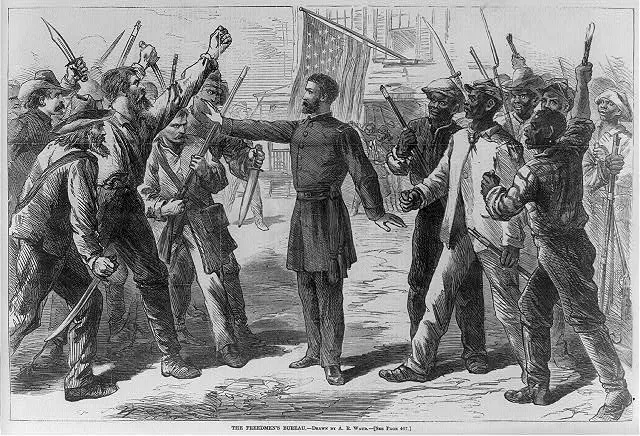
"The Freedmen's Bureau" / Library of Congress.
Following the end of the Civil War in 1865, many Southern states enacted laws called black codes. These laws were a type of legislation designed to control the rights and movements of newly freed African Americans. Although slavery had been abolished by the Thirteenth Amendment, restriction of freedom did not disappear. Instead, black codes created new obstacles and placed limits on where Black people could live, work, and travel.
The problem was rooted in the South’s economic and social structure. Many white landowners wanted to maintain a cheap labor force for their plantations and farms. The black codes required African Americans to sign yearly labor contracts. If they refused, they could be arrested, fined, or forced to work for no pay. In addition, the codes prohibited Black people from owning certain types of property, carrying weapons, or gathering after dark. These laws greatly limited the rights that African Americans were supposed to gain after emancipation.
For example, in Mississippi, the black codes stated that Black people could only work in certain jobs, such as farming or domestic labor. If they tried to find other employment, they could be punished. In Louisiana, special permits were required for Black people to live in towns, and harsh penalties were given for minor offenses. These measures were intended to keep African Americans in a lower social and economic position.
The federal government responded to these unjust laws. Congress passed the Civil Rights Act of 1866, aiming to protect the citizenship and equal rights of African Americans. Many in Congress believed the black codes violated the spirit of freedom and equality promised after the Civil War. As a result, the United States entered the period known as Reconstruction, during which the government supervised the South and required states to grant full rights to all citizens, regardless of race.
Despite these efforts, resistance continued. Some white Southerners used violence and intimidation to prevent African Americans from exercising their new rights. Groups such as the Ku Klux Klan formed to enforce segregation and maintain white supremacy. In response, African Americans and their allies pushed for further legal changes and organized to defend their communities.
The legacy of the black codes is complex. While they were eventually overturned by federal laws and constitutional amendments, their influence lasted for decades. They laid the groundwork for later segregation laws known as Jim Crow laws, which continued to affect the lives of African Americans well into the 20th century.
Interesting Fact: Some black codes included rules about clothing, such as prohibiting African Americans from wearing certain colors or styles, as a way to control social status.
When were black codes passed?
After the Civil WarBefore the Civil WarDuring World War IIIn the 1700s
What did black codes restrict?
Where Black people could workFood pricesVoting in the NorthRailroad building
Which amendment ended slavery?
ThirteenthFirstTenthTwenty-fifth
Why were black codes created?
To limit African American freedomTo end slaveryTo expand voting rightsTo support equal pay
What was one effect of black codes?
African Americans faced new obstaclesSlavery was restoredEqual rights were ensuredPlantations disappeared
How did the federal government respond?
Passed the Civil Rights ActIgnored the lawsSupported black codesBanned voting
Black codes were fair. True or false?
FalseTrue
What does 'prohibited' mean in the passage?
Not allowedCelebratedEncouragedRequired
Perfect For:
👩🏫 Teachers
• Reading comprehension practice
• Auto-graded assessments
• Literacy skill development
👨👩👧👦 Parents
• Reading practice at home
• Comprehension improvement
• Educational reading time
🏠 Homeschoolers
• Reading curriculum support
• Independent reading practice
• Progress monitoring
Reading Features:
📖
Reading Passage
Engaging fiction or nonfiction text
❓
Comprehension Quiz
Auto-graded questions
📊
Instant Feedback
Immediate results and scoring
📄
Printable Version
Download for offline reading
🔊
Read Aloud
Voice-over with word highlighting
Reviews & Ratings
No reviews yet. Be the first to share your experience!
Related Content
Freedmen's Bureau
This passage explores the origins, mission, and significance of the Freedmen's Bureau, a federal agency established duri...
HSS 8.11.2RI.6-8.1RI.6-8.2
Pocahontas: Myth vs. Historical Reality
This passage explores the nuanced history of Pocahontas, moving beyond the myth made popular by movies and stories. Stud...
HSS 5.3.1RI.6-8.1RI.6-8.8
Roger Williams Religious Freedom
This passage explores the life and legacy of Roger Williams, a key figure in Colonial America who was banished from Mass...
HSS 5.4.38.2.2RI.6-8.1RI.6-8.6
Benjamin Franklin in Colonial America
This U.S. History reading passage explores the life and influence of Benjamin Franklin, a key colonial leader whose idea...
HSS 5.58.1RI.6-8.1RI.6-8.3
Colonial Apprenticeship System
This comprehensive passage explores the Colonial Apprenticeship System and its role in education during Colonial America...
HSS 5.4.6RI.6-8.1RI.6-8.2
Colonial Printing Press
This passage explores the revolutionary impact of the colonial printing press in America, examining how it enabled the s...
HSS 5.58.1RI.6-8.1RI.6-8.2
Cities in Colonial America
This engaging U.S. history reading passage explores the rise of colonial American cities such as Boston, Philadelphia, a...
HSS 5.4.68.1RI.6-8.1RI.6-8.7
Frontier Life in Colonial America
This passage examines the realities of frontier life in colonial America, highlighting both the promise and peril faced ...
HSS 5.4.68.1RI.6-8.1RI.6-8.2
Mercy Otis Warren: Political Writer
This passage explores the life and impact of Mercy Otis Warren, a significant political writer during the American Revol...
HSS 5.6.38.1RI.6-8.1RI.6-8.6
Crispus Attucks
This comprehensive U.S. History reading passage examines the life and legacy of Crispus Attucks, the first person killed...
HSS 5.5.38.1RI.6-8.1RI.6-8.3
Lewis and Clark Expedition
This comprehensive U.S. History reading passage explores the Lewis and Clark Expedition (1804-1806), a pivotal journey l...
HSS 8.4.18.8.2RI.6-8.1RI.6-8.3
Exodusters
This passage explores the migration of Exodusters—African Americans who left the South in the 1870s to escape discrimina...
HSS 8.12.1RI.6-8.1RI.6-8.2
Uncle Tom's Cabin
This passage explores the impact of Harriet Beecher Stowe’s Uncle Tom’s Cabin on American society in the 1850s. It exami...
HSS 8.9.48.10.2RI.6-8.1RI.6-8.6
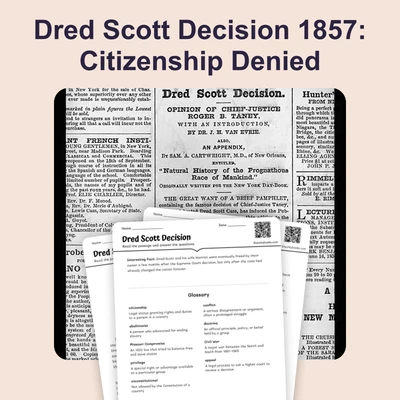
Dred Scott Decision
This rigorous history reading passage delves into the 1857 Dred Scott Decision, a pivotal moment in the lead-up to the C...
HSS 8.9.48.10.3RI.6-8.1RI.6-8.8
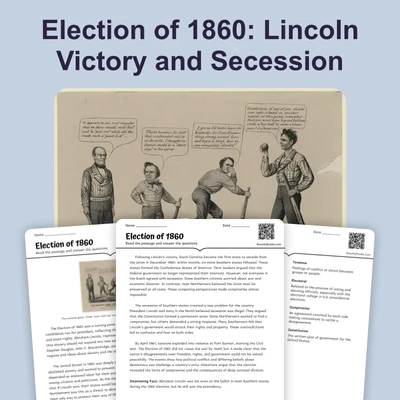
Election of 1860
This passage explores Abraham Lincoln’s election in 1860 and the critical reactions from Southern states, which set the ...
HSS 8.10.4RI.6-8.1RI.6-8.6
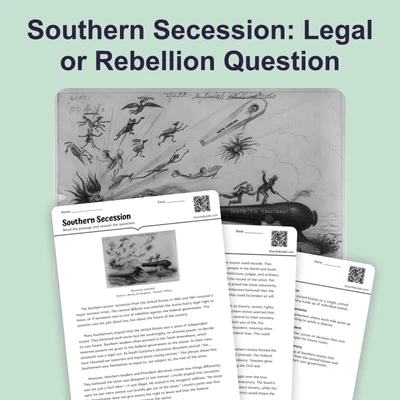
Southern Secession
This passage explores the significant moment in U.S. history when seven Southern states seceded from the Union after Abr...
HSS 8.10.4RI.6-8.1RI.6-8.2
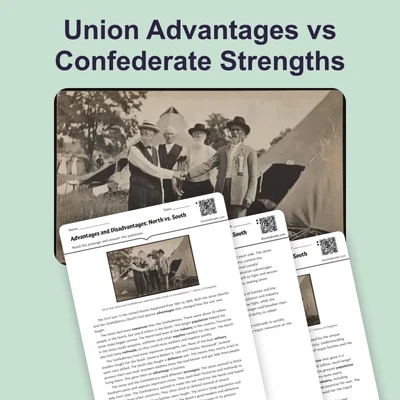
Advantages and Disadvantages: North vs. South
This history reading passage examines the contrasting strengths of the Union and Confederacy during the U.S. Civil War. ...
HSS 8.10.5RI.6-8.1RI.6-8.3
Emancipation Proclamation
This U.S. history passage explores the Emancipation Proclamation of 1863, an executive order issued by President Abraham...
HSS 8.10.6RI.6-8.1RI.6-8.3
Women's Roles in Civil War
This reading passage explores the critical roles women played during the U.S. Civil War, highlighting how they managed f...