This learning resource is available in interactive and printable formats. The interactive worksheet can be played online and assigned to students. The Printable PDF version can be downloaded and printed for completion by hand.
This passage explores the origins, mission, and significance of the Freedmen's Bureau, a federal agency established during the Reconstruction era after the U.S. Civil War. The Freedmen's Bureau aimed to help formerly enslaved people transition to freedom by providing food, medical care, legal assistance, and education. The text examines both the successes and challenges faced by the Bureau, highlighting the complexities of post-war America. Students will analyze cause-and-effect relationships and study how historical context influenced the Bureau's effectiveness. The reading passage includes a glossary of key terms, a timeline, and a variety of interactive activities, such as multiple-choice questions, writing prompts, and graphic organizers. Read-aloud audio and Spanish translation are available to support diverse learners. The lesson aligns with HSS 8.11.2 and Common Core standards RI.6-8.1 and RI.6-8.2, making it an ideal resource for history classrooms seeking rigorous, standards-based content.
CONTENT PREVIEW
Expand content preview
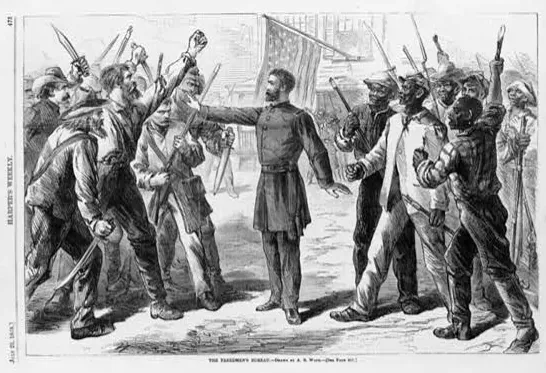
The Freedmen's Bureau was created by the United States government in 1865 to help formerly enslaved African Americans and poor white people in the South after the Civil War. This federal bureau, or government agency, faced a huge challenge: millions of people needed assistance as they began their transition from slavery to freedom. The Civil War had destroyed homes, farms, and communities. Many people had no food, shelter, or work. The Freedmen's Bureau was designed to address these urgent problems in the early years of Reconstruction.
One of the Bureau's first goals was to provide basic needs, such as food and medical care, to those suffering from war's devastation. Agents set up offices across the South to distribute rations and supplies. The Bureau also established hospitals and worked with the U.S. Army to treat people with injuries and diseases. However, the demand for these services often exceeded what the Bureau could supply. Resources were limited, and many communities remained in need.
Education was another major focus of the Freedmen's Bureau. Before the Civil War, laws in Southern states had made it illegal for enslaved people to learn to read or write. Now, the Bureau helped create thousands of schools for freedmen and their children. Teachers came from the North and South, and some were formerly enslaved people themselves. These schools taught reading, writing, and math. Education gave freed people new opportunities, but many white Southerners opposed Black education, sometimes threatening or attacking schools.
Legal assistance was also part of the Bureau's mission. Formerly enslaved people needed help making work contracts, finding family members, and defending their rights in court. The Bureau acted as a legal advocate, helping people secure fair pay for their labor and reunite with loved ones separated by slavery. In some cases, the Bureau intervened to stop violence against African Americans. However, local courts and officials often resisted the Bureau's efforts and did not always protect freed people's rights.
Despite its achievements, the Freedmen's Bureau faced many obstacles. It had limited funding and staff. Some white Southerners resented its presence and tried to block its work. Political changes in Washington, D.C., also affected the agency. The Bureau ended in 1872, less than a decade after it began, as the federal government reduced its involvement in Reconstruction. Even so, the Bureau left a lasting impact by helping millions during a difficult transition period in American history.
Interesting Fact: The Freedmen's Bureau helped establish over 4,000 schools across the South, educating approximately 250,000 African American children and adults during Reconstruction.
When was the Freedmen's Bureau created?
1865187218611880
What was a main goal of the Bureau?
Help with transition to freedomStart a new armyBuild factoriesWrite the Constitution
Who did the Freedmen's Bureau help?
Formerly enslaved peopleBritish soldiersNorthern businessmenOnly white Southerners
Why was education important for freed people?
It gave new opportunitiesIt was required by lawIt replaced farmingIt stopped the Civil War
What challenge did the Bureau face?
Limited resourcesToo much moneyNo need for helpToo many volunteers
How did some Southerners react to the Bureau?
Resented and opposed itCelebrated itIgnored itJoined as agents
The Freedmen's Bureau ended in 1872. True or false?
TrueFalse
What does 'assistance' mean?
Help or supportA type of schoolA new lawA place to live
Perfect For:
👩🏫 Teachers
• Reading comprehension practice
• Auto-graded assessments
• Literacy skill development
👨👩👧👦 Parents
• Reading practice at home
• Comprehension improvement
• Educational reading time
🏠 Homeschoolers
• Reading curriculum support
• Independent reading practice
• Progress monitoring
Reading Features:
📖
Reading Passage
Engaging fiction or nonfiction text
❓
Comprehension Quiz
Auto-graded questions
📊
Instant Feedback
Immediate results and scoring
📄
Printable Version
Download for offline reading
🔊
Read Aloud
Voice-over with word highlighting
Reviews & Ratings
No reviews yet. Be the first to share your experience!
Related Content
Black Codes
This engaging U.S. history reading passage examines the Black Codes—laws passed by Southern states after the Civil War t...
HSS 8.11.2RI.6-8.1RI.6-8.6
Pocahontas: Myth vs. Historical Reality
This passage explores the nuanced history of Pocahontas, moving beyond the myth made popular by movies and stories. Stud...
HSS 5.3.1RI.6-8.1RI.6-8.8
Roger Williams Religious Freedom
This passage explores the life and legacy of Roger Williams, a key figure in Colonial America who was banished from Mass...
HSS 5.4.38.2.2RI.6-8.1RI.6-8.6
Benjamin Franklin in Colonial America
This U.S. History reading passage explores the life and influence of Benjamin Franklin, a key colonial leader whose idea...
HSS 5.58.1RI.6-8.1RI.6-8.3
Colonial Apprenticeship System
This comprehensive passage explores the Colonial Apprenticeship System and its role in education during Colonial America...
HSS 5.4.6RI.6-8.1RI.6-8.2
Colonial Printing Press
This passage explores the revolutionary impact of the colonial printing press in America, examining how it enabled the s...
HSS 5.58.1RI.6-8.1RI.6-8.2
Cities in Colonial America
This engaging U.S. history reading passage explores the rise of colonial American cities such as Boston, Philadelphia, a...
HSS 5.4.68.1RI.6-8.1RI.6-8.7
Frontier Life in Colonial America
This passage examines the realities of frontier life in colonial America, highlighting both the promise and peril faced ...
HSS 5.4.68.1RI.6-8.1RI.6-8.2
Mercy Otis Warren: Political Writer
This passage explores the life and impact of Mercy Otis Warren, a significant political writer during the American Revol...
HSS 5.6.38.1RI.6-8.1RI.6-8.6
Crispus Attucks
This comprehensive U.S. History reading passage examines the life and legacy of Crispus Attucks, the first person killed...
HSS 5.5.38.1RI.6-8.1RI.6-8.3
Lewis and Clark Expedition
This comprehensive U.S. History reading passage explores the Lewis and Clark Expedition (1804-1806), a pivotal journey l...
HSS 8.4.18.8.2RI.6-8.1RI.6-8.3
Exodusters
This passage explores the migration of Exodusters—African Americans who left the South in the 1870s to escape discrimina...
HSS 8.12.1RI.6-8.1RI.6-8.2
Uncle Tom's Cabin
This passage explores the impact of Harriet Beecher Stowe’s Uncle Tom’s Cabin on American society in the 1850s. It exami...
HSS 8.9.48.10.2RI.6-8.1RI.6-8.6
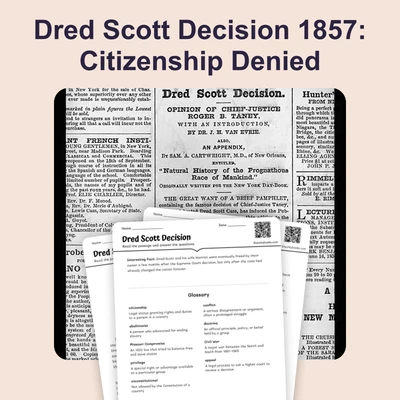
Dred Scott Decision
This rigorous history reading passage delves into the 1857 Dred Scott Decision, a pivotal moment in the lead-up to the C...
HSS 8.9.48.10.3RI.6-8.1RI.6-8.8
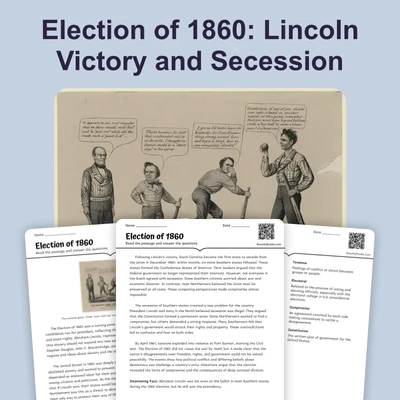
Election of 1860
This passage explores Abraham Lincoln’s election in 1860 and the critical reactions from Southern states, which set the ...
HSS 8.10.4RI.6-8.1RI.6-8.6
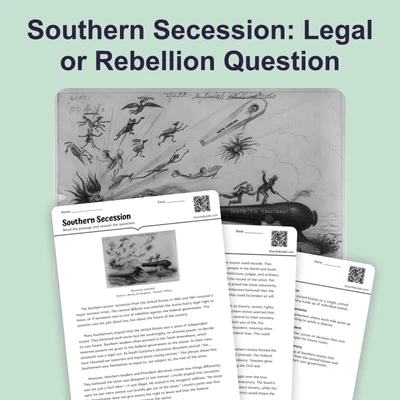
Southern Secession
This passage explores the significant moment in U.S. history when seven Southern states seceded from the Union after Abr...
HSS 8.10.4RI.6-8.1RI.6-8.2
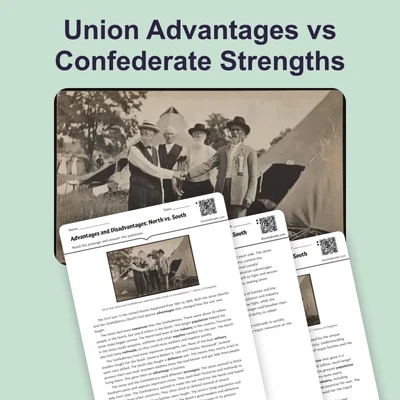
Advantages and Disadvantages: North vs. South
This history reading passage examines the contrasting strengths of the Union and Confederacy during the U.S. Civil War. ...
HSS 8.10.5RI.6-8.1RI.6-8.3
Emancipation Proclamation
This U.S. history passage explores the Emancipation Proclamation of 1863, an executive order issued by President Abraham...
HSS 8.10.6RI.6-8.1RI.6-8.3
Women's Roles in Civil War
This reading passage explores the critical roles women played during the U.S. Civil War, highlighting how they managed f...