Building the Berlin Wall
Interactive passage with audio narration, comprehension questions, and printable PDF.
By completing this purchase you agree to our Terms of Use and Privacy Policy. Your subscription renews automatically until you cancel. You can cancel anytime from your account settings. All sales are final and non-refundable. Digital content is available for download in your account immediately upon purchase.
What's included
Building the Berlin Wall preview and details
About this printable Building the Berlin Wall reading passage (Grades 5-8)
Sample passage and quiz from Building the Berlin Wall
Reading passage and comprehension quiz preview
The Berlin Wall: Symbol of a Divided World
![[Berlin Wall Feb. 1990]](https://assets.workybooks.com/INTERACTIVE/media/pd--Berlin-Wall-Feb--1990--1763136569881-538968018.webp)
The Berlin Wall stood as one of the most powerful symbols of the Cold War. Built in 1961, the Wall divided the city of Berlin, Germany, into East and West. For nearly 30 years, it separated families, friends, and a nation. The Berlin Wall was more than just a physical barrier—it represented the struggle between two different political systems and the impact of ideologies on daily life.
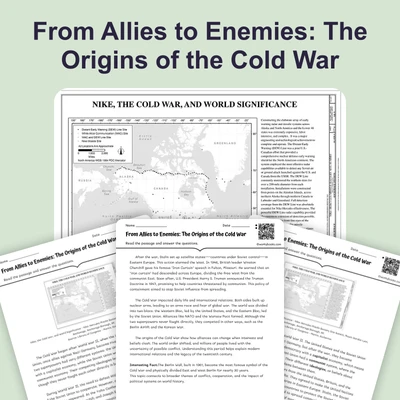
After World War II ended in 1945, Germany was divided into four occupation zones controlled by the United States, the Soviet Union, Britain, and France. Berlin, located deep inside the Soviet zone, was also divided among the four powers. As tensions grew between the United States and the Soviet Union, a period called the Cold War began. The United States and its allies supported democracy and capitalism, while the Soviet Union promoted communism. By 1949, Germany split into two countries: West Germany (Federal Republic of Germany), supported by the West, and East Germany (German Democratic Republic), controlled by the Soviets. Berlin itself was divided into East and West, even though West Berlin was surrounded by communist East Germany.
Life in East and West Berlin became very different. West Berlin was known for its freedom, economic growth, and connection with the West. East Berlin, under communist control, had strict restrictions on travel and speech. By the late 1950s, thousands of people were escaping from East to West Berlin every year, seeking better opportunities and freedoms. The East German government, with Soviet support, decided to stop this "brain drain". On August 13, 1961, soldiers began building the Berlin Wall overnight. Barbed wire and concrete blocks quickly split the city. Families woke up to find themselves cut off from loved ones, and many buildings were divided in half.
The Wall stretched for over 100 miles, with watchtowers, armed guards, and a "death strip" where anyone trying to flee risked their life. Despite the dangers, more than 5,000 people attempted to escape over the years. Some succeeded, using tunnels or hiding in vehicles, while others were caught or killed. The Wall became a focus of international attention. In 1963, U.S. President John F. Kennedy visited West Berlin and declared, "Ich bin ein Berliner," showing Western support for the city's freedom. Meanwhile, East German leaders insisted the Wall protected their society from Western "influence." Diaries and letters from Berliners reveal pain, separation, and hope during this period.
The Berlin Wall stood until November 9, 1989, when political change swept across Eastern Europe. Peaceful protests and growing demand for freedom forced East German leaders to open the borders. Crowds of East and West Berliners celebrated as they tore down the Wall, reuniting a city and symbolizing the end of the Cold War. Today, only small parts of the Wall remain, serving as reminders of how physical and ideological barriers can shape history.
The story of the Berlin Wall helps us understand the impact of political divisions, the value of freedom, and the ways ordinary people shape history. It connects to larger themes of human rights, government, and the struggle for unity in a divided world.
Interesting Fact: The Berlin Wall was not one continuous wall at first—it began as barbed wire and fences, then was rebuilt over four times into a concrete barrier up to 12 feet high.
Comprehension quiz (8 questions)
1. When was the Berlin Wall built?
2. Which city did the Berlin Wall divide?
3. Who gave the 'Ich bin ein Berliner' speech?
4. Why was the Berlin Wall built?
5. What happened in 1989?
6. What did East German leaders claim?
7. The Berlin Wall lasted almost 30 years. True or False?
8. What is 'capitalism'?
Perfect for the way you teach
- Build comprehension skills
- Auto-graded quiz
- Differentiated reading
- Read together at home
- Improve fluency
- Quiet reading time
- Reading curriculum support
- Independent practice
- Track Lexile growth