Calculating Aphelion: Kepler's Laws of Planetary Motion
Interactive passage with audio narration, comprehension questions, and printable PDF.
By completing this purchase you agree to our Terms of Use and Privacy Policy. Your subscription renews automatically until you cancel. You can cancel anytime from your account settings. All sales are final and non-refundable. Digital content is available for download in your account immediately upon purchase.
What's included
Calculating Aphelion: Kepler's Laws of Planetary Motion preview and details
About this printable Calculating Aphelion: Kepler's Laws of Planetary Motion science reading passage, NGSS-aligned (Grade 6)
Sample passage and quiz from Calculating Aphelion: Kepler's Laws of Planetary Motion
Reading passage and comprehension quiz preview
Calculating Aphelion: Kepler's Laws of Planetary Motion
Have you ever wondered why seasons change or why our planet moves the way it does around the Sun? The answers lie in something called Kepler's Laws of Planetary Motion. These laws, created by a brilliant scientist named Johannes Kepler, help us understand how planets orbit the Sun, and they're super important for studying our solar system.
First, let's talk about an orbit. An orbit is the curved path an object in space takes around another object due to gravity. Think of the Earth moving around the Sun. That path is Earth's orbit. For a long time, people thought planets moved in perfect circles. But Kepler discovered that orbits are actually shaped like an ellipse. An ellipse is like a stretched-out circle, sort of like a flattened oval.
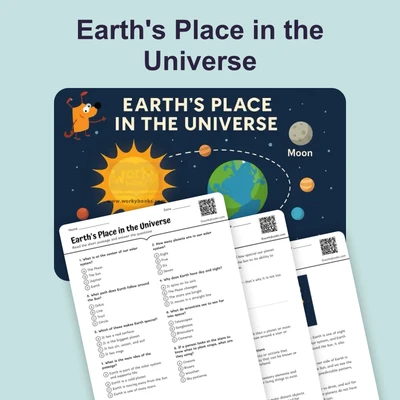
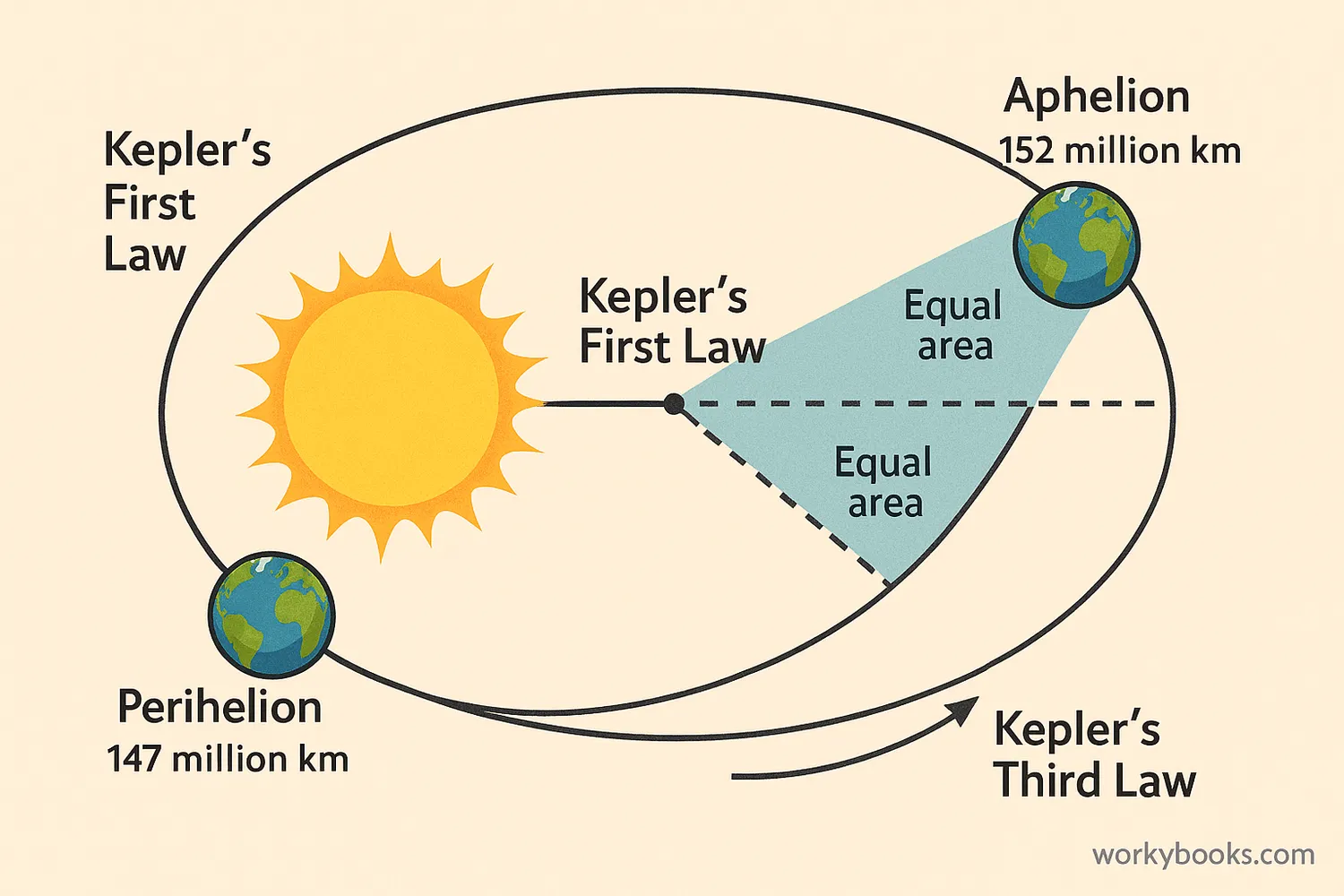
Because Earth's orbit is an ellipse, its distance from the Sun changes throughout the year. There are two special points in every planet's orbit: aphelion and perihelion. Aphelion is the point in a planet's orbit when it is farthest from the Sun. Think 'A' for 'Away' from the Sun. For Earth, aphelion happens around early July. At this time, Earth is about 152 million kilometers (about 94.5 million miles) from the Sun. Even though it's summer in the Northern Hemisphere, Earth is actually farthest from the Sun! This shows that our seasons are not caused by our distance from the Sun, but by the tilt of Earth's axis.
On the other hand, perihelion is the point in a planet's orbit when it is closest to the Sun. Think 'P' for 'Proximity' or 'Pretty close.' For Earth, perihelion occurs around early January. At this point, Earth is about 147 million kilometers (about 91.4 million miles) from the Sun. It's interesting because this happens during winter in the Northern Hemisphere.
Kepler's First Law states that planets orbit the Sun in an ellipse, with the Sun at one of the two foci (plural of focus) of the ellipse. Imagine drawing an ellipse with two thumbtacks and a string; the thumbtacks are the foci. The Sun isn't exactly in the center of the ellipse, but at one of these special points.
Kepler's Second Law talks about how fast a planet moves. It says that a line connecting a planet to the Sun sweeps out equal areas in equal times. This means that when a planet is closer to the Sun (at perihelion), it moves faster. When it's farther away (at aphelion), it moves slower. This makes sense because gravitational pull is stronger when objects are closer together.
Kepler's Third Law compares the orbits of different planets. It says that the square of a planet's orbital period (the time it takes to go around the Sun once) is proportional to the cube of the average distance from the Sun. This law helps scientists understand the relationship between a planet's distance and how long its year is.
So, when we talk about calculating aphelion, we're really thinking about understanding these elliptical orbits and how gravity influences them. Thanks to Kepler, we have a clear picture of how planets like Earth move through space, always following their predictable, elliptical paths around our Sun. This knowledge is a cornerstone of astronomy and helps us develop models of the solar system.
Fun Fact: Pluto, once considered a planet, has a very elliptical orbit, which means its aphelion and perihelion distances from the Sun vary much more dramatically than Earth's.
Comprehension quiz (10 questions)
1. Who created the Laws of Planetary Motion?
2. What is the shape of a planet's orbit?
3. What causes a planet to orbit another object?
4. Which point is Earth farthest from the Sun?
5. When is Earth closest to the Sun?
6. How does Earth's speed change in orbit?
7. What does Kepler's First Law describe?
8. What is the Sun's position in an ellipse?
9. What concept explains Earth's seasons?
10. Why is Pluto's orbit mentioned as an example?
Perfect for the way you teach
- Build comprehension skills
- Auto-graded quiz
- Differentiated reading
- Read together at home
- Improve fluency
- Quiet reading time
- Reading curriculum support
- Independent practice
- Track Lexile growth