Chemical Bonding
Interactive passage with audio narration, comprehension questions, and printable PDF.
By completing this purchase you agree to our Terms of Use and Privacy Policy. Your subscription renews automatically until you cancel. You can cancel anytime from your account settings. All sales are final and non-refundable. Digital content is available for download in your account immediately upon purchase.
What's included
Chemical Bonding preview and details
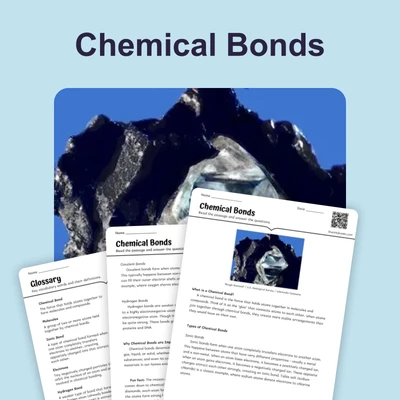
About this printable Chemical Bonding science reading passage, NGSS-aligned (Grades 5-8)
Sample passage and quiz from Chemical Bonding
Reading passage and comprehension quiz preview
Chemical Bonding
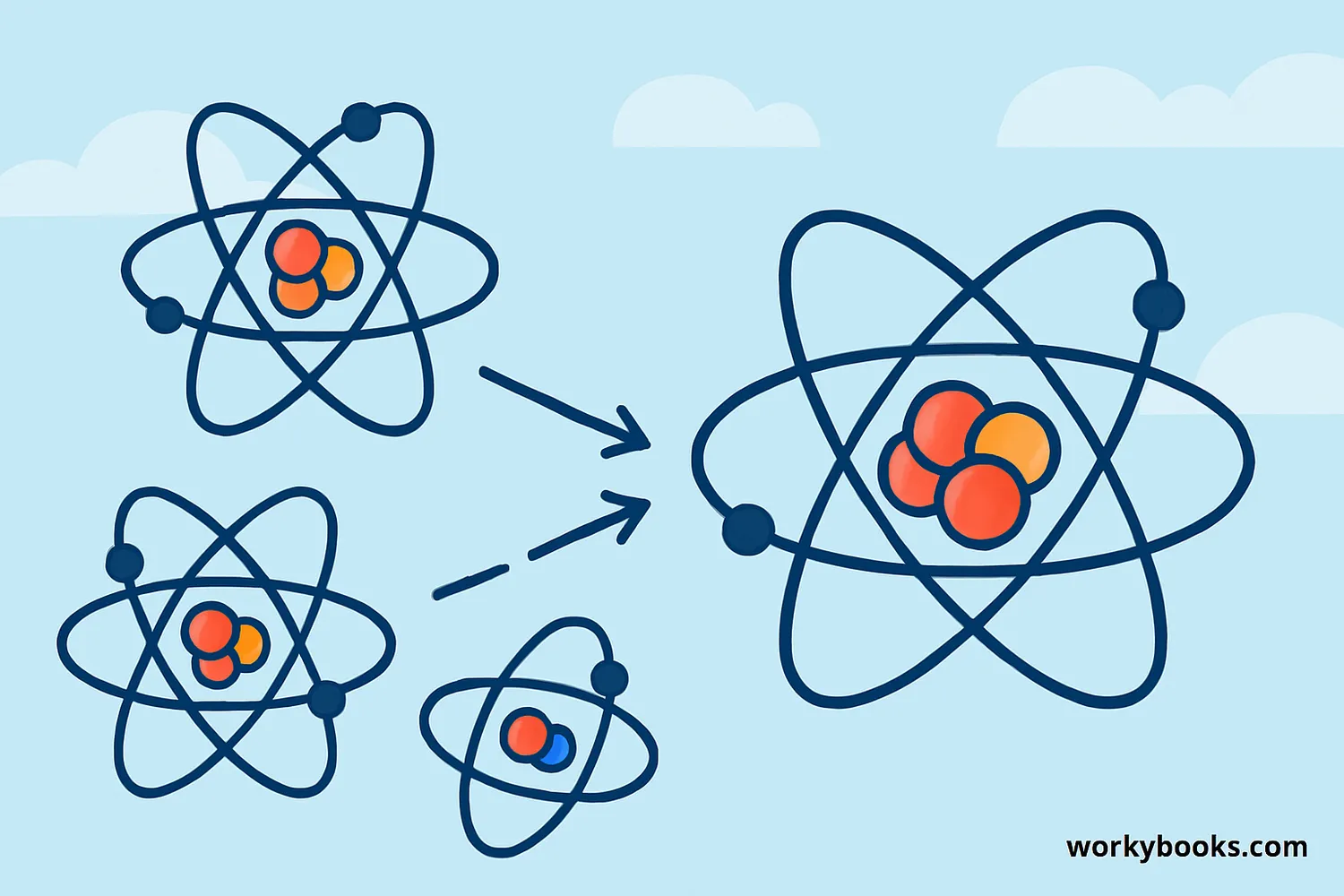
Chemical bonding determines the physical properties of almost every material we encounter. When salt crystals shatter under pressure, or copper wires bend without breaking, these behaviors result from interactions at the atomic level. Understanding the types of bonds that hold atoms together allows scientists to predict and explain the properties of substances found in nature and technology.
How Bond Type Determines Properties
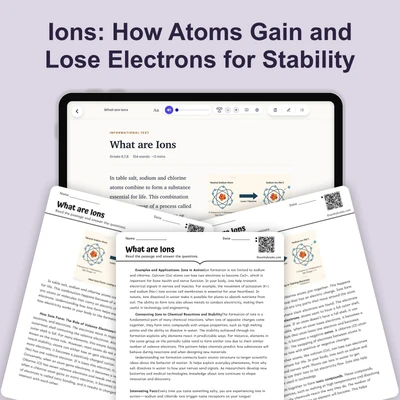
Atoms can join together by forming different types of bonds: ionic, covalent, and metallic. In an ionic bond, one atom transfers electrons to another, creating charged particles called ions. These ions are strongly attracted to each other, forming a rigid and organized structure. Table salt (sodium chloride) is a classic example. The strength of these attractions leads to a high melting point—over 800°C—and makes the solid brittle. However, ionic compounds can conduct electricity when dissolved in water, because their ions are free to move.
Covalent bonds form when atoms share electrons. This type of bond creates molecules like water or sugar. Covalent compounds usually have lower melting points than ionic compounds, and most do not conduct electricity well. Their molecules are held together by weaker forces, so substances like sugar melt easily and do not shatter like salt.
Metals are held together by metallic bonds, where electrons move freely among atoms. This "sea of electrons" explains why metals like copper are good conductors of electricity and heat. Metallic bonds also make metals malleable, allowing them to be hammered into sheets or drawn into wires without breaking.
Predicting Properties and Real-World Applications
Understanding bond types helps scientists and engineers predict the properties of new materials. For example, if a substance is found to be a poor conductor and melts at a low temperature, it is likely covalent. If a crystal shatters easily and only conducts electricity when dissolved, it is probably ionic. This knowledge is used in designing everything from safe cooking pans (metals with high melting points) to batteries (ionic compounds that move ions).
Recent research in materials science uses these principles to develop new materials with customized properties. For instance, scientists have designed metallic alloys for jet engines that resist both heat and pressure. Meanwhile, new ionic compounds are being explored for use in energy storage devices, like advanced batteries, because of their ability to conduct ions efficiently.
Complexities and Exceptions
While these rules explain most materials, there are exceptions. Some ionic compounds, like lithium fluoride, are not very soluble and do not conduct well in water. Some metals, like mercury, are liquid at room temperature. Scientists test materials and analyze their atomic structure to understand these exceptions and improve predictions.
In summary, the type of chemical bond—ionic, covalent, or metallic—controls how a substance behaves, from its melting point to its ability to carry electricity. These patterns guide scientists in choosing and inventing materials for specific jobs, connecting the atomic world to technology, health, and everyday life.
Interesting Fact: Diamonds, which are made entirely of covalently bonded carbon atoms, are the hardest natural substance on Earth!
Comprehension quiz (10 questions)
1. Which type of bond is found in table salt?
2. What property do metallic bonds give to metals like copper?
3. Which property is typical of covalent compounds?
4. What does the term 'malleable' mean as used in the passage?
5. Why do ionic compounds conduct electricity when dissolved in water?
6. Which of the following is an example of a real-world application that uses knowledge of bonding?
7. Based on the passage, what would you predict about a substance that melts easily and does not conduct electricity?
8. True or False: All ionic compounds easily dissolve in water and conduct electricity.
9. True or False: The type of chemical bond affects how a material acts in the real world.
10. What is an ion?
Perfect for the way you teach
- Build comprehension skills
- Auto-graded quiz
- Differentiated reading
- Read together at home
- Improve fluency
- Quiet reading time
- Reading curriculum support
- Independent practice
- Track Lexile growth