Chromosomes, Genes, and Traits
Interactive passage with audio narration, comprehension questions, and printable PDF.
What's included
Chromosomes, Genes, and Traits preview and details
About this printable Chromosomes, Genes, and Traits science reading passage, NGSS-aligned (Grades 5-8)
Sample passage and quiz from Chromosomes, Genes, and Traits
Reading passage and comprehension quiz preview
Chromosomes, Genes, and Traits

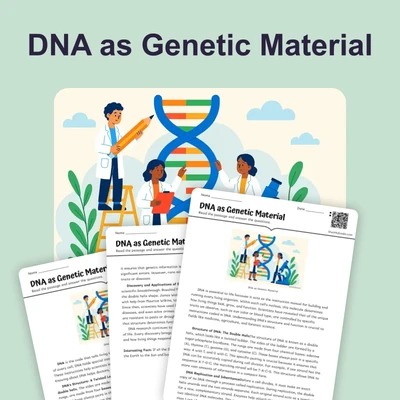
"3D visualization of a double-stranded DNA molecule" by Vika_Glitter / Pixabay.
Human traits—like eye color, hair type, and blood type—are the result of complex biological systems. Scientists have discovered that the instructions for these traits are stored inside each cell in the form of DNA. Understanding how DNA, chromosomes, and genes work together helps explain why people inherit certain characteristics from their parents.
DNA, or deoxyribonucleic acid, is a long molecule that contains the genetic code for all living things. In humans, DNA is tightly coiled into structures called chromosomes. Each human cell has 46 chromosomes, arranged in 23 pairs. These chromosomes carry thousands of genes. A gene is a segment of DNA that provides instructions for making a specific protein. These proteins are responsible for building and controlling the body’s structures and functions, from eye color to blood type. For example, the gene that codes for hemoglobin, the protein in red blood cells, is located on chromosome 11. If the gene's sequence changes, it can affect how much or what type of protein is made, leading to different traits.
How Genes and Alleles Influence Traits
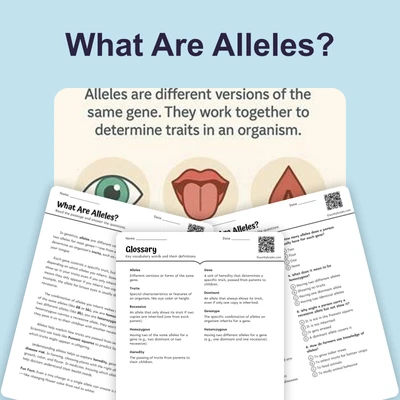
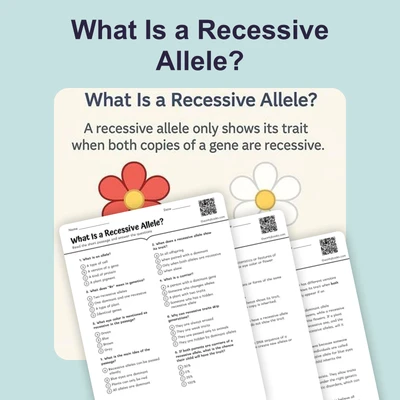
Each gene exists in slightly different forms called alleles. An allele is a version of a gene. For example, the gene for eye color has several alleles, such as one for brown eyes and one for blue eyes. A person inherits two alleles for each gene—one from each parent. Sometimes, one allele is dominant (shows its trait even if only one copy is present), while another is recessive (only shows if both copies are the same). This is why two brown-eyed parents can have a blue-eyed child if both carry the blue eye allele.
Genes, Proteins, and Complex Traits
Genes act as blueprints for making proteins, which determine traits. Some traits, like blood type, are controlled by a single gene with a few alleles. Other traits, such as height or skin color, involve many genes working together—a situation called polygenic inheritance. Environmental factors, like nutrition, can also affect how these genes are expressed. For instance, a child may inherit genes for tall height, but poor nutrition can prevent them from reaching their genetic potential.
Scientists use data from family studies, experiments, and DNA analysis to understand how genes, alleles, and chromosomes shape traits. This research helps explain inherited diseases, predict genetic risks, and develop new medical treatments.
Real-World Applications and Broader Implications
Understanding genes and chromosomes has many practical benefits. Genetic testing can identify inherited disorders, help parents understand risks before having children, and guide doctors in choosing the best treatments. Research on genes also aids in developing gene therapies for diseases like cystic fibrosis and sickle cell anemia. The study of how genes, alleles, and proteins interact is central to biology, medicine, and agriculture.
By learning about the roles of DNA, chromosomes, genes, and alleles, students can appreciate the systems that make each person unique.
Interesting Fact: If you stretched out all the DNA in a single human cell, it would be about two meters long, but it fits inside a nucleus only a few micrometers wide!
Comprehension quiz (10 questions)
1. What is the main function of a gene?
2. Where are chromosomes located in a human cell?
3. How many pairs of chromosomes are found in a typical human cell?
4. What is an allele?
5. What does 'polygenic inheritance' mean?
6. Based on the passage, why can two brown-eyed parents have a blue-eyed child?
7. If a protein is not made correctly due to a change in a gene, what can happen?
8. Why is understanding genetics important for medicine?
9. True or False: An allele is always visible in a person's traits.
10. True or False: Proteins are made by genes and determine traits.
Perfect for the way you teach
- Build comprehension skills
- Auto-graded quiz
- Differentiated reading
- Read together at home
- Improve fluency
- Quiet reading time
- Reading curriculum support
- Independent practice
- Track Lexile growth