This learning resource is available in interactive and printable formats. The interactive worksheet can be played online and assigned to students. The Printable PDF version can be downloaded and printed for completion by hand.
This engaging 350-word science passage introduces Grade 4-5 students to the compass rose, a fundamental map-reading tool. Aligned with NGSS standard 4-ESS2-2, the passage explains how the compass rose displays the four cardinal directions—north, south, east, and west—and helps us navigate using maps. Students learn how to use directional language to describe locations and give directions, connecting abstract map concepts to real-world applications like finding their way to school or describing their neighborhood. The passage includes audio integration for enhanced accessibility, making it perfect for diverse learners. Through concrete analogies and familiar examples, students discover how the compass rose serves as a universal guide for understanding spatial relationships. The content features bolded key vocabulary terms with immediate definitions, multiple-choice comprehension questions, writing activities, and graphic organizers that reinforce understanding of directional concepts and map reading skills essential for scientific observation and geographic literacy.
CONTENT PREVIEW
Expand content preview
Compass Rose
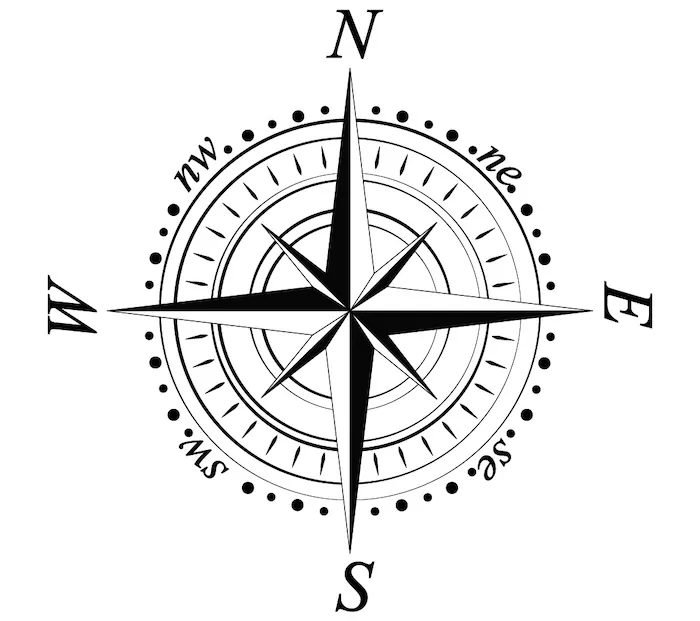
Maps are tools that help us find places and understand where things are located. Every good map includes a special symbol called a compass rose. A compass rose is a drawing on a map that shows the four main directions: north, south, east, and west. This symbol looks like a star or flower with arrows pointing in different directions. The compass rose helps you figure out which way to look or travel when using a map.
The four main directions shown on a compass rose are called cardinal directions. Cardinal directions are the four basic ways you can face or move: north, south, east, and west. North always points toward the top of most maps. South points toward the bottom. East points to the right, and west points to the left. Think of the compass rose like the hands on a clock—each direction has its own special place that never changes. On the compass rose, the letter N marks north, S marks south, E marks east, and W marks west.
Understanding directions helps you describe where things are on a map. If your school is above your house on the map, you would say your school is north of your house. North means toward the top of the map or in the direction the N on the compass rose points. If a park is to the right of your school on the map, the park is east of your school. East means toward the right side of the map. You can use these direction words to tell someone exactly where to find something.
The compass rose also helps you give directions to other people. Imagine you want to tell a friend how to walk from school to the library. You might say, "Walk two blocks north, then turn east and walk one more block." These directions are much clearer than saying "go up and then go that way." Using north, south, east, and west makes your directions easier to understand because everyone knows what those words mean when they look at the compass rose.
People use compass roses and directions in many everyday situations. Mail carriers use directions to deliver letters to the right houses. Pilots use directions to fly airplanes to the correct cities. Even video games use compass roses to help players know which way their characters are facing! When you tell someone how to get to your house, you're using the same directional thinking that explorers and scientists use. Park rangers use directions to guide hikers on trails. Emergency workers use them to find people who need help quickly.
Interesting Fact: The compass rose got its name because early sailors thought the design looked like a blooming rose flower, and it helped them navigate across oceans before GPS existed!
What is a compass rose?
A type of flower that grows on mapsA symbol showing four main directionsA tool for drawing circlesA special kind of map
What are the four cardinal directions?
Up, down, left, and rightForward, backward, sideways, and diagonalNorth, south, east, and westTop, bottom, middle, and corner
Which direction points to the top of maps?
SouthEastWestNorth
If a park is east of school, where is it?
To the left of the schoolTo the right of the schoolAbove the schoolBelow the school
Why is using north, south, east, and west better?
They sound more scientific and fancyEveryone understands what they meanThey are shorter words to sayThey only work on paper maps
Who uses directions in their everyday work?
Only ship captains and airplane pilotsMail carriers, pilots, and park rangersOnly people who make mapsOnly scientists and explorers
TrueFalse
What does the word 'cardinal' mean in this passage?
A type of red birdThe four basic or main directionsA religious leaderA number on a map
Perfect For:
👩🏫 Teachers
• Reading comprehension practice
• Auto-graded assessments
• Literacy skill development
👨👩👧👦 Parents
• Reading practice at home
• Comprehension improvement
• Educational reading time
🏠 Homeschoolers
• Reading curriculum support
• Independent reading practice
• Progress monitoring
Reading Features:
📖
Reading Passage
Engaging fiction or nonfiction text
❓
Comprehension Quiz
Auto-graded questions
📊
Instant Feedback
Immediate results and scoring
📄
Printable Version
Download for offline reading
🔊
Read Aloud
Voice-over with word highlighting
Reviews & Ratings
No reviews yet. Be the first to share your experience!
Related Content
Map Symbols
This engaging 350-word science passage introduces Grade 4-5 students to the concept of map symbols and their importance ...
NGSS 4-ESS2-2
What Are Maps
This engaging 350-word science passage introduces Grade 4-5 students to the concept of maps as flat drawings that repres...
NGSS 4-ESS2-2
Canyons and Valleys
This engaging 350-word science passage helps Grade 4-5 students understand how canyons and valleys form through the proc...