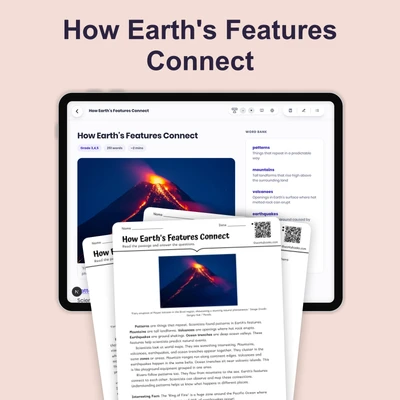
This learning resource is available in interactive and printable formats. The interactive worksheet can be played online and assigned to students. The Printable PDF version can be downloaded and printed for completion by hand.
This engaging 250-word reading passage introduces fourth-grade students to topographic maps and how they represent Earth's surface features. Aligned with NGSS standard 4-ESS2-2 and the Disciplinary Core Idea ESS2.B: Plate Tectonics and Large-Scale System Interactions, the passage explains how contour lines connect points of equal elevation above sea level. Students discover how the spacing of these lines reveals whether land is steep or gently sloping. The passage uses age-appropriate language and relatable examples to help students understand why scientists, engineers, and city planners use topographic maps to study landforms and make important decisions about construction projects. Audio integration supports diverse learners by providing text-to-speech functionality, making the content accessible to students with different reading abilities. The accompanying activities include comprehension questions, writing prompts, and graphic organizers that reinforce understanding of map features, elevation concepts, and real-world applications. This resource builds foundational knowledge about how two-dimensional maps can represent three-dimensional landforms, preparing students for hands-on map reading activities and deeper exploration of Earth's surface processes.
A topographic map is a special kind of map that shows the shape and height of the land. Regular maps show roads, cities, and rivers, but topographic maps also show whether the ground is flat, hilly, or mountainous. These maps help us understand what the land looks like even when we cannot see it in person.
Topographic maps use curved lines called contour lines. Each contour line connects all the points that are at the same height above sea level, which is the level of the ocean's surface. Think of it like the rings you see when you stack plates—each ring is at a different height. When contour lines are close together, the land is steep, like a tall hill or mountain. When the lines are far apart, the land is flat or has a gentle slope, like a field.
Scientists called geologists use topographic maps to study landforms such as valleys, hills, and mountains. Engineers use these maps to decide where to build roads and buildings. City planners look at topographic maps to see if land will flood during heavy rain. These maps turn the three-dimensional world into something we can study on a flat piece of paper.
Interesting Fact: The highest point on Earth is Mount Everest, which rises 29,032 feet above sea level. On a topographic map, you would see hundreds of contour lines packed very close together to show how steep this mountain is!
What do topographic maps show?
Only roads and citiesShape and height of landOnly rivers and lakesWeather patterns
What are contour lines?
Lines showing roads on mapsLines connecting same height pointsLines showing city boundariesLines marking rivers
What does sea level mean?
The top of mountainsThe bottom of valleysThe ocean's surface levelThe height of buildings
Close contour lines mean steep land.
TrueFalse
What do geologists study using these maps?
Weather and climate patternsLandforms like valleys and mountainsOcean currents and tidesAnimal migration routes
Why do engineers use topographic maps?
To predict weatherTo decide where to buildTo study animalsTo measure ocean depth
What do far apart lines show?
Very steep mountainsDeep valleysFlat or gentle slopesTall cliffs
Which word means land at sharp angle?
FlatGentleSteepLevel
Perfect For:
👩🏫 Teachers
• Reading comprehension practice
• Auto-graded assessments
• Literacy skill development
👨👩👧👦 Parents
• Reading practice at home
• Comprehension improvement
• Educational reading time
🏠 Homeschoolers
• Reading curriculum support
• Independent reading practice
• Progress monitoring
Reading Features:
📖
Reading Passage
Engaging fiction or nonfiction text
❓
Comprehension Quiz
Auto-graded questions
📊
Instant Feedback
Immediate results and scoring
📄
Printable Version
Download for offline reading
🔊
Read Aloud
Voice-over with word highlighting
Reviews & Ratings
No reviews yet. Be the first to share your experience!
Related Content
Map Symbols
This engaging 350-word science passage introduces Grade 4-5 students to the concept of map symbols and their importance ...
NGSS 4-ESS2-2
Compass Rose
This engaging 350-word science passage introduces Grade 4-5 students to the compass rose, a fundamental map-reading tool...
NGSS 4-ESS2-2
What Are Maps
This engaging 350-word science passage introduces Grade 4-5 students to the concept of maps as flat drawings that repres...
NGSS 4-ESS2-2
Canyons and Valleys
This engaging 350-word science passage helps Grade 4-5 students understand how canyons and valleys form through the proc...
NGSS 4-ESS2-2
What Are Ocean Floor Maps
This Grade 4 science reading passage introduces students to ocean floor maps and how scientists create them using sonar ...
NGSS 4-ESS2-2
How to Read Data from Maps
This 250-word reading passage introduces fourth-grade students to the essential skill of reading data from maps, aligned...
NGSS 4-ESS2-2
Maps Show Patterns
This engaging 250-word reading passage introduces fourth-grade students to the concept of identifying patterns on maps a...
NGSS 4-ESS2-2ESS2.B
Earth's Land and Water
This 250-word reading passage introduces fourth-grade students to the fundamental concept of how land and water are dist...
NGSS 4-ESS2-2ESS2.B
What Are Mountains
This 250-word reading passage introduces fourth-grade students to mountains as one of Earth's most dramatic landforms. A...
NGSS 4-ESS2-2ESS2.B
Mountain Patterns on Earth
This 250-word reading passage introduces fourth-grade students to mountain patterns on Earth, aligned with NGSS standard...
NGSS 4-ESS2-2
Plains and Plateaus
This Grade 4 science reading passage explores plains and plateaus, two common landforms found across Earth's surface. Al...
NGSS 4-ESS2-2
Rivers and Water Features
This 250-word reading passage introduces fourth-grade students to rivers and water features as outlined in NGSS 4-ESS2-2...
NGSS 4-ESS2-2ESS2.B
Volcano Patterns on Earth
This Grade 4 science reading passage introduces students to volcano patterns on Earth, aligned with NGSS standard 4-ESS2...
NGSS 4-ESS2-2
Earthquake Patterns on Earth
This engaging 250-word reading passage introduces fourth-grade students to earthquake patterns on Earth, aligned with NG...
NGSS 4-ESS2-2
Ocean Trenches
This engaging 250-word reading passage introduces fourth-grade students to ocean trenches, the deepest parts of Earth's ...
NGSS 4-ESS2-2
How Earth's Features Connect
This engaging 250-word reading passage introduces fourth-grade students to the fascinating patterns connecting Earth's m...