Ocean Trenches
Interactive passage with audio narration, comprehension questions, and printable PDF.
By completing this purchase you agree to our Terms of Use and Privacy Policy. Your subscription renews automatically until you cancel. You can cancel anytime from your account settings. All sales are final and non-refundable. Digital content is available for download in your account immediately upon purchase.
What's included
Ocean Trenches preview and details
About this printable Ocean Trenches science reading passage, NGSS-aligned (Grades 3-5)
Sample passage and quiz from Ocean Trenches
Reading passage and comprehension quiz preview
Ocean Trenches
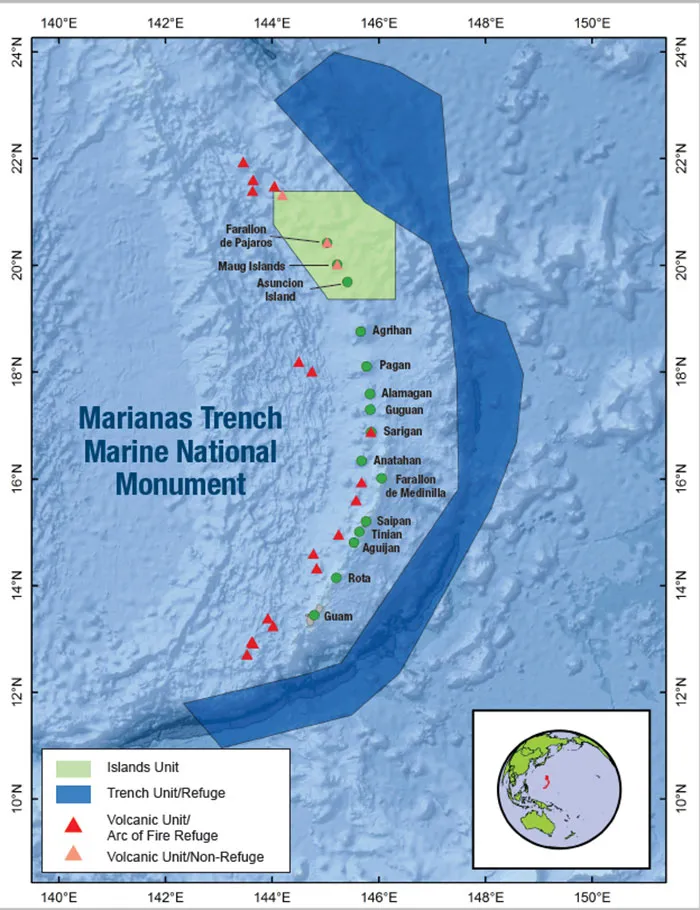
"Map Marianas Trench Marine National Monument" by NOAA / Wikimedia Commons.
An ocean trench is the deepest part of the ocean. Ocean trenches are long, narrow valleys on the ocean floor that drop far below the surrounding seabed—the bottom surface of the ocean. Understanding ocean trenches helps scientists learn about the shape and structure of Earth's surface beneath the water.
The Mariana Trench in the Pacific Ocean is the deepest place on Earth. It reaches down about 36,000 feet below sea level. That is deeper than Mount Everest is tall! If you could put Mount Everest inside the Mariana Trench, the mountain's peak would still be more than a mile underwater.
Ocean trenches are not scattered randomly across the ocean floor. They form patterns. Many trenches appear near chains of islands or along the edges of continents—the large land masses like North America or Asia. When scientists look at maps of the ocean floor, they notice something important. Trenches follow the same zones where volcanoes erupt and earthquakes happen.
This pattern is not a coincidence. Trenches, volcanoes, and earthquakes all occur in the same areas because they are connected to the movement of Earth's outer layer. By studying where trenches are located, scientists can better understand how our planet changes over time.
Interesting Fact: If you could drain all the water from the oceans, you would see that ocean trenches look like giant scars or cracks running across the ocean floor!
Comprehension quiz (8 questions)
1. What is an ocean trench?
2. Where is the Mariana Trench located?
3. How deep is the Mariana Trench?
4. Why do trenches and volcanoes occur together?
5. Where do ocean trenches often appear?
6. What pattern do scientists notice about trenches?
7. Ocean trenches are randomly scattered across the ocean floor.
8. What does seabed mean?
Perfect for the way you teach
- Build comprehension skills
- Auto-graded quiz
- Differentiated reading
- Read together at home
- Improve fluency
- Quiet reading time
- Reading curriculum support
- Independent practice
- Track Lexile growth