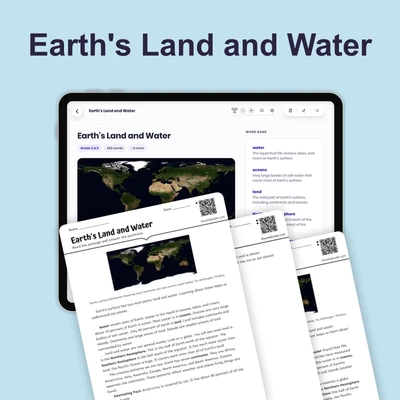
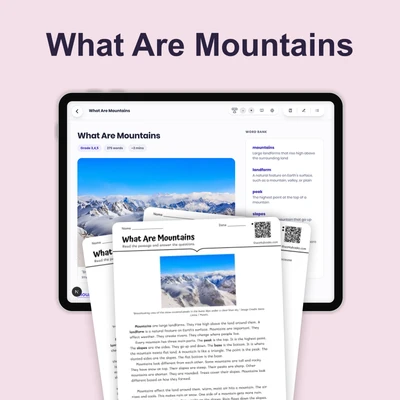
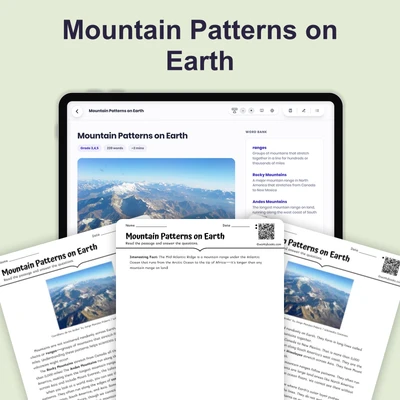
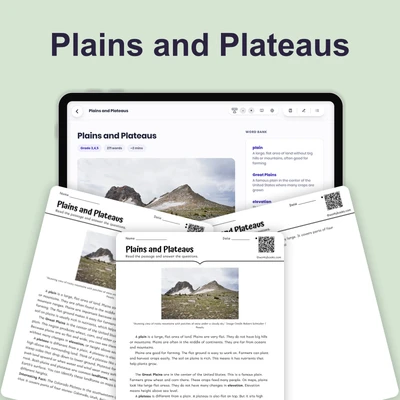
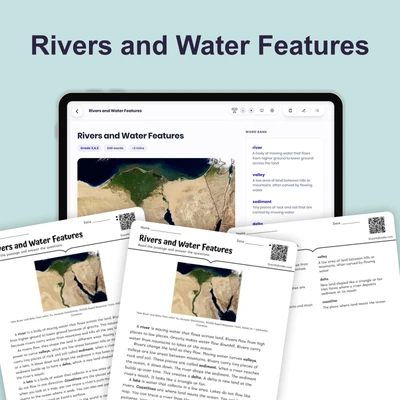
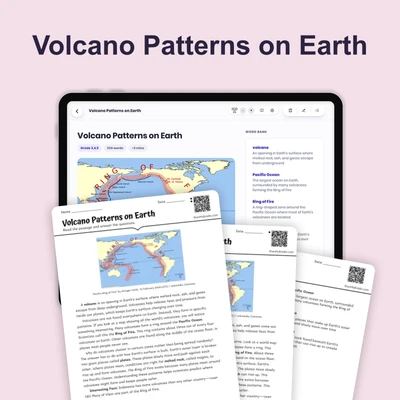
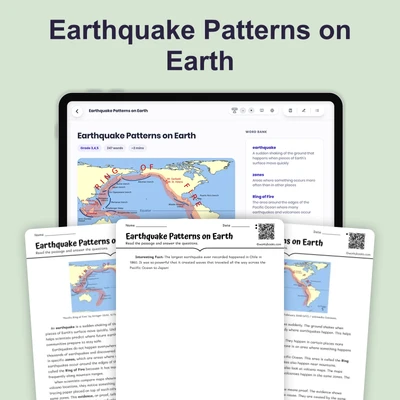
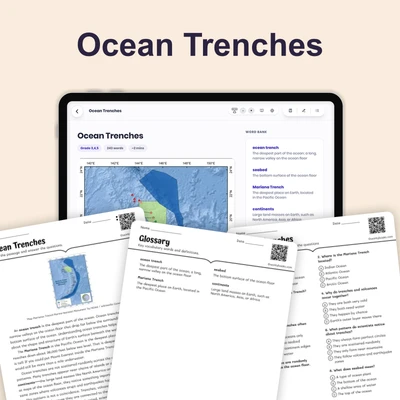
This learning resource is available in interactive and printable formats. The interactive worksheet can be played online and assigned to students. The Printable PDF version can be downloaded and printed for completion by hand.
This engaging 350-word science passage introduces Grade 4-5 students to the concept of map symbols and their importance in map reading. Aligned with NGSS standard 4-ESS2-2, students learn how symbols are small pictures or shapes that represent real things like trees, buildings, and water. The passage explains why using symbols makes maps easier to read and less cluttered than attempting to show everything in detail. Students discover how symbols work like a secret code that helps them understand what maps are showing. The content includes real-world applications of map symbols in everyday life, from hiking trails to city planning. Audio-integrated features support diverse learners, while the passage uses concrete analogies and age-appropriate language to make abstract concepts accessible. Students explore how different types of symbols represent natural and human-made features, and learn about the map legend as a decoder for understanding these symbols. The material encourages critical thinking about how we represent three-dimensional spaces on two-dimensional surfaces.
CONTENT PREVIEW
Expand content preview
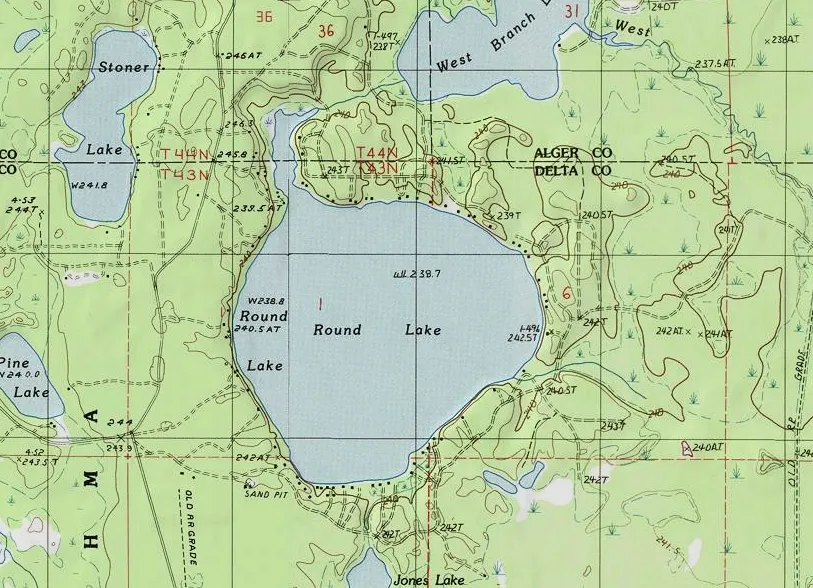
A portion of the Corner Lake Quadrangle topo map showing the Round Lake area in Michigan by United States Geological Survey (USGS) / Wikimedia Commons
Maps are powerful tools that help us understand the world around us. They show us where things are located and help us find our way from one place to another. A map symbol is a small picture or shape that stands for something real in the world. Map symbols represent things like trees, buildings, roads, rivers, and mountains. Instead of drawing every single tree or house exactly as it looks, mapmakers use simple symbols to show where these things are located.
Using symbols makes maps much easier to read and understand. Imagine trying to look at a map that showed every tiny detail of a city—every window on every building, every leaf on every tree! The map would be so crowded and messy that you couldn't find anything. This is called clutter, which means too many things packed together in a confusing way. Symbols solve this problem by keeping maps simple and clear. A small blue line can represent a river. A tiny triangle can stand for a mountain. A dot might show where a city is located. These simple shapes give you important information without making the map too busy.
Map symbols work like a secret code that you can learn to read. Just like letters make words and words make sentences, symbols on a map tell a story about a place. The map legend, also called a map key, is like a decoder that explains what each symbol means. Think of it like a dictionary for your map. If you see a green circle on a map and don't know what it means, you can look at the legend to find out it represents a park. The legend shows you a picture of each symbol and tells you what real thing it stands for. Once you learn the code, you can interpret any map—that means you can understand what the map is showing you.
Different types of symbols show different kinds of information. Some symbols represent natural features like forests, lakes, and hills. These are things that nature created. Other symbols show human-made features like roads, bridges, and buildings. These are things that people built. Colors also help symbols give information. Blue usually means water. Green often shows plants or parks. Brown might represent mountains or dirt roads. The combination of shapes and colors creates a language that map readers everywhere can understand.
People use map symbols every day in the real world. Hikers use trail maps with symbols showing campsites, water sources, and dangerous areas. City planners use maps with symbols to show where schools, hospitals, and fire stations are located. Even the maps on your phone use symbols—a little fork and knife symbol shows restaurants, and a gas pump symbol shows where to fill up a car. Park rangers, scientists, and rescue workers all depend on reading map symbols to do their jobs safely and effectively.
Interesting Fact: The oldest known map is over 4,000 years old and was carved on a clay tablet in ancient Babylon—and it used symbols too!
What is a map symbol?
A small picture representing real thingsA large photograph of placesA written description of locationsA compass showing directions
Why do mapmakers use symbols?
To make maps colorful and prettyTo keep maps simple and clearTo make maps harder to readTo show only buildings
What does the map legend do?
Shows directions on the mapMeasures distances between placesExplains what each symbol meansColors the map beautifully
What color usually represents water on maps?
GreenBrownBlueRed
Which is a natural feature?
A bridgeA roadA riverA building
How do hikers use map symbols?
To find campsites and waterTo build new trailsTo change the landscapeTo create new symbols
Map symbols work like a secret code.
TrueFalse
What does 'clutter' mean in the passage?
A type of map symbolToo many confusing things togetherA color used on mapsA tool for making maps
Perfect For:
👩🏫 Teachers
• Reading comprehension practice
• Auto-graded assessments
• Literacy skill development
👨👩👧👦 Parents
• Reading practice at home
• Comprehension improvement
• Educational reading time
🏠 Homeschoolers
• Reading curriculum support
• Independent reading practice
• Progress monitoring
Reading Features:
📖
Reading Passage
Engaging fiction or nonfiction text
❓
Comprehension Quiz
Auto-graded questions
📊
Instant Feedback
Immediate results and scoring
📄
Printable Version
Download for offline reading
🔊
Read Aloud
Voice-over with word highlighting
Reviews & Ratings
No reviews yet. Be the first to share your experience!
Related Content
Compass Rose
This engaging 350-word science passage introduces Grade 4-5 students to the compass rose, a fundamental map-reading tool...
NGSS 4-ESS2-2
What Are Maps
This engaging 350-word science passage introduces Grade 4-5 students to the concept of maps as flat drawings that repres...
NGSS 4-ESS2-2
Canyons and Valleys
This engaging 350-word science passage helps Grade 4-5 students understand how canyons and valleys form through the proc...