This learning resource is available in interactive and printable formats. The interactive worksheet can be played online and assigned to students. The Printable PDF version can be downloaded and printed for completion by hand.
This 250-word reading passage introduces fourth-grade students to rivers and water features as outlined in NGSS 4-ESS2-2. Students learn that rivers are bodies of moving water that flow from higher ground to lower ground, eventually reaching lakes or oceans. The passage explains how rivers create patterns on the land by carving valleys and depositing sediment to form deltas. Students discover how lakes form in low areas where water collects and how coastlines mark where land meets the ocean. The content emphasizes map-reading skills, helping students trace how rivers connect mountains to oceans and recognize patterns in water feature locations. This audio-integrated passage uses simple, grade-appropriate language to build foundational understanding of Earth's surface processes. The passage aligns with the NGSS Disciplinary Core Idea ESS2.B: Plate Tectonics and Large-Scale System Interactions. Activities include reading comprehension questions, writing prompts, and graphic organizers that reinforce key vocabulary such as rivers, valleys, sediment, deltas, lakes, and coastlines. Students engage with real-world examples and develop skills in identifying cause-and-effect relationships in Earth's water systems. The passage prepares students for hands-on investigations and class discussions about how water shapes our planet's surface features.
CONTENT PREVIEW
Expand content preview
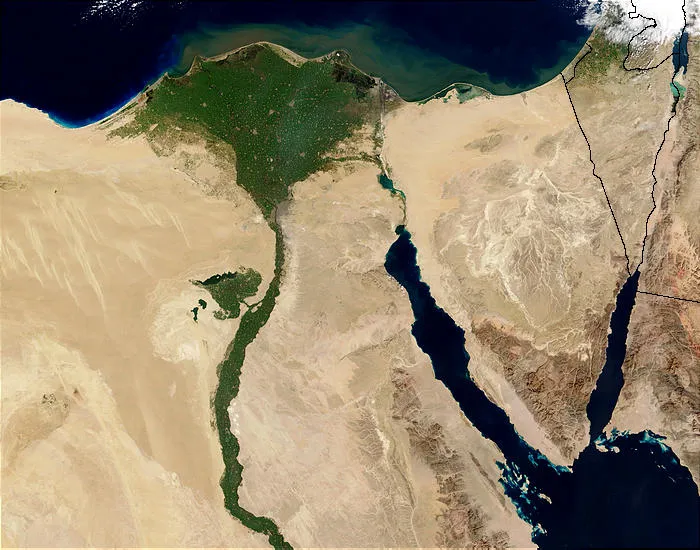
"Nile River and delta from orbit" by Jacques Descloitres, MODIS Rapid Response Team, NASA/sh / Wikimedia Commons.
A river is a body of moving water that flows across the land. Rivers always flow from higher ground to lower ground because of gravity. This movement is important because rivers carry water from mountains and hills all the way to lakes or the ocean.
As rivers flow, they shape the land in different ways. Moving water has enough power to carve valleys, which are low areas between hills or mountains. Rivers also carry tiny pieces of rock and soil called sediment. When a river reaches the ocean or a lake, it slows down and drops the sediment it has been carrying. Over time, this sediment builds up to form a delta, which is new land shaped like a triangle or fan at the river's mouth.
A lake is a body of water that collects in a low area of land. Unlike rivers, lakes do not flow in one direction. Coastlines are the places where land meets the ocean. When you look at a map, you can trace a river's path from the mountains where it starts to the ocean where it ends. You can also see patterns in where water features are located on Earth's surface.
Interesting Fact: The longest river in the world is the Nile River in Africa, which flows for about 4,130 miles—that's like driving from New York to California and back!
Where do rivers always flow?
From higher ground to lower groundFrom lower ground to higher groundIn circles around mountainsOnly through valleys
What are tiny pieces of rock called?
ValleysDeltasSedimentCoastlines
What shape is a delta?
Square or rectangleCircle or ovalTriangle or fanLine or curve
Why do rivers carve valleys?
Because water evaporates quicklyBecause moving water has powerBecause sediment builds upBecause lakes form nearby
What happens when a river slows down?
It carves deeper valleysIt flows faster downhillIt drops the sediment it carriesIt turns into a lake
How can maps help us understand rivers?
They show how fast water flowsThey trace rivers from mountains to oceansThey measure the depth of valleysThey count all the sediment
Lakes flow in one direction like rivers.
TrueFalse
What is a coastline?
Where land meets the oceanA type of sedimentThe start of a riverA low area between mountains
Perfect For:
👩🏫 Teachers
• Reading comprehension practice
• Auto-graded assessments
• Literacy skill development
👨👩👧👦 Parents
• Reading practice at home
• Comprehension improvement
• Educational reading time
🏠 Homeschoolers
• Reading curriculum support
• Independent reading practice
• Progress monitoring
Reading Features:
📖
Reading Passage
Engaging fiction or nonfiction text
❓
Comprehension Quiz
Auto-graded questions
📊
Instant Feedback
Immediate results and scoring
📄
Printable Version
Download for offline reading
🔊
Read Aloud
Voice-over with word highlighting
Reviews & Ratings
No reviews yet. Be the first to share your experience!
Related Content
Structures on the Ocean Floor
ESS2.B4-ESS2-2RI.4.10RI.4.7
Maps Show Patterns
This engaging 250-word reading passage introduces fourth-grade students to the concept of identifying patterns on maps a...
NGSS 4-ESS2-2ESS2.B
Earth's Land and Water
This 250-word reading passage introduces fourth-grade students to the fundamental concept of how land and water are dist...
NGSS 4-ESS2-2ESS2.B
What Are Mountains
This 250-word reading passage introduces fourth-grade students to mountains as one of Earth's most dramatic landforms. A...
NGSS 4-ESS2-2ESS2.B
Map Symbols
This engaging 350-word science passage introduces Grade 4-5 students to the concept of map symbols and their importance ...
NGSS 4-ESS2-2
Compass Rose
This engaging 350-word science passage introduces Grade 4-5 students to the compass rose, a fundamental map-reading tool...
NGSS 4-ESS2-2
What Are Maps
This engaging 350-word science passage introduces Grade 4-5 students to the concept of maps as flat drawings that repres...
NGSS 4-ESS2-2
Canyons and Valleys
This engaging 350-word science passage helps Grade 4-5 students understand how canyons and valleys form through the proc...
NGSS 4-ESS2-2
What Are Topographic Maps
This engaging 250-word reading passage introduces fourth-grade students to topographic maps and how they represent Earth...
NGSS 4-ESS2-2
What Are Ocean Floor Maps
This Grade 4 science reading passage introduces students to ocean floor maps and how scientists create them using sonar ...
NGSS 4-ESS2-2
How to Read Data from Maps
This 250-word reading passage introduces fourth-grade students to the essential skill of reading data from maps, aligned...
NGSS 4-ESS2-2
Mountain Patterns on Earth
This 250-word reading passage introduces fourth-grade students to mountain patterns on Earth, aligned with NGSS standard...
NGSS 4-ESS2-2
Plains and Plateaus
This Grade 4 science reading passage explores plains and plateaus, two common landforms found across Earth's surface. Al...
NGSS 4-ESS2-2
Volcano Patterns on Earth
This Grade 4 science reading passage introduces students to volcano patterns on Earth, aligned with NGSS standard 4-ESS2...
NGSS 4-ESS2-2
Earthquake Patterns on Earth
This engaging 250-word reading passage introduces fourth-grade students to earthquake patterns on Earth, aligned with NG...
NGSS 4-ESS2-2
Ocean Trenches
This engaging 250-word reading passage introduces fourth-grade students to ocean trenches, the deepest parts of Earth's ...
NGSS 4-ESS2-2
How Earth's Features Connect
This engaging 250-word reading passage introduces fourth-grade students to the fascinating patterns connecting Earth's m...