This learning resource is available in interactive and printable formats. The interactive worksheet can be played online and assigned to students. The Printable PDF version can be downloaded and printed for completion by hand.
This engaging 250-word reading passage introduces fourth-grade students to the concept of identifying patterns on maps as outlined in NGSS standard 4-ESS2-2. Students learn how scientists study maps to discover that Earth's features are not randomly distributed. The passage explains how mountains often form in long chains, rivers consistently flow from high ground to low ground, and volcanoes and earthquakes tend to occur in the same zones. Through accessible language and relatable examples, students understand that these patterns provide important clues about how Earth works. The passage includes audio integration to support diverse learners and is accompanied by comprehension activities, writing prompts, and graphic organizers. Students explore real-world applications of map pattern analysis and build foundational understanding of Earth's surface features. This resource aligns with ESS2.B: Plate Tectonics and Large-Scale System Interactions, helping students develop essential map literacy skills while introducing them to the scientific practice of identifying and analyzing patterns in nature.
CONTENT PREVIEW
Expand content preview
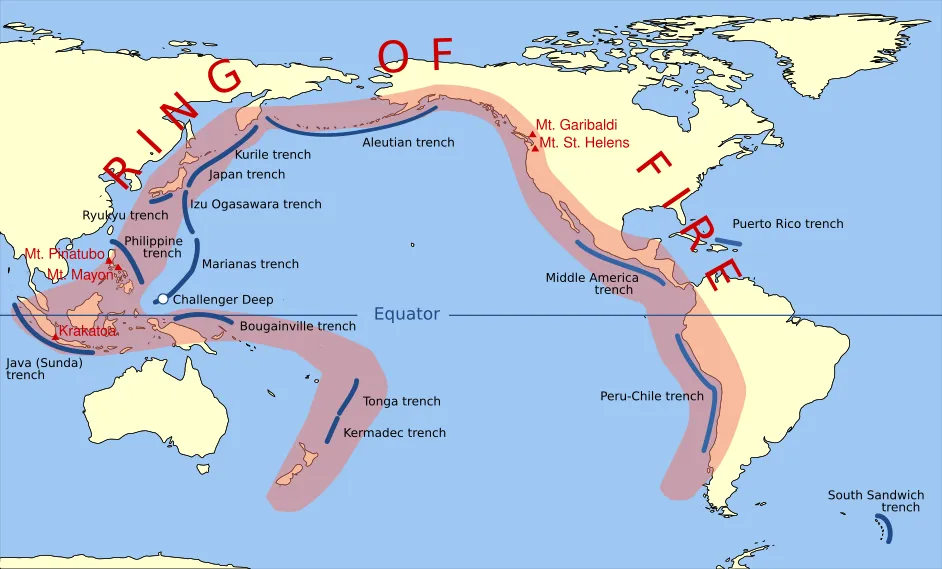
"Pacific Ring of Fire" by Gringer 23:52, 10 February 2009 (UTC) / Wikimedia Commons.
When scientists study maps, they look for patterns — features that repeat or appear in groups in certain areas. A pattern is something that happens over and over in a predictable way. Maps help scientists see these patterns clearly.
Mountains are tall landforms that rise high above the surrounding land. On maps, mountains often form in long chains, which are groups of mountains connected in a line. The Rocky Mountains in North America and the Andes Mountains in South America are examples of mountain chains. These chains stretch for thousands of miles.
Rivers are large streams of flowing water. Rivers always flow from high ground to low ground, usually ending in an ocean or lake. If you look at a map, you can trace a river from the mountains where it starts down to the sea where it ends. This pattern happens because water flows downhill, just like a ball rolling down a playground slide.
Scientists also notice that volcanoes and earthquakes tend to happen in the same zones, or areas. A volcano is a mountain that can erupt with hot melted rock. An earthquake is when the ground shakes. These events cluster together on maps, often near mountain chains or ocean edges.
These patterns are not random. They give scientists important clues about how Earth works beneath its surface.
Interesting Fact: The "Ring of Fire" is a zone around the Pacific Ocean where 75% of the world's volcanoes are located and where 90% of earthquakes happen!
What is a pattern?
Something that happens onceSomething that repeats predictablyA type of mountainA kind of map
How do mountains often appear on maps?
Scattered randomly everywhereOnly near oceansIn long connected chainsIn perfect circles
Where do rivers always flow?
From low ground to high groundFrom high ground to low groundIn circles around mountainsOnly through flat areas
Why do scientists study map patterns?
To make maps look prettyTo count all the mountainsTo learn how Earth worksTo find buried treasure
Where do volcanoes and earthquakes cluster?
Only in flat plainsIn the same zonesOnly at the North PoleRandomly across all areas
What makes water flow downhill in rivers?
Wind pushing itFish swimming in itGravity pulling it downPeople pumping it
Patterns on maps are completely random.
TrueFalse
What is a chain in geography?
A metal link used on bikesA group of connected mountainsA type of riverA tool for measuring maps
Perfect For:
👩🏫 Teachers
• Reading comprehension practice
• Auto-graded assessments
• Literacy skill development
👨👩👧👦 Parents
• Reading practice at home
• Comprehension improvement
• Educational reading time
🏠 Homeschoolers
• Reading curriculum support
• Independent reading practice
• Progress monitoring
Reading Features:
📖
Reading Passage
Engaging fiction or nonfiction text
❓
Comprehension Quiz
Auto-graded questions
📊
Instant Feedback
Immediate results and scoring
📄
Printable Version
Download for offline reading
🔊
Read Aloud
Voice-over with word highlighting
Reviews & Ratings
No reviews yet. Be the first to share your experience!
Related Content
Structures on the Ocean Floor
ESS2.B4-ESS2-2RI.4.10RI.4.7
Earth's Land and Water
This 250-word reading passage introduces fourth-grade students to the fundamental concept of how land and water are dist...
NGSS 4-ESS2-2ESS2.B
What Are Mountains
This 250-word reading passage introduces fourth-grade students to mountains as one of Earth's most dramatic landforms. A...
NGSS 4-ESS2-2ESS2.B
Rivers and Water Features
This 250-word reading passage introduces fourth-grade students to rivers and water features as outlined in NGSS 4-ESS2-2...
NGSS 4-ESS2-2ESS2.B
Map Symbols
This engaging 350-word science passage introduces Grade 4-5 students to the concept of map symbols and their importance ...
NGSS 4-ESS2-2
Compass Rose
This engaging 350-word science passage introduces Grade 4-5 students to the compass rose, a fundamental map-reading tool...
NGSS 4-ESS2-2
What Are Maps
This engaging 350-word science passage introduces Grade 4-5 students to the concept of maps as flat drawings that repres...
NGSS 4-ESS2-2
Canyons and Valleys
This engaging 350-word science passage helps Grade 4-5 students understand how canyons and valleys form through the proc...
NGSS 4-ESS2-2
What Are Topographic Maps
This engaging 250-word reading passage introduces fourth-grade students to topographic maps and how they represent Earth...
NGSS 4-ESS2-2
What Are Ocean Floor Maps
This Grade 4 science reading passage introduces students to ocean floor maps and how scientists create them using sonar ...
NGSS 4-ESS2-2
How to Read Data from Maps
This 250-word reading passage introduces fourth-grade students to the essential skill of reading data from maps, aligned...
NGSS 4-ESS2-2
Mountain Patterns on Earth
This 250-word reading passage introduces fourth-grade students to mountain patterns on Earth, aligned with NGSS standard...
NGSS 4-ESS2-2
Plains and Plateaus
This Grade 4 science reading passage explores plains and plateaus, two common landforms found across Earth's surface. Al...
NGSS 4-ESS2-2
Volcano Patterns on Earth
This Grade 4 science reading passage introduces students to volcano patterns on Earth, aligned with NGSS standard 4-ESS2...
NGSS 4-ESS2-2
Earthquake Patterns on Earth
This engaging 250-word reading passage introduces fourth-grade students to earthquake patterns on Earth, aligned with NG...
NGSS 4-ESS2-2
Ocean Trenches
This engaging 250-word reading passage introduces fourth-grade students to ocean trenches, the deepest parts of Earth's ...
NGSS 4-ESS2-2
How Earth's Features Connect
This engaging 250-word reading passage introduces fourth-grade students to the fascinating patterns connecting Earth's m...