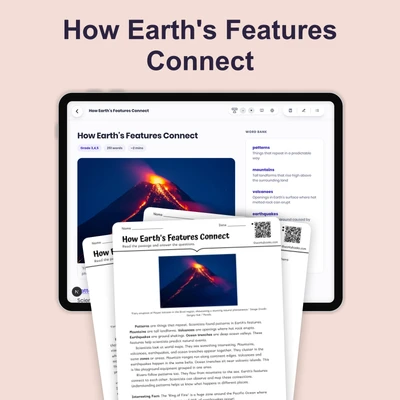
This learning resource is available in interactive and printable formats. The interactive worksheet can be played online and assigned to students. The Printable PDF version can be downloaded and printed for completion by hand.
This Grade 4 science reading passage introduces students to ocean floor maps and how scientists create them using sonar and satellites. Aligned with NGSS 4-ESS2-2, the passage explains that the ocean floor is not flat but contains dramatic features like underwater mountains, deep trenches, and flat plains. Students learn why we cannot see the ocean floor directly and how mapping technology helps scientists discover patterns in where these features are located. The passage uses simple, age-appropriate language to build foundational understanding of ocean floor topography and mapping techniques. Audio-integrated components support diverse learners. Activities include comprehension questions, writing prompts, and graphic organizers that help students organize information about ocean floor features and mapping methods. This resource is perfect for introducing earth science concepts related to ocean systems and helps students understand how technology enables scientific discovery.
CONTENT PREVIEW
Expand content preview
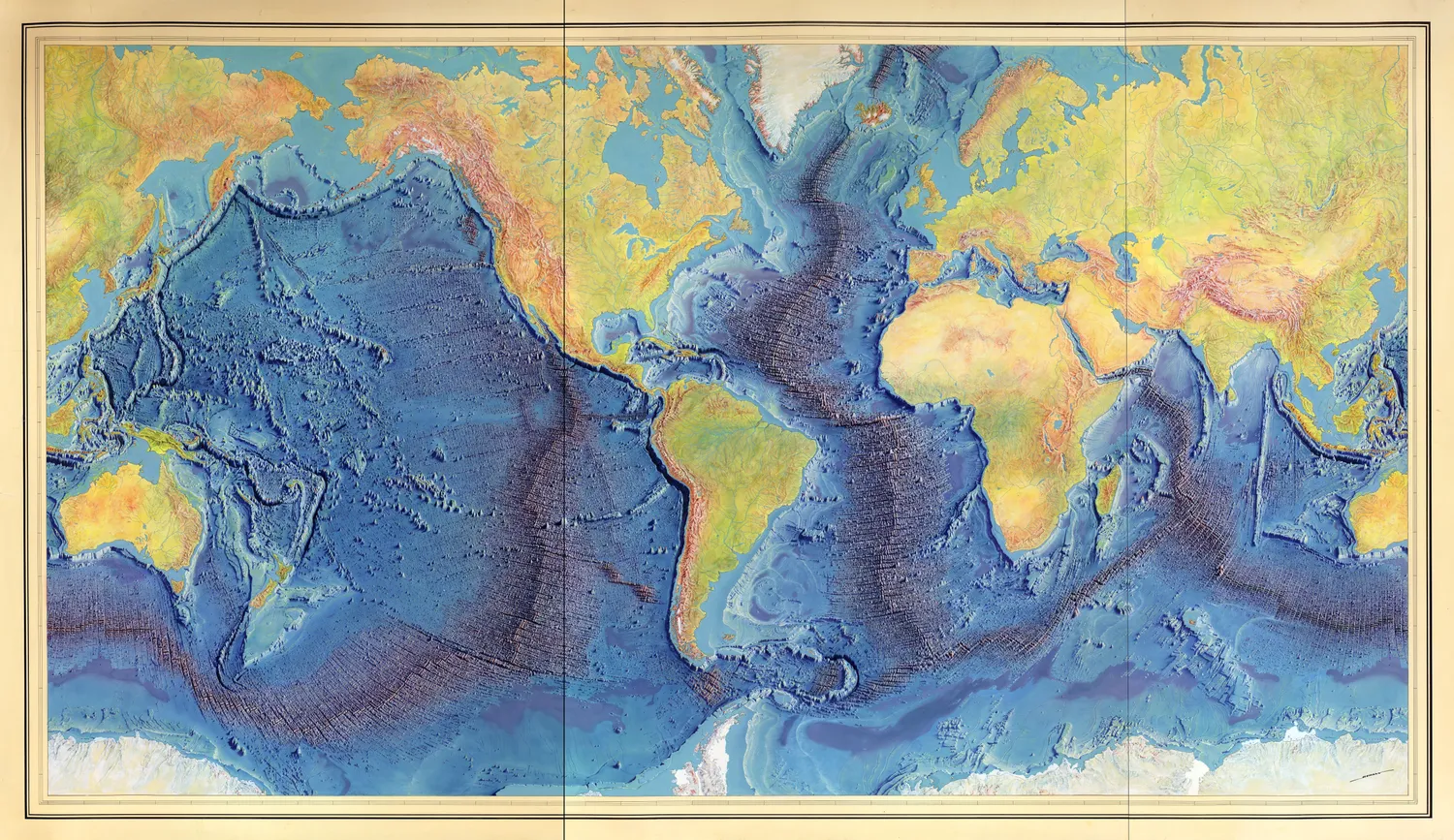
"(Manuscript painting of Heezen-Tharp World ocean floor map by Berann)" by Berann, Heinrich C., Heezen, Bruce C., Tharp, Marie. / Wikimedia Commons.
Ocean floor maps are special maps that show what the bottom of the ocean looks like. These maps are important because they help scientists understand the hidden world beneath the water. The ocean covers most of our planet, but we cannot see its bottom from the surface.
Scientists use tools called sonar and satellites to make ocean floor maps. Sonar works by sending sound waves down to the ocean floor. When the sound bounces back, it tells scientists how deep the water is and what shapes are on the bottom. This is similar to how you hear an echo in a canyon. Satellites in space also help by measuring tiny changes in the ocean's surface that show what lies below.
Ocean floor maps reveal amazing features underwater. There are tall underwater mountains called seamounts that rise from the ocean floor. Some are taller than mountains on land! Maps also show deep trenches, which are like giant canyons that drop far below the ocean floor. Between these features are flat plains that stretch for miles.
The ocean floor is not flat at all. It has features just as dramatic as those we see on land. Ocean floor maps help scientists find patterns in where trenches and underwater volcanoes are located. These patterns teach us about how Earth's surface changes over time.
Interesting Fact: The deepest part of the ocean is the Mariana Trench, which is almost 7 miles deep—deep enough to fit Mount Everest inside with room to spare!
What do ocean floor maps show?
What the bottom of the ocean looks likeWhere fish swim in the oceanHow warm the ocean water isWhere boats travel on the ocean
How does sonar help scientists map the ocean?
It takes pictures of the ocean floorIt sends sound waves that bounce backIt measures the temperature of waterIt collects rocks from the bottom
What are underwater mountains called?
Ocean peaksWater hillsSeamountsDeep trenches
Why can't we see the ocean floor directly?
It is covered by waterIt is too small to seeIt is always movingIt is covered by sand
What do patterns on ocean floor maps teach?
Where to catch the most fishHow Earth's surface changes over timeWhen ocean storms will happenHow deep ships can travel
What features are found on the ocean floor?
Mountains, trenches, and flat plainsOnly flat sand everywhereTrees and forests underwaterRoads and buildings
The ocean floor is completely flat everywhere.
TrueFalse
What does the word 'trench' mean?
A flat area on the ocean floorA very deep canyon underwaterAn underwater mountainA type of ocean wave
Perfect For:
👩🏫 Teachers
• Reading comprehension practice
• Auto-graded assessments
• Literacy skill development
👨👩👧👦 Parents
• Reading practice at home
• Comprehension improvement
• Educational reading time
🏠 Homeschoolers
• Reading curriculum support
• Independent reading practice
• Progress monitoring
Reading Features:
📖
Reading Passage
Engaging fiction or nonfiction text
❓
Comprehension Quiz
Auto-graded questions
📊
Instant Feedback
Immediate results and scoring
📄
Printable Version
Download for offline reading
🔊
Read Aloud
Voice-over with word highlighting
Reviews & Ratings
No reviews yet. Be the first to share your experience!
Related Content
Map Symbols
This engaging 350-word science passage introduces Grade 4-5 students to the concept of map symbols and their importance ...
NGSS 4-ESS2-2
Compass Rose
This engaging 350-word science passage introduces Grade 4-5 students to the compass rose, a fundamental map-reading tool...
NGSS 4-ESS2-2
What Are Maps
This engaging 350-word science passage introduces Grade 4-5 students to the concept of maps as flat drawings that repres...
NGSS 4-ESS2-2
Canyons and Valleys
This engaging 350-word science passage helps Grade 4-5 students understand how canyons and valleys form through the proc...
NGSS 4-ESS2-2
What Are Topographic Maps
This engaging 250-word reading passage introduces fourth-grade students to topographic maps and how they represent Earth...
NGSS 4-ESS2-2
How to Read Data from Maps
This 250-word reading passage introduces fourth-grade students to the essential skill of reading data from maps, aligned...
NGSS 4-ESS2-2
Maps Show Patterns
This engaging 250-word reading passage introduces fourth-grade students to the concept of identifying patterns on maps a...
NGSS 4-ESS2-2ESS2.B
Earth's Land and Water
This 250-word reading passage introduces fourth-grade students to the fundamental concept of how land and water are dist...
NGSS 4-ESS2-2ESS2.B
What Are Mountains
This 250-word reading passage introduces fourth-grade students to mountains as one of Earth's most dramatic landforms. A...
NGSS 4-ESS2-2ESS2.B
Mountain Patterns on Earth
This 250-word reading passage introduces fourth-grade students to mountain patterns on Earth, aligned with NGSS standard...
NGSS 4-ESS2-2
Plains and Plateaus
This Grade 4 science reading passage explores plains and plateaus, two common landforms found across Earth's surface. Al...
NGSS 4-ESS2-2
Rivers and Water Features
This 250-word reading passage introduces fourth-grade students to rivers and water features as outlined in NGSS 4-ESS2-2...
NGSS 4-ESS2-2ESS2.B
Volcano Patterns on Earth
This Grade 4 science reading passage introduces students to volcano patterns on Earth, aligned with NGSS standard 4-ESS2...
NGSS 4-ESS2-2
Earthquake Patterns on Earth
This engaging 250-word reading passage introduces fourth-grade students to earthquake patterns on Earth, aligned with NG...
NGSS 4-ESS2-2
Ocean Trenches
This engaging 250-word reading passage introduces fourth-grade students to ocean trenches, the deepest parts of Earth's ...
NGSS 4-ESS2-2
How Earth's Features Connect
This engaging 250-word reading passage introduces fourth-grade students to the fascinating patterns connecting Earth's m...