Convergent Plate Boundaries
Interactive passage with audio narration, comprehension questions, and printable PDF.
By completing this purchase you agree to our Terms of Use and Privacy Policy. Your subscription renews automatically until you cancel. You can cancel anytime from your account settings. All sales are final and non-refundable. Digital content is available for download in your account immediately upon purchase.
What's included
Convergent Plate Boundaries preview and details
About this printable Convergent Plate Boundaries science reading passage, NGSS-aligned (Grades 5-8)
Sample passage and quiz from Convergent Plate Boundaries
Reading passage and comprehension quiz preview
Convergent Plate Boundaries
Convergent plate boundaries are zones where two of Earth's massive tectonic plates move toward each other. These collisions create some of the planet’s most dramatic and destructive natural events, such as earthquakes, volcanic eruptions, and the formation of mountain ranges. Scientists observe these boundaries using seismic data, satellite imagery, and geological field studies to understand how the Earth’s surface is constantly changing. The study of convergent boundaries reveals how powerful forces beneath the surface shape the landscape we see today.
How Convergent Boundaries Work
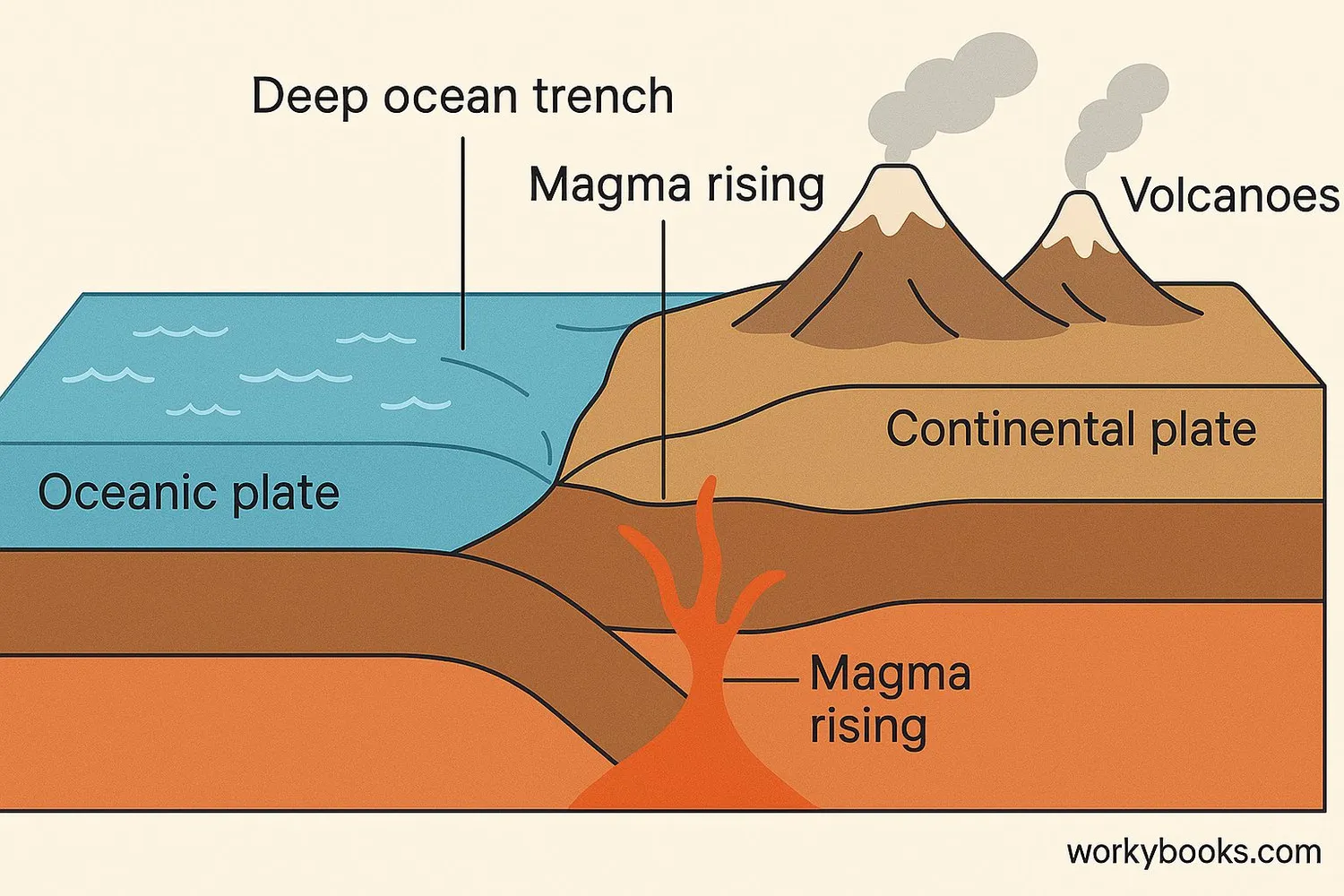
At a convergent boundary, plates can collide in different ways, depending on their composition and density. When an oceanic plate meets another oceanic plate, the denser plate is forced beneath the other in a process called subduction. This creates deep ocean trenches like the Mariana Trench, which plunges over 11,000 meters below sea level. The subducted plate melts as it sinks into the mantle, forming magma that rises to build a volcanic island arc. Japan is an example of this process, where the Pacific Plate subducts beneath the Eurasian Plate, causing frequent earthquakes and volcanic activity.
Variations in Convergent Boundaries
When an oceanic plate collides with a continental plate, the oceanic plate, being denser, subducts under the continental plate. This forms both a trench and a volcanic mountain range on land. The Andes Mountains in South America were formed by the subduction of the Nazca Plate beneath the South American Plate. Similarly, the Cascades in North America are a result of this process. In contrast, when two continental plates meet, such as the Indian and Eurasian Plates, neither plate subducts easily. Instead, they crumple and fold, pushing up enormous mountain ranges like the Himalayas, which continue to grow taller each year.
Interactions and Impacts
Convergent boundaries create chains of cause and effect. Subduction leads to the melting of the subducted plate, producing magma and resulting in volcanoes above the subduction zone. Collisions cause intense pressure, leading to earthquakes that can be shallow or deep, depending on the angle and speed of subduction—some zones produce hundreds of earthquakes per year. These processes not only shape continents but also influence climate, water cycles, and even where people can safely live. By studying convergent boundaries, scientists gain insight into Earth’s past and can better predict future geologic events.
Understanding convergent plate boundaries connects to larger scientific principles about how energy and matter move within Earth’s systems. These boundaries show that the planet is always evolving, with forces deep within shaping the world above us.
Interesting Fact: The Himalayas are still rising at a rate of about 5 millimeters per year due to the ongoing collision of the Indian and Eurasian plates.
Comprehension quiz (10 questions)
1. What happens at a convergent plate boundary?
2. Which feature is formed when an oceanic plate subducts beneath another oceanic plate?
3. Which mountain range formed due to the collision of two continental plates?
4. What is subduction?
5. What word in the passage means 'a deep, narrow depression in the ocean floor'?
6. In the passage, what does 'volcanic island arc' refer to?
7. Why do earthquakes occur at convergent plate boundaries?
8. If an oceanic plate collides with a continental plate, what is most likely to happen?
9. True or False: The Himalayas are still rising due to plate movement.
10. True or False: Volcanoes only form at convergent plate boundaries where two continental plates meet.
Perfect for the way you teach
- Build comprehension skills
- Auto-graded quiz
- Differentiated reading
- Read together at home
- Improve fluency
- Quiet reading time
- Reading curriculum support
- Independent practice
- Track Lexile growth