Transform Plate Boundaries
Interactive passage with audio narration, comprehension questions, and printable PDF.
By completing this purchase you agree to our Terms of Use and Privacy Policy. Your subscription renews automatically until you cancel. You can cancel anytime from your account settings. All sales are final and non-refundable. Digital content is available for download in your account immediately upon purchase.
What's included
Transform Plate Boundaries preview and details
About this printable Transform Plate Boundaries science reading passage, NGSS-aligned (Grades 5-8)
Sample passage and quiz from Transform Plate Boundaries
Reading passage and comprehension quiz preview
Transform Plate Boundaries
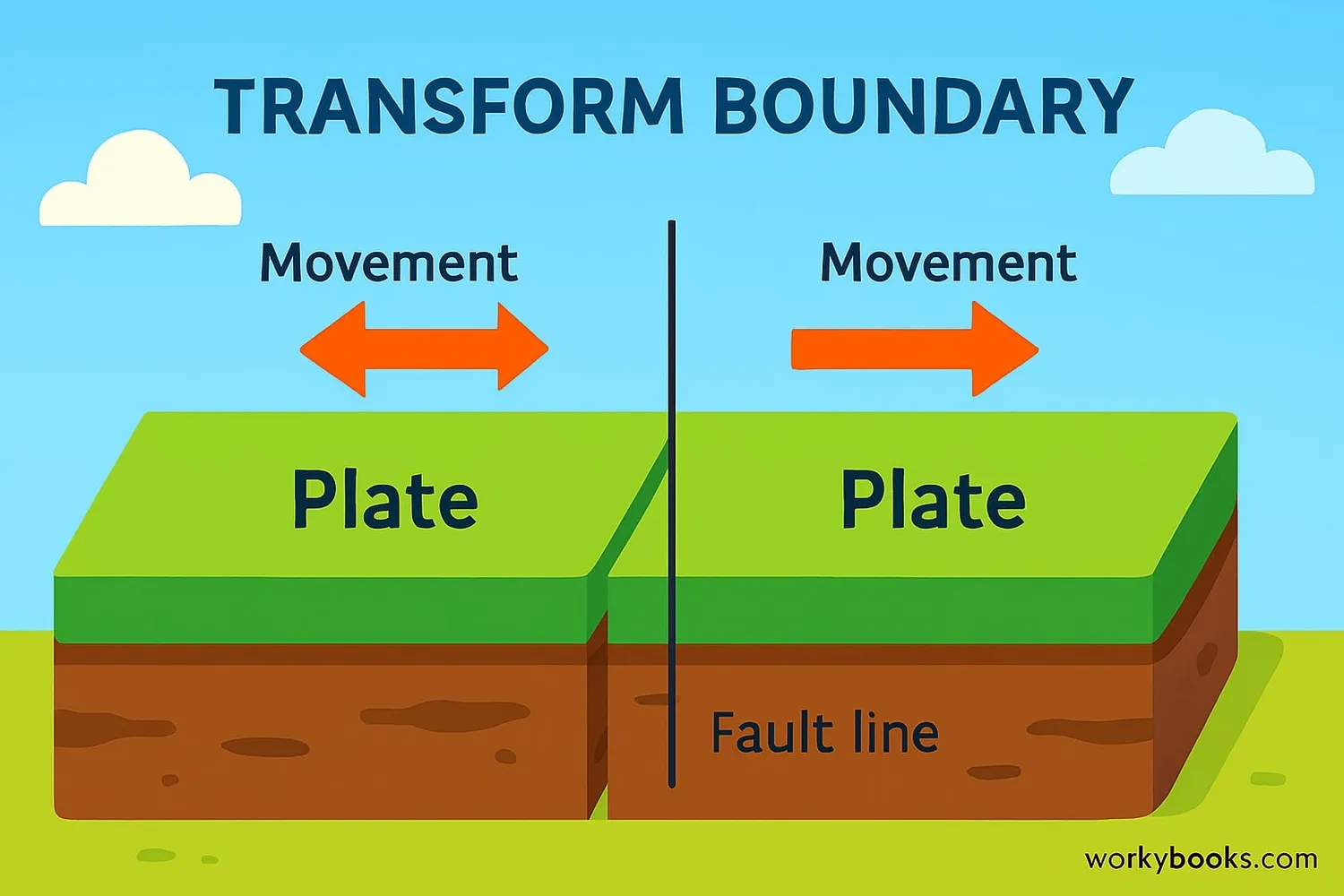
Transform plate boundaries are one of the three main types of boundaries where Earth’s tectonic plates interact. These boundaries are especially important for understanding the cause of earthquakes in many parts of the world. At a transform boundary, two plates slide horizontally past each other. Unlike other boundaries, no new crust is created, and none is destroyed. This movement is responsible for some of the most powerful and unpredictable earthquakes on Earth.
How Transform Boundaries Work
At a transform plate boundary, the plates often move slowly, at rates of just a few centimeters per year. However, their edges are rough and can become stuck due to friction. As the plates continue to push against each other, stress builds up. Eventually, the stress overcomes the friction, causing the plates to slip suddenly along a fault zone. This rapid release of energy creates an earthquake. Most earthquakes along transform boundaries occur in the upper 15 kilometers of the crust, making them relatively shallow but potentially very strong. Because the movement is side-to-side, transform boundaries do not produce volcanic activity or form new mountains.
Examples and Real-World Impacts
One of the most famous examples of a transform boundary is the San Andreas Fault in California. Here, the Pacific Plate slides northwest past the North American Plate. This fault stretches for about 1,200 kilometers and passes near major population centers like San Francisco and Los Angeles. The San Andreas Fault is responsible for many large earthquakes, including the devastating 1906 San Francisco earthquake. Transform faults are also found under the ocean, where they connect segments of mid-ocean ridges. These underwater transform boundaries help accommodate the movement of plates as new crust forms at the ridges and is pulled away.
Hazards and Scientific Principles
Earthquakes at transform boundaries are difficult to predict, and the sudden movement can cause significant damage, especially in urban areas. Scientists study the history of earthquakes, the rate of plate movement, and the structure of fault zones to better understand and prepare for future events. Transform boundaries illustrate the principle of conservation of crust, as no material is added or removed. They also show how energy is stored and released in Earth’s crust, a key concept in the study of plate tectonics and natural hazards. Understanding transform boundaries helps engineers design safer buildings and guides communities in making emergency plans.
In summary, transform plate boundaries play a crucial role in shaping Earth’s surface and affecting human society. Their side-to-side motion causes earthquakes but not volcanoes, and their unpredictable nature makes them a focus of scientific research and safety planning.
Interesting Fact: The San Andreas Fault moves at an average rate of about 2.5 to 5 centimeters per year—about as fast as your fingernails grow!
Comprehension quiz (10 questions)
1. What is the main feature of a transform plate boundary?
2. Which of the following is NOT typically found at a transform boundary?
3. What causes the plates at a transform boundary to slip suddenly?
4. What is the San Andreas Fault an example of?
5. What is a ‘fault zone’ as used in the passage?
6. Which word best describes the earthquakes at transform boundaries?
7. Why are earthquakes at transform boundaries often strong and shallow?
8. True or False: Transform boundaries create new crust as plates move.
9. True or False: The San Andreas Fault is close to major cities like San Francisco and Los Angeles.
10. How do transform faults under the ocean help the plates move?
Perfect for the way you teach
- Build comprehension skills
- Auto-graded quiz
- Differentiated reading
- Read together at home
- Improve fluency
- Quiet reading time
- Reading curriculum support
- Independent practice
- Track Lexile growth