Reading PassagePremium

Could There Be Life on Europa

Interactive passage with audio narration, comprehension questions, and printable PDF.

No ratings yet
Grades 5–8ScienceElaEnglish · SpanishInteractive · Printable
Aligned toMS-ESS1-1
Just this resource
$1.50
One-time purchase
Best value
Unlock everything
$49.99$29.99/yr
40% off until Aug 1 — 10,000+ resources
Renews at $49.99/year.
Unlock above to use these actions

What's included

Reading passage
Audio narration
Comprehension quiz
Writing activity
Glossary & flashcards
Differentiated version
Spanish translation

Could There Be Life on Europa preview and details

About this printable Could There Be Life on Europa science reading passage, NGSS-aligned (Grades 5-8)

science,ela
Written by Workybooks TeamPublished by Workybooks
Preview

Sample passage and quiz from Could There Be Life on Europa

Reading passage and comprehension quiz preview

Could There Be Life on Europa?
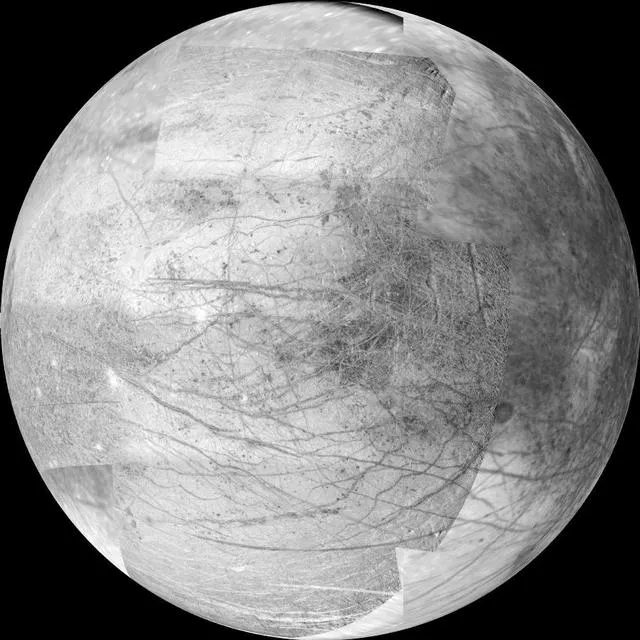
Europa Jupiter-Facing Hemisphere
 Europa's icy surface is incredibly smooth and young, with very few craters "Europa Jupiter-Facing Hemisphere" / NASA.

Scientists believe that life could exist on Europa, one of Jupiter's moons. Evidence shows that beneath Europa's thick icy crust lies a vast saltwater ocean. This ocean may contain twice as much water as all of Earth's oceans combined. The possibility of life on Europa excites scientists because liquid water is essential for life as we know it.

Europa's ocean stays liquid because of a process called tidal heating. Jupiter's powerful gravity pulls on Europa as the moon orbits the giant planet. This pulling creates friction inside Europa that generates heat. The heat prevents the ocean from freezing solid, even though Europa is extremely cold on the surface. Scientists explain that this energy source could support life without any sunlight reaching the ocean depths.

On Earth, scientists have discovered thriving ecosystems around hydrothermal vents on the ocean floor. These vents release hot, mineral-rich water from beneath Earth's crust. Organisms called extremophiles live near these vents without any sunlight. They get energy from chemicals in the hot water through a process called chemosynthesis. Europa might have similar vents on its ocean floor, providing energy for life forms.

NASA's Europa Clipper mission will help answer questions about life on this distant moon. The spacecraft will launch in 2024 and arrive at Jupiter in 2030. It will make nearly 50 close flybys of Europa to study the moon's ice shell and ocean. The mission will search for plumes of water vapor that may shoot up through cracks in the ice. Scientists can analyze these plumes for signs of life without landing on the surface.

Understanding Europa matters because it expands our knowledge of where life might exist in our solar system. If Europa harbors life, it would suggest that life may be common throughout the universe. The moon teaches us that life does not require conditions exactly like Earth's. Instead, life may thrive in many different environments across space.

Interesting Fact: Europa's icy surface is incredibly smooth and young, with very few craters. Scientists estimate the surface is only 20 to 180 million years old, suggesting that fresh ice constantly resurfaces from the ocean below.

Comprehension quiz (10 questions)

1. What lies beneath Europa's icy surface?

A vast saltwater ocean
A layer of solid rock
Frozen methane lakes
Hot lava flows

2. What causes tidal heating on Europa?

Heat from the Sun
Volcanic eruptions on the surface
Jupiter's gravitational pull creating friction
Chemical reactions in the ice

3. What does the term 'extremophiles' mean in the passage?

Organisms that live in extreme environments
Scientists who study extreme weather
Rocks found in deep ocean trenches
Spacecraft designed for harsh conditions

4. What is chemosynthesis?

A process where organisms use sunlight for energy
A process where organisms use chemicals for energy
A method of freezing water quickly
A way to measure ocean depth

5. Based on the passage, why do scientists think Europa might support life?

It has a thick atmosphere like Earth
It receives plenty of sunlight
It has liquid water and a potential energy source
It has the same temperature as Earth

6. What will the Europa Clipper mission do?

Land on Europa's surface and drill through the ice
Make close flybys to study the ice shell and ocean
Collect rock samples from Jupiter
Search for life on other moons of Saturn

7. How can scientists search for signs of life on Europa without landing on its surface?

By using telescopes from Earth
By analyzing water vapor plumes shooting through cracks
By measuring the temperature of Jupiter
By studying Europa's orbit pattern

8. Why does the discovery of life on Europa matter to our understanding of the universe?

It would prove that all planets have life
It would suggest life may be common throughout the universe
It would show that Earth is the only planet with water
It would confirm that life needs sunlight to exist

9. Europa's surface has very few craters, suggesting it is geologically young.

True
False

10. Life on Earth near hydrothermal vents requires sunlight to survive.

True
False
Who it's for

Perfect for the way you teach

Teachers
  • Build comprehension skills
  • Auto-graded quiz
  • Differentiated reading
Parents
  • Read together at home
  • Improve fluency
  • Quiet reading time
Homeschoolers
  • Reading curriculum support
  • Independent practice
  • Track Lexile growth
Topics

Reviews & Ratings

No reviews yet. Be the first to share your experience!

More reading you might love

20 more
Passage
What is Solar Radiation - reading educational content
Grades 3–7

What is Solar Radiation

science · MS-ESS1-1

Free
Passage
How Incoming Solar Radiation Changes with Latitude - reading educational content
Grades 3–7

How Incoming Solar Radiation Changes with Latitude

science · MS-ESS1-1

$1.50
Passage
Tides and Tidal Forces - reading educational content
Grades 5–8

Tides and Tidal Forces

science · MS-ESS1-1

$1.50
Passage
The Night Sky - reading educational content
Grades 5–8

The Night Sky

earth science · MS-ESS1-1

$1.50
Passage
Ancient Astronomy - reading educational content
Grades 5–8

Ancient Astronomy

earth science · MS-ESS1-1

$1.50
Passage
Tools of Modern Astronomy - reading educational content
Grades 5–8

Tools of Modern Astronomy

earth science · MS-ESS1-1

$1.50
Passage
How Astronomy Became a Science - reading educational content
Grades 5–8

How Astronomy Became a Science

earth science · MS-ESS1-1

$1.50
Passage
Earth's Rotation - reading educational content
Grades 5–8

Earth's Rotation

science · MS-ESS1-1

$1.50
Passage
Earth's Revolution - reading educational content
Grades 5–8

Earth's Revolution

science · MS-ESS1-1

$1.50
Passage
Why We Have Seasons - reading educational content
Grades 5–8

Why We Have Seasons

science · MS-ESS1-1

$1.50
Passage
Earth's Seasons - reading educational content
Grades 5–8

Earth's Seasons

science · MS-ESS1-1

$1.50
Passage
The Moon's Characteristics - reading educational content
Grades 5–8

The Moon's Characteristics

science · MS-ESS1-1

$1.50
Passage
The Sun's Characteristics - reading educational content
Grades 5–8

The Sun's Characteristics

science · MS-ESS1-1

$1.50
Passage
What Is a Galaxy? - reading educational content
Grades 5–8

What Is a Galaxy?

earth science · MS-ESS1-1

$1.50
Passage
The Milky Way: Our Home Galaxy - reading educational content
Grades 5–8

The Milky Way: Our Home Galaxy

earth science · MS-ESS1-1

$1.50
Passage
Types of Galaxies - reading educational content
Grades 5–8

Types of Galaxies

earth science · MS-ESS1-1

$1.50
Passage
The Expanding Universe - reading educational content
Grades 5–8

The Expanding Universe

earth science · MS-ESS1-1

$1.50
Passage
The Big Bang - reading educational content
Grades 5–8

The Big Bang

earth science · MS-ESS1-1

$1.50
Passage
Dark Matter and Dark Energy - reading educational content
Grades 5–8

Dark Matter and Dark Energy

earth science · MS-ESS1-1

$1.50
Passage
How Do Stars Die - reading educational content
Grades 5–8

How Do Stars Die

science · MS-ESS1-1

$1.50
Copyright © 2026 Workybooks. Made with ♥ in California.