This learning resource is available in interactive and printable formats. The interactive worksheet can be played online and assigned to students. The Printable PDF version can be downloaded and printed for completion by hand.
This comprehensive middle school science passage, designed for grades 6-8 and aligned with NGSS standard MS-PS1-1, introduces students to the concept of covalent bonds. Students will learn how atoms share electrons to form molecules, contrasting this process with ionic bonding. The passage provides clear explanations, real-world examples such as water (H₂O) and carbon dioxide (CO₂), and simple Lewis dot diagrams to illustrate electron sharing. Interactive features include a glossary of science terms, a multiple-choice quiz, writing prompts, and graphic organizers to deepen understanding. The content is scaffolded with a differentiated reading version and Spanish translations, making it accessible to a broad range of learners. With integrated audio support and engaging, standards-based activities, this resource supports inquiry-based learning and helps students build foundational chemistry skills for future science success.
CONTENT PREVIEW
Expand content preview
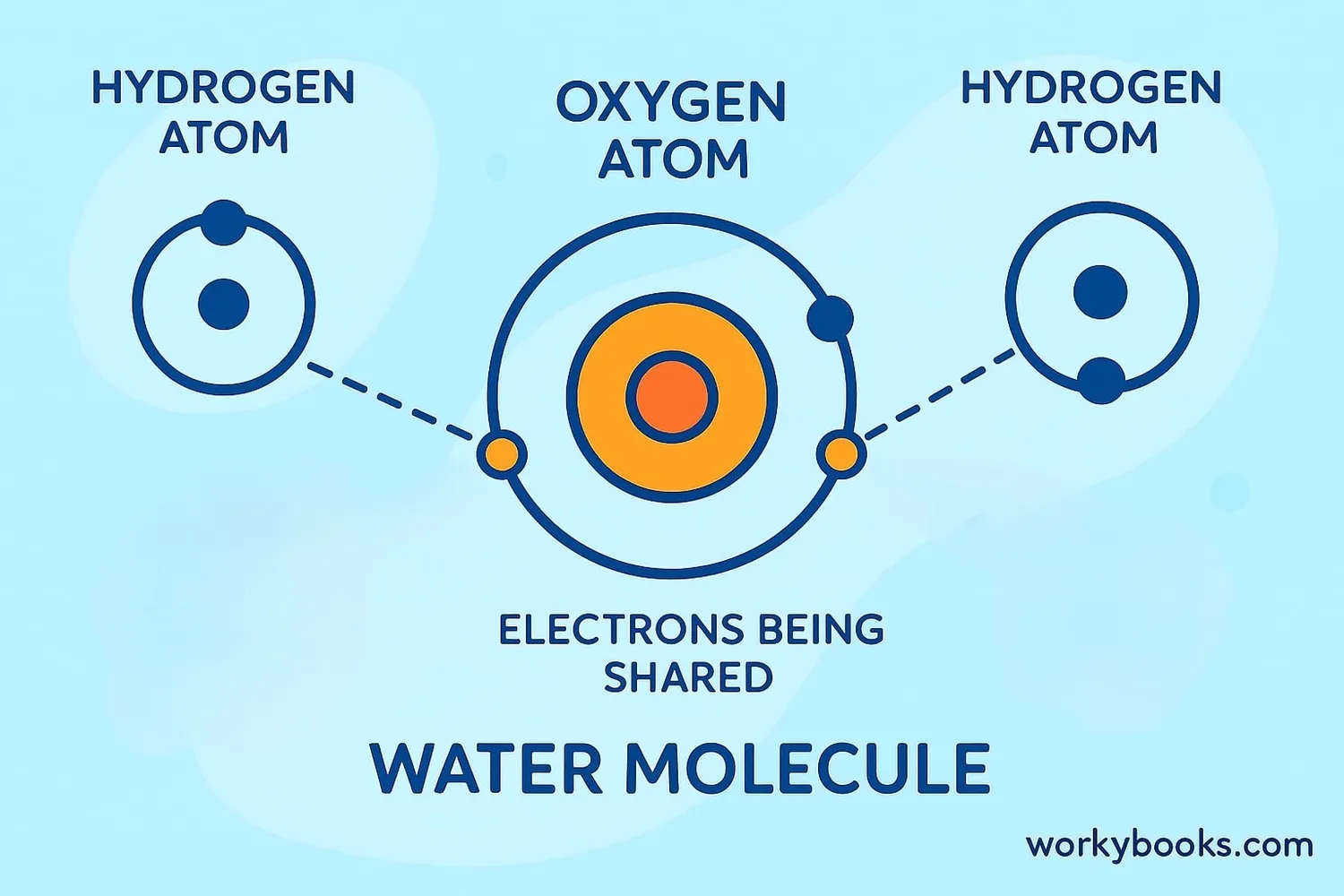
Diagram of electron sharing in covalent bonds
Covalent bonds are essential to life and matter on Earth. For example, water can dissolve many substances and carbon dioxide is crucial for plants to make food. Both water and carbon dioxide are created when atoms join together by sharing electrons, not by taking or giving them away. Understanding how atoms share electrons helps explain why molecules have the properties they do, and why some substances behave differently from others.
How Covalent Bonds Work
Atoms are made of a nucleus surrounded by electrons. When two nonmetal atoms want to fill their outer electron shells, they can share one or more pairs of electrons. This sharing creates a covalent bond, forming a molecule. For example, in a water molecule (H2O), each hydrogen atom shares one electron with oxygen, and oxygen shares one electron with each hydrogen. This creates two single covalent bonds. A double covalent bond, like in carbon dioxide (CO2), involves two pairs of shared electrons between carbon and each oxygen atom. Sometimes, atoms share three pairs of electrons, forming a triple bond, as seen in nitrogen gas (N2). Lewis dot structures use dots to show these shared electrons, making it easier to see how atoms are connected.
Covalent vs. Ionic Compounds
Covalent bonds are different from ionic bonds. In ionic bonding, atoms transfer electrons, creating positive and negative ions that stick together. Table salt (NaCl) is an example of an ionic compound. In covalent compounds, like water or oxygen gas (O2), there are no charged ions. Instead, atoms form stable molecules by sharing electrons. Molecules made from covalent bonds tend to have lower melting points and may not conduct electricity, unlike many ionic compounds. These differences are crucial in chemistry and daily life, affecting everything from how water dissolves salt to how plastics are made.
Applications and Broader Connections
Many substances important to life are made of covalent molecules. For example, DNA, proteins, and sugars all have covalent bonds. Chemists use the idea of electron sharing to design new medicines and materials. The study of covalent bonding also helps us understand chemical reactions, climate change (because of carbon dioxide), and even how our bodies use oxygen. Understanding covalent bonds connects to larger principles, such as the conservation of matter and how energy is stored in chemical bonds.
Covalent bonds are a foundation of chemistry, explaining how atoms stick together to form the world around us. From the air we breathe to the food we eat, covalent molecules shape our lives and our planet. As science advances, new discoveries about how atoms bond may lead to new technologies and solutions for global challenges.
Interesting Fact: The oxygen we breathe (O2) is held together by a double covalent bond, making it stable and essential for life!
What is the main way atoms form covalent bonds?
By sharing electronsBy giving away electronsBy taking electrons from other atomsBy becoming ions
Which of the following is an example of a molecule formed by covalent bonds?
Two pairs of electrons are sharedOne electron is transferredAtoms repel each otherThree pairs of electrons are shared
In the passage, the term 'molecule' refers to what?
A group of atoms held together by covalent bondsAn atom by itselfA group of ionsA metal crystal
What is shown in a Lewis dot structure?
Shared electrons between atomsElement namesPhysical appearance of moleculesThe color of the atoms
How are ionic bonds different from covalent bonds?
Ionic bonds involve electron transfer; covalent bonds involve electron sharingIonic bonds only form in waterCovalent bonds make ionsIonic bonds use Lewis dot structures
Which statement best describes a triple covalent bond?
Three pairs of electrons are shared between two atomsIt only happens in metalsAtoms lose three electronsIt is weaker than a single bond
Why do molecules with covalent bonds tend to have lower melting points?
Because there are no strong attractions like in ionic compoundsBecause they are heavierBecause they conduct electricityBecause they are made of metals
True or False: Covalent bonds always form between metals and nonmetals.
FalseTrue
True or False: DNA, proteins, and sugars all have covalent bonds.
TrueFalse
Perfect For:
👩🏫 Teachers
• Reading comprehension practice
• Auto-graded assessments
• Literacy skill development
👨👩👧👦 Parents
• Reading practice at home
• Comprehension improvement
• Educational reading time
🏠 Homeschoolers
• Reading curriculum support
• Independent reading practice
• Progress monitoring
Reading Features:
📖
Reading Passage
Engaging fiction or nonfiction text
❓
Comprehension Quiz
Auto-graded questions
📊
Instant Feedback
Immediate results and scoring
📄
Printable Version
Download for offline reading
🔊
Read Aloud
Voice-over with word highlighting
Reviews & Ratings
No reviews yet. Be the first to share your experience!
Related Content
Atomic Structure
This reading passage on Atomic Structure provides middle school students with an accessible explanation of the fundament...
MS-PS1-1RI.6.3RI.7.1
Parts of an Atom
This reading passage on Parts of an Atom provides middle school students with a structured and accessible explanation of...
MS-PS1-1RI.6.3RI.7.1
Chemical Bonds
This reading passage on Chemical Bonds provides middle school students with a clear explanation of how and why atoms con...
MS-PS1-1RI.6.3RI.7.1
The Freezing Point of Water
This science reading passage, titled 'The Freezing Point of Water', introduces students to a key physical science concep...
MS-PS1-1RI.6.3RI.7.1
Physical Properties of Matter
This comprehensive reading passage introduces grades 6-8 students to the concept of physical properties of matter, perfe...
MS-PS1-1
Mixtures and Pure Substances
This middle school science passage provides an in-depth exploration of mixtures and pure substances, directly aligned to...
MS-PS1-1
Types of Mixtures
This comprehensive science passage for grades 6-8 introduces students to the concept of mixtures, focusing on distinguis...
MS-PS1-1
Solutions, Suspensions, and Colloids
This comprehensive science passage explores the differences between solutions, suspensions, and colloids, focusing on ho...
MS-PS1-1
The Nature of Science
This passage explores the nature of science for middle school students, aligning with NGSS standards MS-ETS1-4, MS-PS1-1...
MS-ETS1-4MS-PS1-1MS-LS1-1
Scientific Theories
This reading passage for grades 6-8 introduces students to the concept of scientific theories, emphasizing that these ar...
MS-PS1-1MS-PS1-4MS-PS3-4SCIENCE AND ENGINEERING PRACTICES
Particle Model of Matter
This comprehensive science reading passage for grades 6-8 explores the particle model of matter, aligning with NGSS stan...
MS-PS1-1MS-PS1-4
Valence Electrons
This middle school science passage introduces students to the concept of valence electrons, the outermost electrons that...
MS-PS1-1
The Idea of the Atom
This informational science passage introduces middle school students (grades 6-8) to the concept that all matter is made...
MS-PS1-1
Protons, Neutrons, and Electrons
This comprehensive middle school science passage explores the roles of protons, neutrons, and electrons, the three main ...
MS-PS1-1
What are Ions
This passage introduces middle school students to the concept of ions, explaining the processes by which atoms gain or l...
MS-PS1-1
Nucleus of the Atom
This comprehensive passage for grades 6-8 introduces students to the nucleus of the atom, the dense center that contains...
MS-PS1-1
How Atoms Differ
This middle school science reading passage, aligned with NGSS standard MS-PS1-1, explores the fundamental differences am...
MS-PS1-1
Isotopes
This middle school science passage explores the concept of isotopes, which are atoms of the same element with different ...
MS-PS1-1
Compounds vs. Mixtures
This educational passage for grades 6-8 explores the fundamental differences between compounds and mixtures, aligning wi...
MS-PS1-1
Organizing the Elements
This passage for middle school science explores how scientists organized the elements as more were discovered, leading t...