

This learning resource is available in interactive and printable formats. The interactive worksheet can be played online and assigned to students. The Printable PDF version can be downloaded and printed for completion by hand.
This middle school science passage, aligned with NGSS standard MS-PS1-1, introduces students to the concept of density in solids. Students learn why some solids, such as metals, are denser than others like wood or plastic, and how atomic structure and packing influence density. The passage explains how density is measured, provides comparative examples using density tables, and demonstrates how scientists use density to identify unknown materials. Real-world applications are included, such as why ice floats in water and how engineers use density in construction. Audio integration helps support diverse learners. The passage is accompanied by a glossary, Spanish translation, differentiated version, comprehension quiz, writing prompts, and graphic organizers. This resource deepens understanding of materials science, strengthens skills in comparing and analyzing physical properties, and fosters scientific thinking about systems and interactions.
CONTENT PREVIEW
Expand content preview
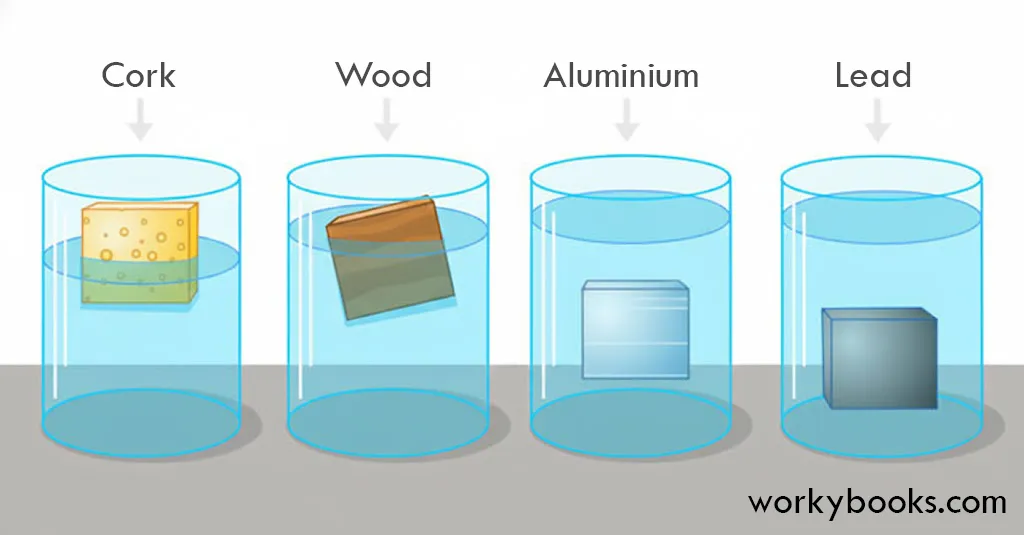
Comparing solid densities by water displacement.
Density is a property of matter that determines whether an object will float or sink when placed in a liquid. For example, a rock drops to the bottom of a lake, but a piece of wood floats. Scientists use density to compare and identify materials, because every substance has its own typical density. Understanding why some solids are denser than others helps us learn more about the structure of matter and how materials are used in the real world.
The Mechanism of Density Density measures how much mass is packed into a certain volume. The mathematical formula for density is D = mass/volume. Solids are made of atoms arranged in different ways. Metals like iron have heavy atoms packed tightly together, making them very dense. Wood has lighter atoms and a more open structure, so it is less dense. Ice is less dense than liquid water because its molecules are arranged in a way that leaves more empty space. This explains why ice floats while most rocks sink. Scientists use precise instruments to measure mass and volume and calculate density, often using density tables to compare materials.
Comparing and Identifying Solids Different solids have different densities. For example, the density of aluminum is about 2.7 grams per cubic centimeter (g/cm³), while wood can range from 0.4 to 0.8 g/cm³, and granite rock is about 2.7 g/cm³. Plastics vary, but most common plastics are less dense than metals and rocks. To identify an unknown solid, scientists measure its mass and volume, calculate its density, and compare it to known density values. This method is used in geology to identify rocks and minerals, in engineering to select building materials, and even in recycling to sort plastics and metals.
Density in the Real World The concept of density is important in many areas of science and technology. Ships are built from steel, which is denser than water, but their overall shape means they displace enough water to float. Submarines adjust their density by taking in or releasing water to dive or surface. Environmental scientists study density to understand why oil spills float on water and how pollutants travel. Even health scientists use density to study bones and diagnose diseases. Density connects to larger scientific principles, like the structure of matter and the behavior of materials in different environments.
Understanding density helps us explain everyday phenomena, identify unknown substances, and design safer, more efficient technology. It is a key idea in physical science, linking atomic structure to observable properties.
Interesting Fact: Gold is one of the densest solids found in nature, with a density of 19.3 g/cm³—over 24 times denser than water!
What does density measure?
How much mass is in a certain volumeHow fast an object movesThe color of a materialHow hard a substance is
Why does ice float on water?
Ice is less dense than waterIce is heavier than waterIce is made of metalIce has no atoms
What is the typical density of aluminum as stated in the passage?
0.5 g/cm³2.7 g/cm³7.8 g/cm³19.3 g/cm³
According to the passage, what property is used to identify unknown solids?
DensityColorSmellTexture
What does the word "property" mean as used in the passage?
A quality or characteristic of a materialA type of buildingSomething you ownA scientific formula
What does "identify" mean in the passage?
To find out what something isTo break something apartTo make something largerTo heat something
Why are metals usually denser than wood?
Metals have heavier atoms packed closely togetherWood is made of metal atomsWood is always heavier than metalMetals have more color
How do scientists use density tables?
To compare the density of substances and identify materialsTo measure temperatureTo find the weight of an objectTo see what color something is
Ships float because they are made of wood.
TrueFalse
Gold is more than 20 times denser than water.
TrueFalse
Perfect For:
👩🏫 Teachers
• Reading comprehension practice
• Auto-graded assessments
• Literacy skill development
👨👩👧👦 Parents
• Reading practice at home
• Comprehension improvement
• Educational reading time
🏠 Homeschoolers
• Reading curriculum support
• Independent reading practice
• Progress monitoring
Reading Features:
📖
Reading Passage
Engaging fiction or nonfiction text
❓
Comprehension Quiz
Auto-graded questions
📊
Instant Feedback
Immediate results and scoring
📄
Printable Version
Download for offline reading
🔊
Read Aloud
Voice-over with word highlighting
Reviews & Ratings
No reviews yet. Be the first to share your experience!
Related Content
Atomic Structure
This reading passage on Atomic Structure provides middle school students with an accessible explanation of the fundament...
MS-PS1-1RI.6.3RI.7.1
Parts of an Atom
This reading passage on Parts of an Atom provides middle school students with a structured and accessible explanation of...
MS-PS1-1RI.6.3RI.7.1
Chemical Bonds
This reading passage on Chemical Bonds provides middle school students with a clear explanation of how and why atoms con...
MS-PS1-1RI.6.3RI.7.1
The Freezing Point of Water
This science reading passage, titled 'The Freezing Point of Water', introduces students to a key physical science concep...
MS-PS1-1RI.6.3RI.7.1
Physical Properties of Matter
This comprehensive reading passage introduces grades 6-8 students to the concept of physical properties of matter, perfe...
MS-PS1-1
Mixtures and Pure Substances
This middle school science passage provides an in-depth exploration of mixtures and pure substances, directly aligned to...
MS-PS1-1
Types of Mixtures
This comprehensive science passage for grades 6-8 introduces students to the concept of mixtures, focusing on distinguis...
MS-PS1-1
Solutions, Suspensions, and Colloids
This comprehensive science passage explores the differences between solutions, suspensions, and colloids, focusing on ho...
MS-PS1-1
The Nature of Science
This passage explores the nature of science for middle school students, aligning with NGSS standards MS-ETS1-4, MS-PS1-1...
MS-ETS1-4MS-PS1-1MS-LS1-1
Scientific Theories
This reading passage for grades 6-8 introduces students to the concept of scientific theories, emphasizing that these ar...
MS-PS1-1MS-PS1-4MS-PS3-4SCIENCE AND ENGINEERING PRACTICES
Particle Model of Matter
This comprehensive science reading passage for grades 6-8 explores the particle model of matter, aligning with NGSS stan...
MS-PS1-1MS-PS1-4
Valence Electrons
This middle school science passage introduces students to the concept of valence electrons, the outermost electrons that...
MS-PS1-1
The Idea of the Atom
This informational science passage introduces middle school students (grades 6-8) to the concept that all matter is made...
MS-PS1-1
Protons, Neutrons, and Electrons
This comprehensive middle school science passage explores the roles of protons, neutrons, and electrons, the three main ...
MS-PS1-1
What are Ions
This passage introduces middle school students to the concept of ions, explaining the processes by which atoms gain or l...
MS-PS1-1
Nucleus of the Atom
This comprehensive passage for grades 6-8 introduces students to the nucleus of the atom, the dense center that contains...
MS-PS1-1
How Atoms Differ
This middle school science reading passage, aligned with NGSS standard MS-PS1-1, explores the fundamental differences am...
MS-PS1-1
Isotopes
This middle school science passage explores the concept of isotopes, which are atoms of the same element with different ...
MS-PS1-1
Compounds vs. Mixtures
This educational passage for grades 6-8 explores the fundamental differences between compounds and mixtures, aligning wi...
MS-PS1-1
Organizing the Elements
This passage for middle school science explores how scientists organized the elements as more were discovered, leading t...