Does Earth's Mantle Flow Like Liquid
Interactive passage with audio narration, comprehension questions, and printable PDF.
By completing this purchase you agree to our Terms of Use and Privacy Policy. Your subscription renews automatically until you cancel. You can cancel anytime from your account settings. All sales are final and non-refundable. Digital content is available for download in your account immediately upon purchase.
What's included
Does Earth's Mantle Flow Like Liquid preview and details
About this printable Does Earth's Mantle Flow Like Liquid science reading passage, NGSS-aligned (Grades 5-8)
Sample passage and quiz from Does Earth's Mantle Flow Like Liquid
Reading passage and comprehension quiz preview
Does Earth's Mantle Flow Like Liquid
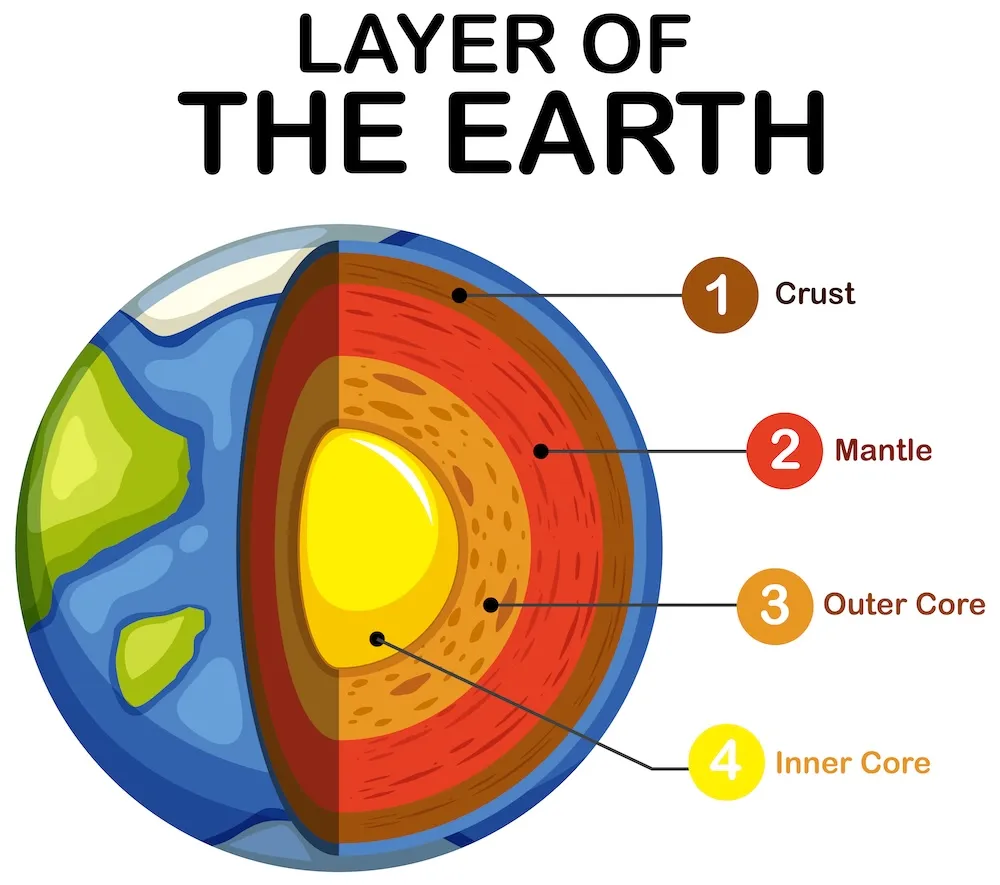
Is Earth's mantle liquid or solid? Many believe the mantle is liquid rock, but scientists explain that the mantle is actually solid. However, this solid rock can flow and bend over very long periods of time. Understanding this solid-that-flows concept is essential for explaining how Earth's surface changes.
The mantle sits between Earth's crust and core. It extends about 2,900 kilometers deep into our planet. Pressure from the weight of rock above and extreme heat from Earth's core create unusual conditions. Temperatures in the mantle can reach 3,700 degrees Celsius. Under these conditions, solid rock behaves differently than it does at Earth's surface.
Scientists use the term plasticity to describe how solid materials can slowly change shape without breaking. The mantle has high plasticity because of its heat and pressure. Think of silly putty as a comparison. If you hit silly putty quickly, it snaps like a solid. But if you leave it on a table, it slowly oozes and spreads. The mantle works similarly, though much more slowly. Another helpful comparison is a glacier. Glaciers are solid ice, yet they flow downhill over many years. The mantle flows in a similar way, moving just a few centimeters each year.
Evidence shows that mantle rock can flow because of a property called viscosity. Viscosity measures how easily a material flows. Water has low viscosity and flows quickly. Honey has higher viscosity and flows slowly. The mantle has extremely high viscosity, so it flows very, very slowly. Scientists observe this movement by studying seismic waves from earthquakes. These waves travel through Earth and reveal that the mantle is solid, not liquid.
The mantle's ability to flow has real consequences for our planet. In Hawaii, scientists measure how the islands slowly sink into the mantle over time. The weight of the volcanic islands pushes down on the solid mantle below. The mantle rock slowly flows out of the way, allowing the islands to sink about one centimeter every ten years. This process provides direct evidence that solid mantle rock can flow.
Why does this matter? The flowing mantle drives convection currents deep inside Earth. Hot mantle rock slowly rises toward the surface while cooler rock sinks. These currents move the giant tectonic plates that make up Earth's crust. Without the mantle's ability to flow, we would not have earthquakes, volcanoes, or mountain building. The solid mantle's slow movement shapes our planet's surface and makes Earth a dynamic, changing world.
Interesting Fact: Scientists can recreate mantle conditions in laboratories by squeezing rocks with tremendous pressure and heating them to extreme temperatures. In these experiments, solid rocks actually bend and flow, confirming what happens deep inside Earth.
Comprehension quiz (10 questions)
1. What is the state of matter of Earth's mantle?
2. How fast does the mantle typically move each year?
3. What does the term 'viscosity' mean in the passage?
4. Which property allows the mantle to slowly change shape without breaking?
5. Based on the passage, why can scientists conclude that the mantle is solid and not liquid?
6. What causes the mantle to have the ability to flow?
7. How do the Hawaiian Islands provide evidence that the mantle flows?
8. What happens to hot mantle rock in convection currents?
9. True or False: The mantle is liquid rock that flows quickly.
10. True or False: Without the mantle's ability to flow, Earth would not have volcanoes or earthquakes.
Perfect for the way you teach
- Build comprehension skills
- Auto-graded quiz
- Differentiated reading
- Read together at home
- Improve fluency
- Quiet reading time
- Reading curriculum support
- Independent practice
- Track Lexile growth