Enslaved People Escape to Union Lines — Reading Comprehension
Rate this
Premium Resource
Present
Present in classroom. No work saved
Assign
Classroom with student accounts, Track progress
Quick Play
No student accounts, assign with a link
Grades
6
7
8
PRINT+DIGITAL RESOURCE
This learning resource is available in interactive and printable formats. The interactive worksheet can be played online and assigned to students. The Printable PDF version can be downloaded and printed for completion by hand.
This reading passage explores the experiences of enslaved people who escaped to Union lines during the American Civil War. It examines their motivations, the risks they faced, and the crucial contributions they made to the Union cause. The passage addresses concepts such as self-emancipation and contraband, and explains the complex choices faced by both the Union and the enslaved individuals. Students will engage with key academic vocabulary, analyze cause and effect, and practice historical reasoning. This resource aligns with HSS 8.10.6 and CCSS.RI.6-8.1, RI.6-8.6 standards. Included are differentiated reading versions, a Spanish translation, glossary, comprehension quiz, writing prompts, graphic organizers, and a timeline. Audio read-aloud and activities support diverse learners. This is a complete U.S. History reading lesson suitable for classrooms and independent study.
CONTENT PREVIEW
Expand content preview
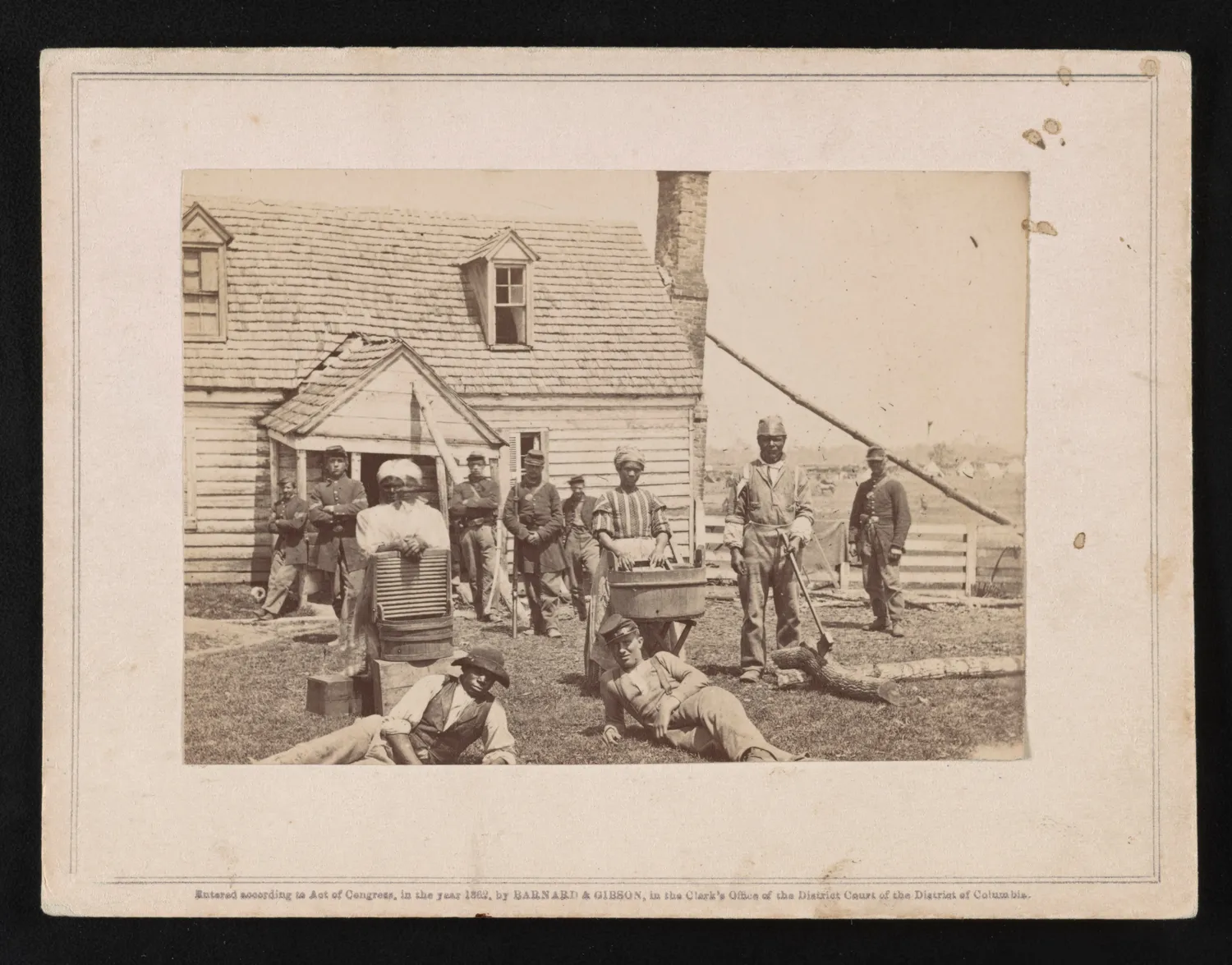
"Contrabands at headquarters of General Lafayette LCCN2014646902" by Gibson, James F., 1828-, photographer; Barnard & Gibson, copyright claimant / Source: Wikimedia Commons (Public domain).
During the Civil War, thousands of enslaved people in the southern United States made the difficult decision to escape from plantations and seek safety with advancing Union armies. For these men, women, and children, the path to freedom was filled with danger, uncertainty, and hope. As the Union army moved deeper into Confederate territory, more enslaved people saw a chance to gain their liberty by reaching Union lines.
This process was not simple or risk-free. Enslaved people often traveled at night, avoiding patrols and hostile locals who might return them to their enslavers. Some walked for miles, while others hid in swamps or forests. Upon arrival at Union camps, these individuals faced a new set of challenges. Many Union officers were unsure about what to do with escaped slaves. Early in the war, U.S. law still recognized slavery in the South, so there was debate about whether to return escapees or offer them protection.
The situation changed in 1861, when General Benjamin Butler declared that enslaved people who reached Union lines would be considered contraband of war. By calling them contraband, the Union army treated escaped slaves as property seized from the enemy, which allowed them to keep the individuals safe instead of returning them to bondage. This decision marked a turning point. Union camps soon filled with thousands of people seeking freedom and protection.
These self-emancipated individuals were sometimes called contrabands. They supported the Union army in multiple ways. Many worked as laborers, cooks, or nurses. Their knowledge of local geography and conditions often provided valuable intelligence to Union commanders. Over time, some men were allowed to join the Union military, forming regiments such as the United States Colored Troops. Their courage and commitment challenged the Union to reconsider the goals of the war and to fight not only for national unity, but also for the end of slavery.
However, living conditions behind Union lines were often harsh. Crowded camps, disease, and lack of supplies made life difficult for the escapees. Despite these hardships, many believed the risk was worth the chance to control their own destinies. Their decisions forced Union leaders to confront the issue of slavery and contributed to the passage of the Emancipation Proclamation in 1863. This document declared freedom for enslaved people in Confederate states, making the destruction of slavery an official Union war aim.
The story of enslaved people escaping to Union lines is complex. It involves bravery, uncertainty, and the struggle for human rights. It shows how individuals took action to change their own futures and influenced the course of American history. Their choices and sacrifices helped transform the Civil War from a conflict over union into a fight for freedom.
Interesting Fact: Some Union generals at first returned escapees to slaveholders, but public pressure and the actions of the escapees themselves helped change government policy.
Who declared escapees 'contraband' of war?
General ButlerPresident LincolnGeneral GrantGeneral Lee
What document was issued in 1863?
Emancipation ProclamationBill of RightsDeclaration of IndependenceThe Constitution
What was a main reason enslaved people escaped?
To gain freedomTo join ConfederatesTo find new landTo meet generals
Why did Union camps become crowded?
Many escapees arrivedMore soldiers joinedFewer supplies existedCamps were small
How did escapees help the Union army?
Provided labor and intelligenceBuilt Confederate fortsFought against the UnionBecame plantation owners
What does 'contraband' mean in this passage?
Property taken from the enemyA type of foodA military leaderA secret plan
True or False: All Union generals helped escapees.
TrueFalse
What is a 'regiment'?
A group of soldiersA secret codeA safe houseA type of ship
Perfect For:
👩🏫 Teachers
• Reading comprehension practice
• Auto-graded assessments
• Literacy skill development
👨👩👧👦 Parents
• Reading practice at home
• Comprehension improvement
• Educational reading time
🏠 Homeschoolers
• Reading curriculum support
• Independent reading practice
• Progress monitoring
Reading Features:
📖
Reading Passage
Engaging fiction or nonfiction text
❓
Comprehension Quiz
Auto-graded questions
📊
Instant Feedback
Immediate results and scoring
📄
Printable Version
Download for offline reading
🔊
Read Aloud
Voice-over with word highlighting
Reviews & Ratings
No reviews yet. Be the first to share your experience!
Related Content
Civil War Causes
This comprehensive U.S. history reading passage investigates the complex causes of the Civil War, focusing on the debate...
D2.HIS.2.3-5D2.HIS.3.3-5RI.4.3RI.4.4
Women's Roles in Civil War
This reading passage explores the critical roles women played during the U.S. Civil War, highlighting how they managed f...
HSS 8.10.7RI.6-8.1RI.6-8.2
Challenges After the Civil War
This engaging history reading passage explores the key challenges Americans faced after the Civil War, such as rebuildin...
D2.HIS.1-6.3-5RI.4.3RI.4.4W.4.2
African American Soldiers in Civil War
This engaging history reading passage examines the pivotal role African American soldiers played in the American Civil W...
D2.HIS.2.3-5D2.HIS.3.3-5RI.4.3RI.4.4
Children and Women During the Civil War
This engaging history reading passage explores the important roles of children and women during the Civil War. Aligned w...
D2.HIS.2.3-5D2.HIS.3.3-5D2.HIS.16.3-5RI.4.1
Sharecropping System After Civil War
This engaging U.S. history reading passage examines the rise of the sharecropping system in the South after the Civil Wa...
D2.HIS.2.3-5D2.HIS.3.3-5RI.4.3RI.4.4
Home Front Life Civil War
This engaging U.S. history reading passage explores daily life on the home front during the Civil War, focusing on how c...
The Civil War Finally Ends
This engaging reading passage explores the end of the Civil War, focusing on the events of 1865 when General Robert E. L...
D2.HIS.1-6.3-5RI.4.3RI.4.4RI.4.10
Fort Sumter 1861: Civil War Begins
This passage explores the pivotal events at Fort Sumter in April 1861, marking the beginning of the American Civil War. ...
D2.HIS.2.3-5D2.HIS.3.3-5RI.4.3RI.4.4
Clara Barton: Civil War Nurse and Founder
This comprehensive U.S. history reading passage explores the life and legacy of Clara Barton, a pivotal figure during th...
D2.HIS.2.3-5D2.HIS.3.3-5RI.4.3RI.4.4
Surrender at Appomattox
This reading passage explores the historic surrender at Appomattox Court House in April 1865, which marked the conclusio...
HSS 8.10.7RI.6-8.1RI.6-8.6
Rebuilding the South
This engaging history reading passage explores the challenges and debates over the future of the South after the U.S. Ci...
Civil Rights Act of 1964
This reading passage explores the Civil Rights Act of 1964, a landmark piece of U.S. legislation that outlawed discrimin...
HSS 11.10.5RI.6-8.1RI.6-8.6
Advantages and Disadvantages: North vs. South
This history reading passage examines the contrasting strengths of the Union and Confederacy during the U.S. Civil War. ...
HSS 8.10.5RI.6-8.1RI.6-8.3
Segregation in America After World War II
This rigorous U.S. history reading passage explores the persistence of segregation and continued inequality in the Unite...
D2.HIS.2.3-5D2.HIS.3.3-5RI.4.3RI.4.4
African Americans Fight for the Union
This engaging U.S. history reading passage explores the important role African Americans played in helping the Union dur...
D2.HIS.2.3-5D2.HIS.14.3-5RI.4.3RI.4.4
New York Draft Riots 1863
This engaging reading passage explores the 1863 New York City Draft Riots, one of the most turbulent moments in American...
D2.HIS.2.3-5D2.HIS.3.3-5RI.4.3RI.4.4
New Schools in the South
This U.S. history reading passage explores the creation of new public schools in the Southern United States during and a...
Soldiers' Letters from the Battlefield
This passage examines the experiences of Civil War soldiers by analyzing their letters from the battlefield. Students wi...
African American Political Leaders
This passage examines the significant changes for African Americans in the United States during the Reconstruction era a...