Extrusive Igneous Rocks
Interactive passage with audio narration, comprehension questions, and printable PDF.
By completing this purchase you agree to our Terms of Use and Privacy Policy. Your subscription renews automatically until you cancel. You can cancel anytime from your account settings. All sales are final and non-refundable. Digital content is available for download in your account immediately upon purchase.
What's included
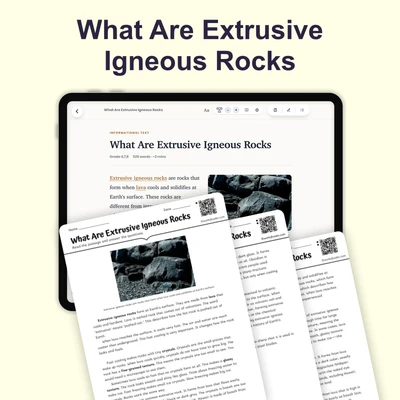
Extrusive Igneous Rocks preview and details
About this printable Extrusive Igneous Rocks science reading passage, NGSS-aligned (Grades 3-8)
Sample passage and quiz from Extrusive Igneous Rocks
Reading passage and comprehension quiz preview
Extrusive Igneous Rocks
Extrusive Igneous Rocks
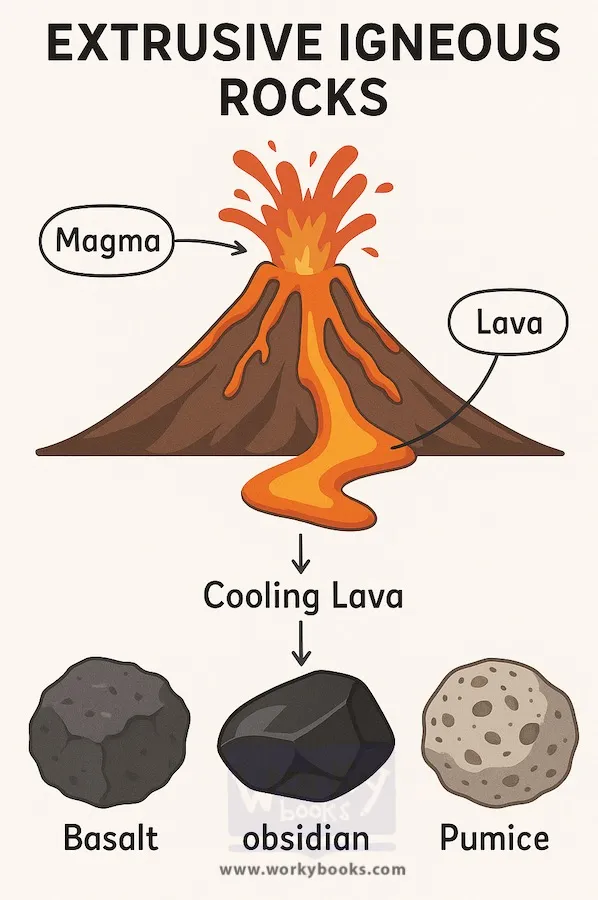
Some rocks are born in a flash when hot, melted rock called lava bursts out of a volcano and cools quickly on Earth's surface. These rocks are called extrusive igneous rocks. The word "extrusive" means the rock formed outside, or on top of, the ground.
The journey of these rocks starts deep inside Earth, where intense heat melts solid rock into magma. Pressure pushes the magma up through cracks and openings until it erupts out of a volcano as lava. Once the lava is out in the open air (or underwater), it cools and hardens very fast—sometimes in just minutes!
Because the lava cools so quickly, there isn't time for big crystals to grow. This is why extrusive igneous rocks have tiny crystals or can even look like smooth, shiny glass. Think of it like ice cream: if you freeze it very fast, it stays smooth; if you freeze it slowly, big ice crystals form. Extrusive rocks are like flash-frozen lava popsicles!
There are several cool types of extrusive igneous rocks you might find or see in collections. Basalt is the most common. It is dark gray or black and makes up most of the ocean floors and the Hawaiian islands. Obsidian is shiny, black, and looks like glass. Long ago, people used obsidian to make sharp arrowheads. Pumice is so full of air bubbles that it can float on water! Scoria is rough, red or black, and full of holes from escaping gas bubbles.
You can find extrusive igneous rocks in places with volcanoes, such as Hawaii, Iceland, and Yellowstone National Park. Next time you visit a rock collection or see a volcano on TV, look for these special rocks made from flash-frozen lava!
Interesting Fact: The ocean floor is mostly made of basalt, an extrusive igneous rock!
Comprehension quiz (8 questions)
1. What forms extrusive igneous rocks?
2. What is magma?
3. Which rock can float on water?
4. Why are crystals in extrusive rocks small?
5. Where can you find basalt?
6. What is obsidian used for?
7. Extrusive igneous rocks form inside Earth. True or false?
8. What does 'extrusive' mean?
Perfect for the way you teach
- Build comprehension skills
- Auto-graded quiz
- Differentiated reading
- Read together at home
- Improve fluency
- Quiet reading time
- Reading curriculum support
- Independent practice
- Track Lexile growth