First Scientist To Use The Telescope In Astronomy — Reading Comprehension
Rate this
Premium Resource
Present
Present in classroom. No work saved
Assign
Classroom with student accounts, Track progress
Quick Play
No student accounts, assign with a link
Grades
6
PRINT+DIGITAL RESOURCE
This learning resource is available in interactive and printable formats. The interactive worksheet can be played online and assigned to students. The Printable PDF version can be downloaded and printed for completion by hand.
This audio-integrated passage introduces students to Galileo Galilei, often called the "father of observational astronomy," and his revolutionary use of the telescope. Students will learn about his groundbreaking discoveries, such as the moons of Jupiter and the phases of Venus, and how these observations changed our understanding of the solar system. The passage explains key terms like 'observational astronomy' and 'celestial bodies' in simple language suitable for a 6th-grade reading level. Aligned with NGSS MS-ESS1-3, it helps students analyze and interpret data to determine scale properties of objects in the solar system by understanding how early astronomers made their observations. This resource includes engaging activities like multiple-choice questions, a glossary, and short answer questions to reinforce learning about Galileo's contributions to science.
CONTENT PREVIEW
Expand content preview
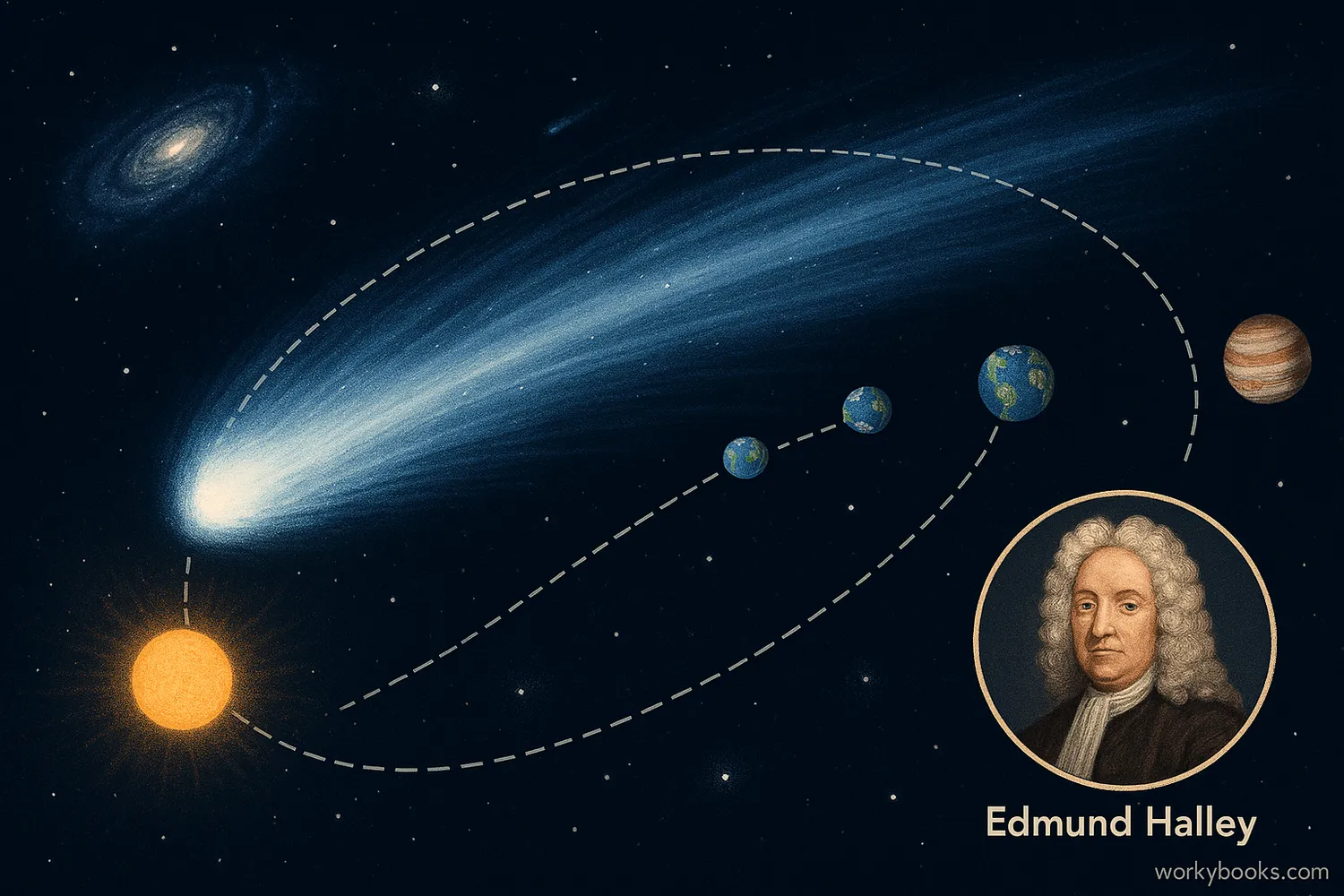
Elliptical orbit of Halley’s Comet illustrating its return path and cosmic context.
Have you ever looked up at the night sky and wondered about the amazing things floating in space? One of the most famous objects is a comet called Halley's Comet. This incredible space rock has fascinated people for thousands of years. It's like a dusty snowball that travels around the Sun, appearing in our sky only once in a long while. Understanding Halley's Comet helps us learn about the solar system and the huge distances involved.
A comet is a small, icy body in space that, when it gets close to the Sun, warms up and releases gases. This creates a visible atmosphere, or coma, and often a tail. Halley's Comet is particularly special because it's a periodic comet, meaning it returns regularly. Its orbit, the path it takes around the Sun, is an elongated oval shape, called an ellipse. This is different from the nearly circular orbits of planets like Earth.
The comet is named after an English astronomer named Edmund Halley. In the 17th century, Halley studied records of comets that appeared in 1531, 1607, and 1682. He noticed that these appearances were separated by roughly the same amount of time. Using Isaac Newton's laws of motion and gravity, Halley made a remarkable prediction: he proposed that these were all sightings of the same comet, and it would return in 1758. Halley died before he could see his prediction come true, but the comet did indeed return, just as he had calculated! This was a huge scientific achievement and proved that comets are also bound by the laws of gravity.
Halley's Comet orbits the Sun once every 75 to 76 years. Imagine that – it takes a human's entire lifetime to see it twice! Its last visit was in 1986, which means many of you weren't even born yet. Its next expected appearance will be in the year 2061. This long orbital period is a perfect example of the vast scale properties of objects in our solar system. The comet travels far beyond the orbits of Mars and Jupiter, almost reaching the orbit of Neptune, before turning back towards the Sun.
When Halley's Comet approaches the Sun, the ice on its surface turns directly into gas, creating the spectacular bright coma and a long tail that can stretch for millions of kilometers. This tail is made of dust and gas pushed away from the comet by the solar wind and radiation from the Sun. Studying comets like Halley's helps scientists understand the early solar system, as comets are believed to be leftover materials from when our solar system first formed.
Observing Halley's Comet offers a unique chance to witness a piece of history and a cosmic marvel. Its predictable return reminds us of the orderly, yet vast and dynamic, nature of our solar neighborhood. By analyzing its orbit and past appearances, astronomers continue to refine our understanding of these celestial wanderers.
Fun Fact: The Bayeux Tapestry, a famous embroidery from the 11th century, depicts a comet that is believed to be Halley's Comet appearing in 1066!
Who is Halley's Comet named after?
Edmund HalleyIsaac NewtonGalileo GalileiJohannes Kepler
How long is one orbit of Halley's Comet?
10-20 years75-76 yearsOver 100 years50-51 years
What shape is Halley's Comet's orbit?
Perfect circleSquare shapeElongated oval (ellipse)Straight line
Why is Halley's Comet called 'periodic'?
It changes colorIt comes back regularlyIt has a short tailIt is very small
What happens when a comet nears the Sun?
It gets colderIt speeds up slowlyIt forms a tail and comaIt becomes invisible
Why was Halley's prediction important?
It proved Earth was flatIt showed comets follow gravityIt explained the moonIt made stars brighter
What is a comet often compared to?
A hot rockA dusty snowballA giant starA small planet
When was Halley's Comet last seen?
1758206119861066
If a comet had a very short orbital period, what could be true?
It would be seen oftenIt would be very farIt would have no tailIt would be very hot
How would seeing Halley's Comet twice feel?
Common experienceVery rare opportunityDifficult to recallLike seeing the moon
Perfect For:
👩🏫 Teachers
• Reading comprehension practice
• Auto-graded assessments
• Literacy skill development
👨👩👧👦 Parents
• Reading practice at home
• Comprehension improvement
• Educational reading time
🏠 Homeschoolers
• Reading curriculum support
• Independent reading practice
• Progress monitoring
Reading Features:
📖
Reading Passage
Engaging fiction or nonfiction text
❓
Comprehension Quiz
Auto-graded questions
📊
Instant Feedback
Immediate results and scoring
📄
Printable Version
Download for offline reading
🔊
Read Aloud
Voice-over with word highlighting
Reviews & Ratings
No reviews yet. Be the first to share your experience!
Related Content
Earth: Our Home in Space
This engaging Grade 4-5 science passage, aligned to NGSS, introduces students to Earth's special place in the solar syst...
Tools and Technology in Earth Science
This middle school science reading passage explores the wide range of tools and technologies used in Earth science, from...
MS-ESS2-2MS-ESS3-2MS-ETS1-1MS-PS4-3
Earth's Place in the Universe
This reading passage explains Earth's place in the universe, supporting NGSS 1-ESS1-1. It describes how Earth is one of ...
1-ESS1-1
Scientific Inquiry in Earth Science
This passage explores scientific inquiry in Earth science for grades 6-8, aligned with NGSS standards MS-ESS1-4, MS-ESS2...
MS-ESS1-4MS-ESS2-1MS-ESS3-5SEP
What Is Space Weather and How Does It Affect the Earth?
This NGSS-aligned science passage for middle school explains what space weather is and how it affects Earth. Students le...
MS-ESS2-2
Escape Velocity and Space Travel
This middle school science passage introduces students to the concept of escape velocity—the minimum speed required to b...
MS-ESS1-2MS-PS2-4
Space Stations
This informational science reading passage for grades 6-8 explores the complex systems and technology behind space stati...
MS-ESS1-3MS-ETS1-1
What Is Earth Science?
This engaging middle school science passage introduces students to the field of Earth science, aligning with NGSS standa...
MS-ESS1MS-ESS2MS-ESS3SEP
The Space Garden
This innovative passage combines plant science with space exploration, aligning with NGSS standards for life sciences an...
RL.3.1RL.2.1RL.4.9
Measuring Distances in Space
This middle school science passage explores how astronomers measure the vast distances in space, aligning with NGSS stan...
MS-ESS1-3
Earth: Our Home Planet
This comprehensive science passage for grades 6-8 explores Earth’s unique characteristics and the interconnected systems...
MS-ESS1-2
Meteorite Impacts on Earth
This engaging science reading passage for Grades 4-5 explores meteorite impacts on Earth, aligning with NGSS standards. ...
Exploring Space: Rockets and Spacecraft
Space exploration has been one of humanity's greatest achievements, made possible by rockets and spacecraft. Rockets act...
RI.4.4RI.4.2
Earth's Rotation
This middle school science passage, aligned with NGSS standard MS-ESS1-1, focuses on Earth's rotation—how Earth spins on...
MS-ESS1-1
Facts About Earth
This engaging science reading passage introduces Grade 4 and 5 students to Earth, our home planet. Aligned with NGSS sta...
Earth's Moon Facts
This engaging science passage, 'The Moon: Earth's Companion,' is designed for Grade 4-5 students and aligns with NGSS ge...
Earth's Seasons
This comprehensive reading passage for grades 6-8 explains why Earth has seasons, revealing the scientific mechanisms be...
MS-ESS1-1
International Space Station
Discover the wonders of the International Space Station with this informative coloring page showcasing the orbiting outpost where astronauts live and work in space. As children color the complex modul...
Venus: Earth's Twin?
This comprehensive science passage for grades 6-8 examines Venus—often called Earth's twin—by exploring its similarities...
MS-ESS1-2MS-ESS1-3
What Makes Earth Perfect for Life?
This Grade 4-5 science passage, aligned with NGSS standards, explores the essential features that make Earth the perfect...