Fisheries and Climate Change
Interactive passage with audio narration, comprehension questions, and printable PDF.
By completing this purchase you agree to our Terms of Use and Privacy Policy. Your subscription renews automatically until you cancel. You can cancel anytime from your account settings. All sales are final and non-refundable. Digital content is available for download in your account immediately upon purchase.
What's included
Fisheries and Climate Change preview and details
About this printable Fisheries and Climate Change science reading passage, NGSS-aligned (Grades 5-8)
Sample passage and quiz from Fisheries and Climate Change
Reading passage and comprehension quiz preview
Fisheries and Climate Change
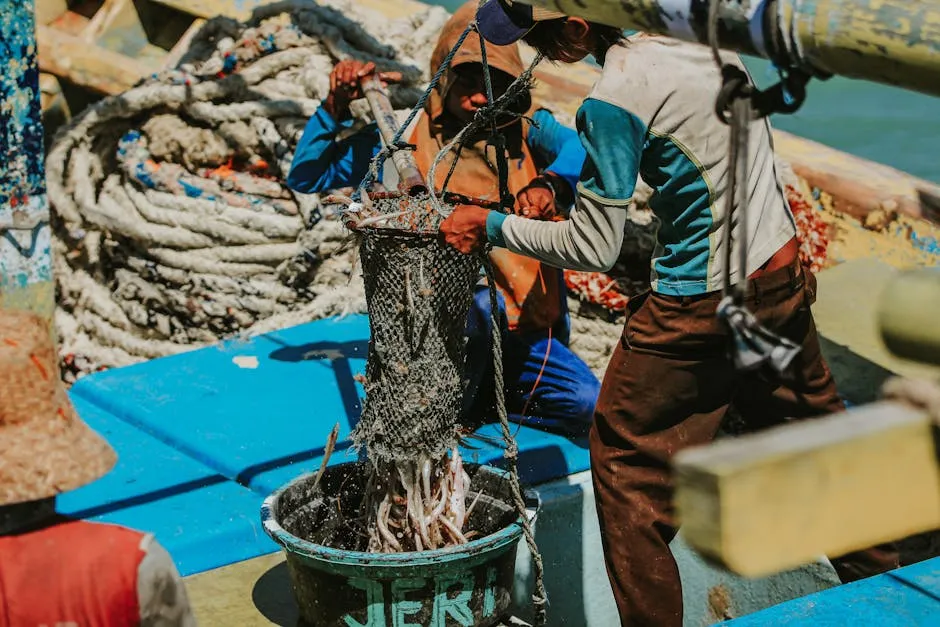
"Traditional fishermen in East Java haul in their catch on a sunny day." by setengah lima sore / Pexels.
Fish feed billions of people worldwide and provide jobs for millions in coastal communities. As Earth's climate changes, ocean temperatures rise and affect where fish can live. Evidence shows that many fish species are moving toward cooler waters near the poles or swimming deeper into the ocean. This movement creates serious challenges for fishing communities and global food supplies.
Scientists observe that warming ocean waters force fish to migrate because fish are cold-blooded animals. Their body temperature matches the water around them, so they must find suitable conditions to survive. When surface waters become too warm, fish populations shift to cooler regions. Some species move hundreds of miles toward the Arctic or Antarctic. Others dive to deeper, colder ocean layers. These migrations mean that regions which once had abundant fish may lose their traditional catches. Meanwhile, areas closer to the poles gain new fish species they never had before.
Ocean acidification adds another layer of stress to fish populations. When seawater absorbs carbon dioxide from the atmosphere, it becomes more acidic. This process disrupts marine food webs by harming plankton and other tiny organisms at the base of the ocean ecosystem. If plankton populations decline, the entire food chain suffers. Fish have less food to eat, which can reduce their numbers and size. Overfishing makes this problem worse because humans catch fish faster than populations can recover.
The North Atlantic provides a clear example of these changes. Cod populations near Iceland have shifted northward as waters warm. Some fishing communities in southern areas now catch different species than their ancestors did. In Alaska, salmon runs show changes in timing and location. These shifts create uncertainty for fishers who depend on predictable catches. Food security becomes a concern when fisheries cannot supply the same amount of fish year after year.
The health of fisheries matters because fish provide protein for over three billion people. Coastal communities depend on fishing for income and cultural identity. When fish populations move or decline, people face difficult choices. They may need to travel farther to fish, switch to different species, or find new ways to earn a living. Understanding how climate change affects ocean ecosystems helps scientists and communities plan for the future. Protecting fish populations requires managing both climate impacts and fishing practices.
Interesting Fact: Some fish species can migrate over 6,000 miles following ocean temperature changes. Scientists track these movements using electronic tags that record depth, temperature, and location data.
Comprehension quiz (10 questions)
1. Why are fish moving to cooler waters near the poles or deeper ocean layers?
2. What happens when seawater absorbs carbon dioxide from the atmosphere?
3. What does the term 'food web' mean in the context of this passage?
4. According to the passage, what is one example of fish populations changing location?
5. How does ocean acidification affect fish populations?
6. What can scientists infer about fishing communities when fish populations shift to new locations?
7. Why does overfishing make the problem of declining fish populations worse?
8. If a coastal community depends on fishing and fish populations move away, what might happen?
9. True or False: Fish are cold-blooded, which means their body temperature matches the water around them.
10. True or False: Over three billion people depend on fish for protein.
Perfect for the way you teach
- Build comprehension skills
- Auto-graded quiz
- Differentiated reading
- Read together at home
- Improve fluency
- Quiet reading time
- Reading curriculum support
- Independent practice
- Track Lexile growth