Genotype and Phenotype
Interactive passage with audio narration, comprehension questions, and printable PDF.
By completing this purchase you agree to our Terms of Use and Privacy Policy. Your subscription renews automatically until you cancel. You can cancel anytime from your account settings. All sales are final and non-refundable. Digital content is available for download in your account immediately upon purchase.
What's included
Genotype and Phenotype preview and details
About this printable Genotype and Phenotype science reading passage, NGSS-aligned (Grades 5-8)
Sample passage and quiz from Genotype and Phenotype
Reading passage and comprehension quiz preview
Genotype and Phenotype
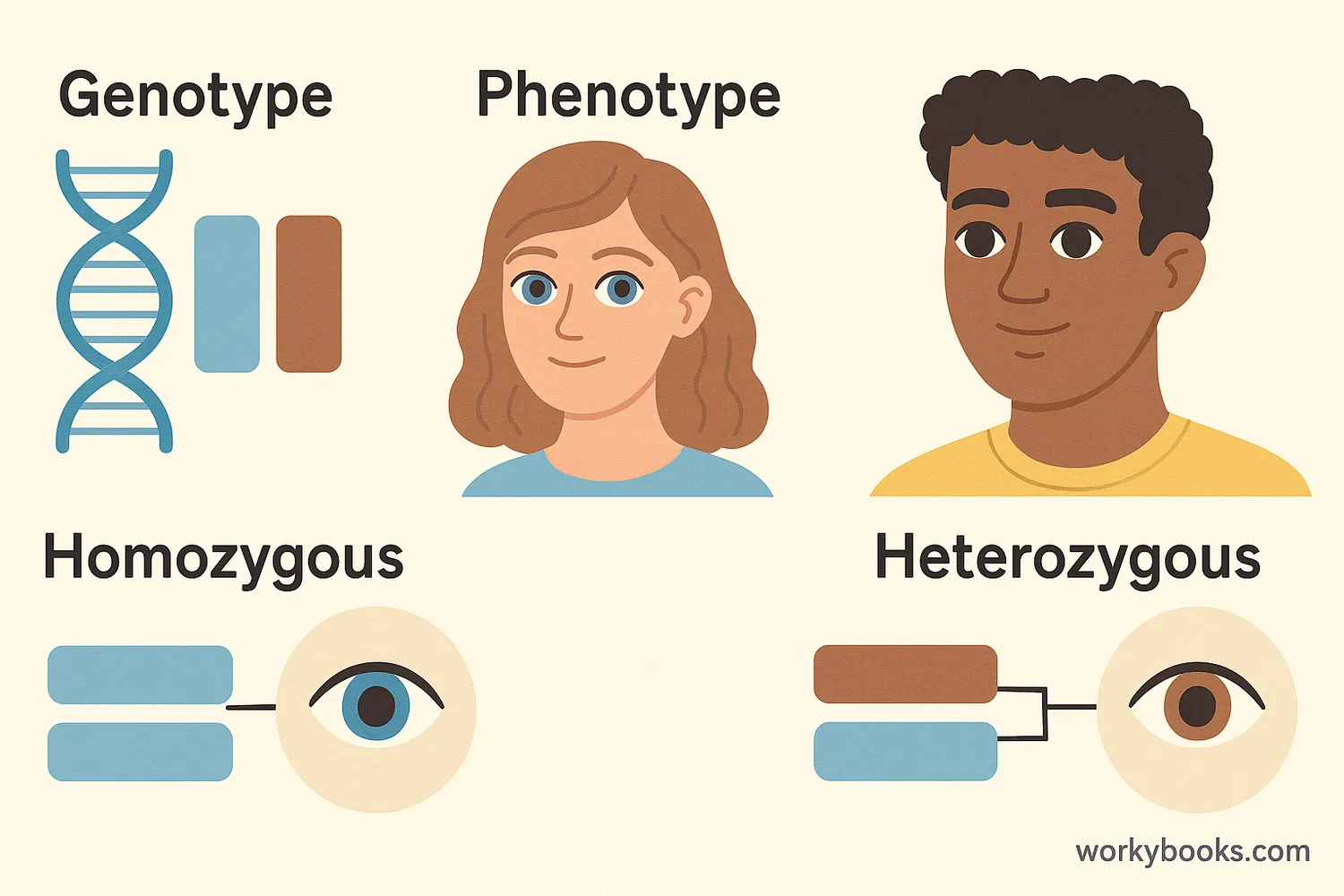
Genetics explores how living things inherit traits from their parents. In every population, some individuals have brown eyes, while others have blue or green. Scientists discovered that these differences are caused by a combination of genes and environmental factors. Understanding how our genotype and environment shape our phenotype is essential for learning about heredity and variation in living things.
How Genotype Determines Phenotype
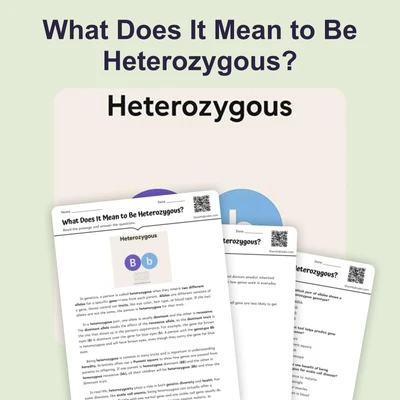
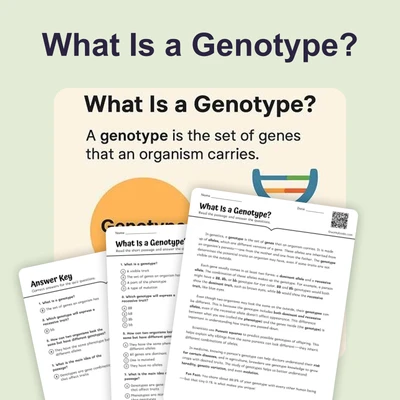
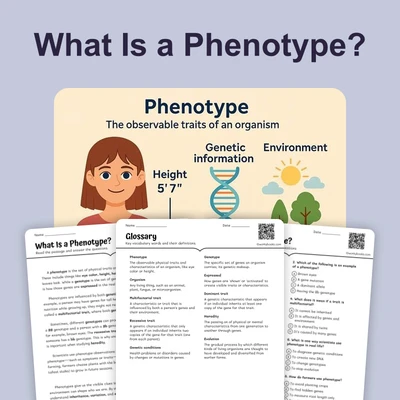
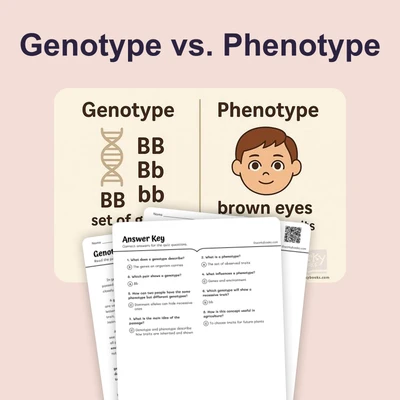
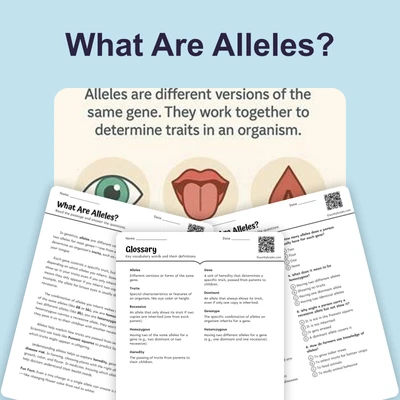
An organism's genotype is its complete set of genes, made up of pairs of alleles. Alleles are different forms of a gene. For example, the gene for eye color can have an allele for brown (B) and another for blue (b). The combination of these alleles—such as homozygous (BB or bb) or heterozygous (Bb)—determines the genotype. The phenotype is the visible or measurable trait, like having brown eyes. In humans, the B allele is dominant, so a person with genotype BB or Bb will have brown eyes, while only someone with bb will have blue eyes. This direct connection between genotype and phenotype is called Mendelian inheritance.
Environment's Role in Shaping Phenotype
Although genotype provides the genetic instructions, the environment can influence how these instructions are expressed. For example, a plant may have the genotype to grow tall, but if the soil lacks nutrients, its phenotype might be a short plant. This demonstrates that phenotype results from the interaction between genotype and environment. Studies show that identical twins, who share the same genotype, can have differences in height or weight if they grow up in different environments. Some traits, like blood type, depend almost entirely on genotype, while others, like body weight, are influenced by both genes and lifestyle factors.
Why Different Genotypes Can Have the Same Phenotype
Sometimes, different genotypes produce the same phenotype. For example, both BB and Bb genotypes result in brown eyes. This is due to dominant and recessive alleles, where the dominant allele masks the effect of the recessive allele. Additionally, environmental factors can sometimes override genetic differences. For instance, a plant with a genotype for green leaves may develop yellow leaves if it receives too little sunlight, regardless of its genes. These complexities show that predicting phenotype from genotype alone can be challenging.
Understanding the relationship between genotype, phenotype, and environment helps scientists explain variation in populations and how organisms adapt to their surroundings. This knowledge is important in fields such as agriculture, medicine, and conservation biology, where predicting traits can have significant impacts.
Interesting Fact: A single human cell contains about 25,000 genes, but environmental factors can affect how many of these genes are expressed throughout a person’s life.
Comprehension quiz (10 questions)
1. What is the main difference between genotype and phenotype?
2. Which of the following is an example of a phenotype?
3. What do alleles determine in an organism?
4. What does it mean if an organism is homozygous for a gene?
5. According to the passage, how can the environment affect the phenotype of a plant?
6. What is meant by Mendelian inheritance?
7. If two organisms have the genotypes BB and Bb, what is true about their phenotype for eye color?
8. True or False: The phenotype of an organism is always determined only by its genotype.
9. True or False: Environmental factors can sometimes override genetic instructions and change the phenotype.
10. What is an example from the passage of a trait determined almost entirely by genotype?
Perfect for the way you teach
- Build comprehension skills
- Auto-graded quiz
- Differentiated reading
- Read together at home
- Improve fluency
- Quiet reading time
- Reading curriculum support
- Independent practice
- Track Lexile growth