Germany Invades France and Western Europe
Interactive passage with audio narration, comprehension questions, and printable PDF.
By completing this purchase you agree to our Terms of Use and Privacy Policy. Your subscription renews automatically until you cancel. You can cancel anytime from your account settings. All sales are final and non-refundable. Digital content is available for download in your account immediately upon purchase.
What's included
Germany Invades France and Western Europe preview and details
About this printable Germany Invades France and Western Europe reading passage (Grades 5-8)
Sample passage and quiz from Germany Invades France and Western Europe
Reading passage and comprehension quiz preview
Germany Invades France and Western Europe
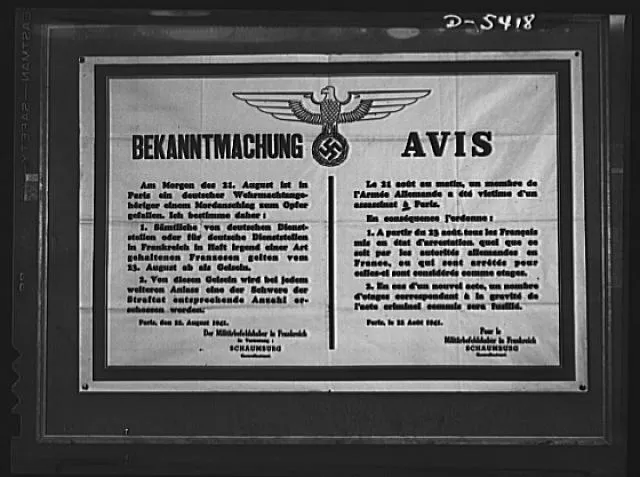
"German warning to occupied France. Here, in the Nazis' own black and white, is visual testimony to the fact that the battle of France continues. This grim poster came to the Office of War Information (OWI) from Paris by a devious route, a route which for obvious reasons cannot be given but which, by its very existence, proves that the Gestapo isn't all-powerful. Bordered in red, surmounted by eagle and swastika, the poster is a notice that a member of the German army was killed in Paris, August 21, 1941, and that, as a consequence, every Frenchman under arrest, from August 23 on, will be considered a hostage. "In the case of another attack," the notice--in French and German--states, "hostages in a number corresponding to the seriousness of the criminal act committed will be shot." Here is the full text of the warning which the angry Nazis--probably frightened, too - plastered on the walls of occupied France" by United States. Office of War Information. / Library of Congress.
The German military launched a sudden and powerful offensive against France in May 1940, using a strategy known as blitzkrieg, or “lightning war.” This approach combined speed, surprise, and advanced technology to overwhelm the enemy. The fall of France in just six weeks shocked the world and marked a turning point in World War II.
The blitzkrieg strategy relied on the rapid movement of tanks, or armored divisions, supported by airplanes and infantry. On May 10, 1940, Germany attacked the Low Countries—Belgium, the Netherlands, and Luxembourg—to bypass the heavily fortified French Maginot Line. German troops crossed the Ardennes Forest, a region French commanders believed was too difficult for an army to cross quickly. Primary sources, such as diaries from French soldiers, reveal their surprise and confusion as German panzers broke through their lines at Sedan on May 13. By encircling French and British forces, the Germans cut off their retreat and created chaos in military command structures.
One of the most dramatic moments occurred at Dunkirk. Between May 26 and June 4, over 338,000 British and French soldiers were evacuated from the beaches by a fleet of military and civilian boats. Newspapers and government broadcasts from the time describe the evacuation as both miraculous and desperate. Despite this success, France was unable to recover. Paris fell to German forces on June 14, and the French government signed an armistice on June 22, 1940. The occupation of France led to significant changes in daily life, including rationing, censorship, and the persecution of certain groups. Civilians faced new hardships, and the social hierarchy shifted as some cooperated with the occupiers while others joined the resistance.
Geography played a crucial role in these events. The difficult terrain of the Ardennes, once seen as a natural barrier, became the path to invasion due to German innovation and risk-taking. The speed of the German advance demonstrated how new military technology could transform warfare. The impact of blitzkrieg was felt across Europe, as many nations realized their traditional defenses were outdated. The rapid defeat of France allowed Germany to control much of Western Europe and forced Great Britain to stand alone for the next year.
The fall of France affected the course of World War II by shifting the balance of power in Europe. It also showed how military strategy, technology, and geography interact in shaping historical outcomes. Understanding the events of 1940 helps explain why the Allies later placed such importance on innovation and cooperation to defeat the Axis powers.
Interesting Fact: During the evacuation at Dunkirk, hundreds of small civilian boats, called the “Little Ships,” helped rescue Allied soldiers, showing the important role of ordinary people in wartime events.
This episode connects to broader themes of war, innovation, and the ways societies respond to crisis in world history.
Comprehension quiz (8 questions)
1. When did Germany attack France?
2. What does 'blitzkrieg' mean?
3. Where did German tanks break through?
4. Why was the Ardennes important?
5. What effect did the Dunkirk evacuation have?
6. How did geography help Germany win?
7. France signed an armistice in June 1940. True or false?
8. What is a 'hierarchy'?
Perfect for the way you teach
- Build comprehension skills
- Auto-graded quiz
- Differentiated reading
- Read together at home
- Improve fluency
- Quiet reading time
- Reading curriculum support
- Independent practice
- Track Lexile growth