Globular Clusters vs. Open Clusters — Reading Comprehension
Rate this
Premium Resource
Present
Present in classroom. No work saved
Assign
Classroom with student accounts, Track progress
Quick Play
No student accounts, assign with a link
Grades
6
PRINT+DIGITAL RESOURCE
This learning resource is available in interactive and printable formats. The interactive worksheet can be played online and assigned to students. The Printable PDF version can be downloaded and printed for completion by hand.
This educational passage, 'Globular Clusters vs. Open Clusters,' is designed for a 6th-grade reading level and provides an engaging introduction to two distinct types of star formations: globular clusters and open clusters. Students will learn about the key differences between these celestial objects, including their age, size, star density, and location within galaxies like our own Milky Way. The passage emphasizes the role of gravity in holding these clusters together, directly aligning with NGSS MS-ESS1-2, which focuses on gravity's role in motions within galaxies and the solar system. Key terms like 'gravity,' 'galaxy,' 'stars,' 'nebula,' and 'stellar nursery' are introduced and defined. This content is audio integrated, making it accessible for diverse learners. Students will explore concepts like star formation and the life cycle of stars through these fascinating cosmic structures.
CONTENT PREVIEW
Expand content preview
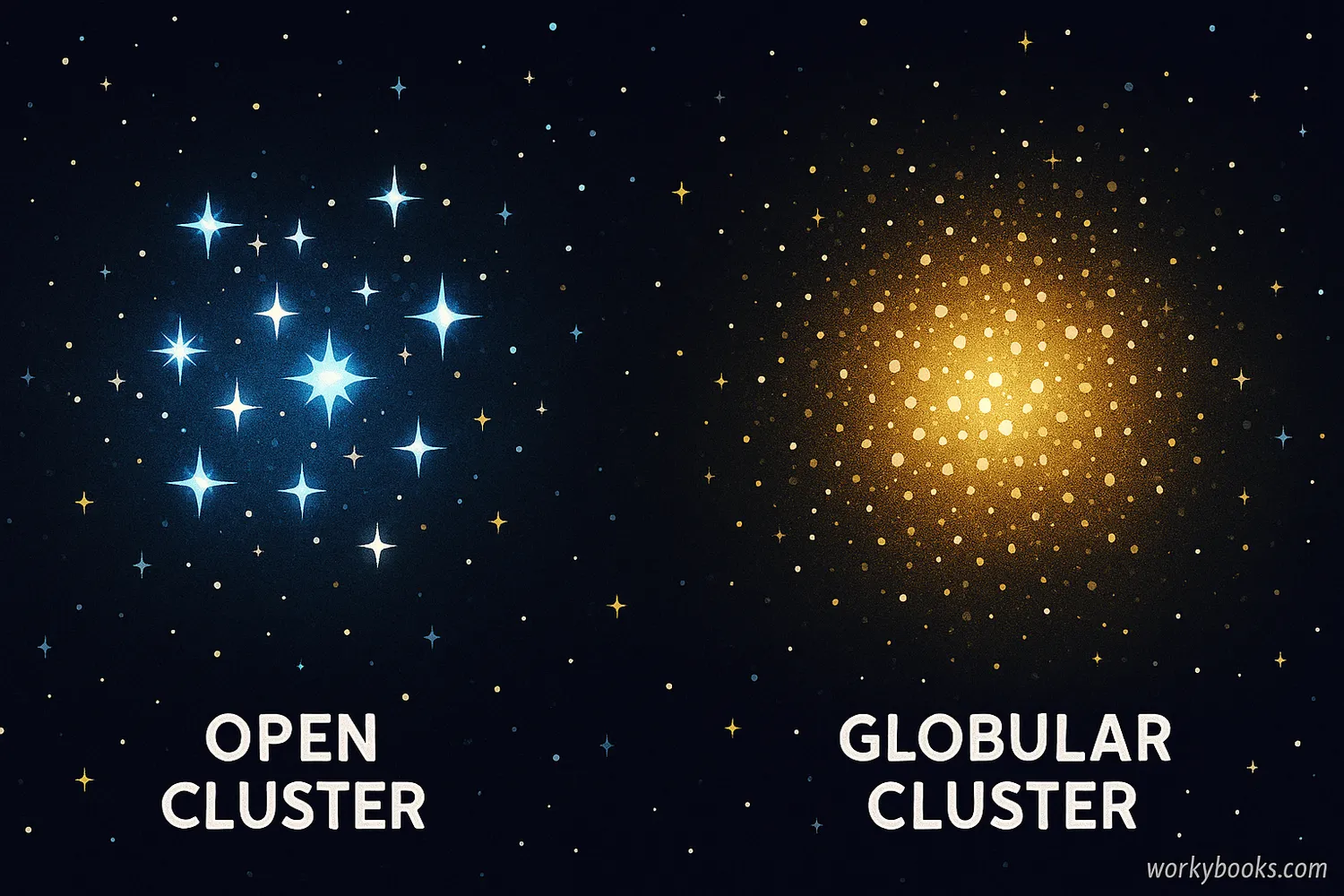
Open clusters in spiral arms; globular clusters in halo with dense, older stars.
When you look up at the night sky, you might see individual stars twinkling. But sometimes, stars group together into amazing collections called star clusters. There are two main types of star clusters we often talk about: globular clusters and open clusters. Both are held together by gravity, but they have some big differences!
Let's start with open clusters. Imagine a small, loose gathering of friends. That's a bit like an open cluster! These clusters usually contain a few dozen to a few thousand stars. The stars in an open cluster are relatively young, often having formed at the same time from the same giant cloud of gas and dust called a nebula. Because they are young, these stars are often bright and blue. Open clusters are found in the flat, spiral arms of galaxies, like our own Milky Way. Over long periods, the gravitational pull from other stars and gas clouds can cause open clusters to slowly drift apart. They are like stellar nurseries where new stars are born and grow for a while before moving out.
Now, picture a giant, crowded city. That's closer to a globular cluster! These are much larger and denser than open clusters. A single globular cluster can contain hundreds of thousands, or even millions, of stars packed tightly together. These stars are very old, some of the oldest in the universe! Unlike the young stars in open clusters, stars in globular clusters are typically redder and less active. Globular clusters are often found in the halo or outer regions of galaxies, orbiting the galactic center like satellites. Their strong gravitational pull keeps them together for billions of years, making them very stable and long-lasting.
So, the main differences are age, size, and where they live in a galaxy. Open clusters are young, smaller, and found in the spiral arms. Globular clusters are old, massive, and found in the halo. Both are incredible examples of how gravity organizes matter in space, creating stunning cosmic structures for us to observe and study. Understanding these clusters helps astronomers learn more about the history and evolution of galaxies.
Interesting Fact: The brightest globular cluster in the Milky Way, Omega Centauri, contains over 10 million stars!
Which force holds star clusters together?
GravityMagnetismWindLight
What are young open cluster stars often like?
Bright and blueDim and redSmall and oldVery dense
Globular clusters usually contain fewer stars than open clusters. (True/False)
FalseTrue
What is a nebula?
Cloud of gas/dustType of galaxyOld star clusterBrightest star
Which type of cluster is found in the spiral arms of a galaxy?
Open clustersGlobular clustersBoth typesNeither type
Why do open clusters tend to drift apart over time?
A new cluster is forming from a gas cloud. What type is it likely to be?
Open clusterGlobular clusterDwarf galaxySupernova remnant
If two clusters have vastly different numbers of stars, which one likely has stronger internal gravity?
More starsFewer starsYounger starsOlder stars
Perfect For:
👩🏫 Teachers
• Reading comprehension practice
• Auto-graded assessments
• Literacy skill development
👨👩👧👦 Parents
• Reading practice at home
• Comprehension improvement
• Educational reading time
🏠 Homeschoolers
• Reading curriculum support
• Independent reading practice
• Progress monitoring
Reading Features:
📖
Reading Passage
Engaging fiction or nonfiction text
❓
Comprehension Quiz
Auto-graded questions
📊
Instant Feedback
Immediate results and scoring
📄
Printable Version
Download for offline reading
🔊
Read Aloud
Voice-over with word highlighting
Reviews & Ratings
No reviews yet. Be the first to share your experience!
Related Content
Earth: Our Home in Space
This engaging Grade 4-5 science passage, aligned to NGSS, introduces students to Earth's special place in the solar syst...
Tools and Technology in Earth Science
This middle school science reading passage explores the wide range of tools and technologies used in Earth science, from...
MS-ESS2-2MS-ESS3-2MS-ETS1-1MS-PS4-3
Earth's Place in the Universe
This reading passage explains Earth's place in the universe, supporting NGSS 1-ESS1-1. It describes how Earth is one of ...
1-ESS1-1
Scientific Inquiry in Earth Science
This passage explores scientific inquiry in Earth science for grades 6-8, aligned with NGSS standards MS-ESS1-4, MS-ESS2...
MS-ESS1-4MS-ESS2-1MS-ESS3-5SEP
What Is Space Weather and How Does It Affect the Earth?
This NGSS-aligned science passage for middle school explains what space weather is and how it affects Earth. Students le...
MS-ESS2-2
Escape Velocity and Space Travel
This middle school science passage introduces students to the concept of escape velocity—the minimum speed required to b...
MS-ESS1-2MS-PS2-4
Space Stations
This informational science reading passage for grades 6-8 explores the complex systems and technology behind space stati...
MS-ESS1-3MS-ETS1-1
What Is Earth Science?
This engaging middle school science passage introduces students to the field of Earth science, aligning with NGSS standa...
MS-ESS1MS-ESS2MS-ESS3SEP
The Space Garden
This innovative passage combines plant science with space exploration, aligning with NGSS standards for life sciences an...
RL.3.1RL.2.1RL.4.9
Measuring Distances in Space
This middle school science passage explores how astronomers measure the vast distances in space, aligning with NGSS stan...
MS-ESS1-3
Earth: Our Home Planet
This comprehensive science passage for grades 6-8 explores Earth’s unique characteristics and the interconnected systems...
MS-ESS1-2
Meteorite Impacts on Earth
This engaging science reading passage for Grades 4-5 explores meteorite impacts on Earth, aligning with NGSS standards. ...
Earth's Rotation
This middle school science passage, aligned with NGSS standard MS-ESS1-1, focuses on Earth's rotation—how Earth spins on...
MS-ESS1-1
Exploring Space: Rockets and Spacecraft
Space exploration has been one of humanity's greatest achievements, made possible by rockets and spacecraft. Rockets act...
RI.4.4RI.4.2
Facts About Earth
This engaging science reading passage introduces Grade 4 and 5 students to Earth, our home planet. Aligned with NGSS sta...
Earth's Moon Facts
This engaging science passage, 'The Moon: Earth's Companion,' is designed for Grade 4-5 students and aligns with NGSS ge...
Earth's Seasons
This comprehensive reading passage for grades 6-8 explains why Earth has seasons, revealing the scientific mechanisms be...
MS-ESS1-1
Venus: Earth's Twin?
This comprehensive science passage for grades 6-8 examines Venus—often called Earth's twin—by exploring its similarities...
MS-ESS1-2MS-ESS1-3
International Space Station
Discover the wonders of the International Space Station with this informative coloring page showcasing the orbiting outpost where astronauts live and work in space. As children color the complex modul...
What Makes Earth Perfect for Life?
This Grade 4-5 science passage, aligned with NGSS standards, explores the essential features that make Earth the perfect...