Gold and Salt Trade in West Africa
Interactive passage with audio narration, comprehension questions, and printable PDF.
By completing this purchase you agree to our Terms of Use and Privacy Policy. Your subscription renews automatically until you cancel. You can cancel anytime from your account settings. All sales are final and non-refundable. Digital content is available for download in your account immediately upon purchase.
What's included
Gold and Salt Trade in West Africa preview and details
About this printable Gold and Salt Trade in West Africa reading passage (Grades 5-8)
Sample passage and quiz from Gold and Salt Trade in West Africa
Reading passage and comprehension quiz preview
Gold and Salt Trade in West Africa
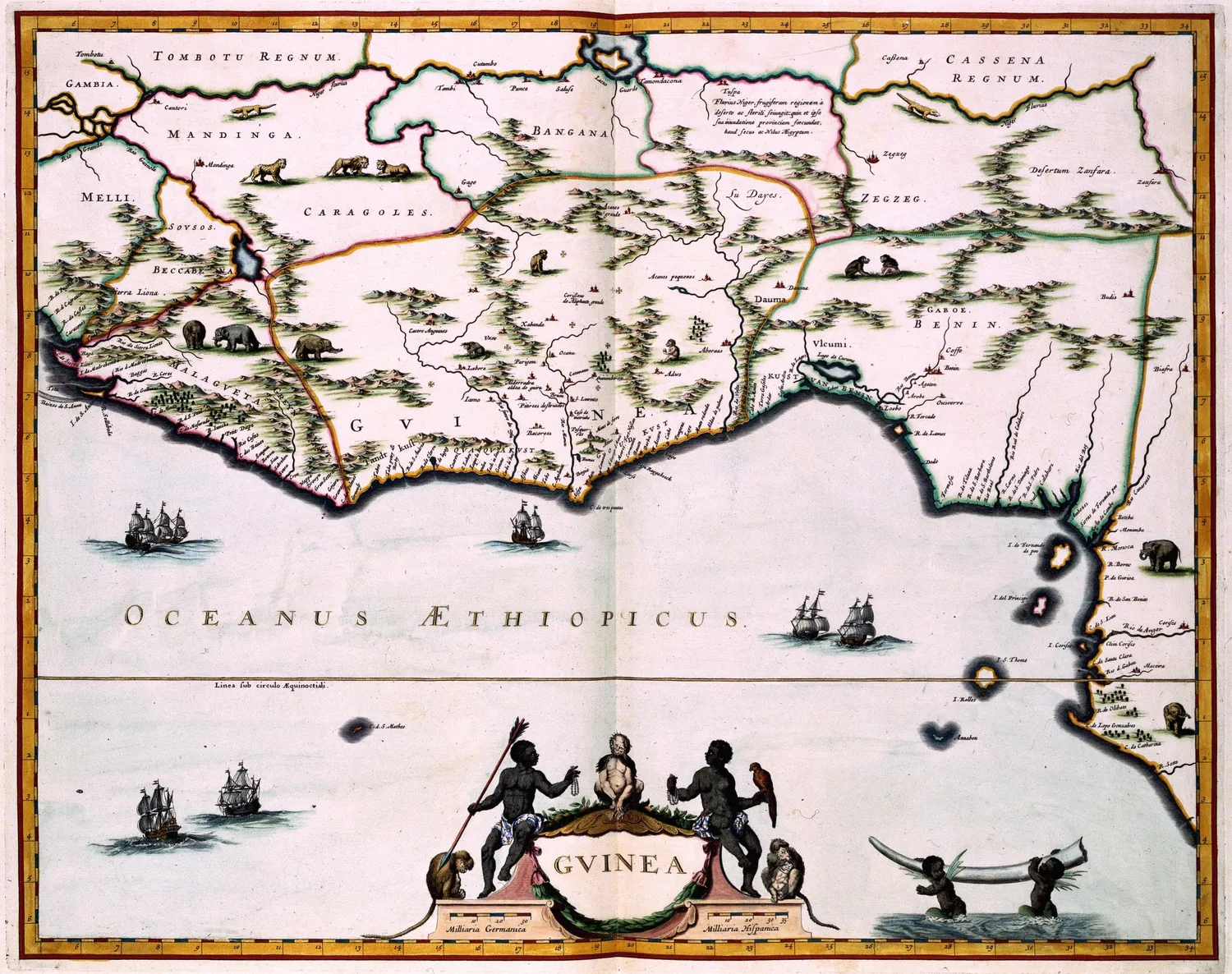
This map of the West African Gold Coast was published in 1635 by Willem Jansz. Blaeu (1571-1638). Wikimedia Commons
The civilizations of ancient West Africa were shaped by two highly prized resources: gold and salt. These commodities were not only valuable for their material worth, but also for their influence on trade, society, and culture across vast regions. The importance of gold and salt helped establish powerful kingdoms like Ghana and Mali, and connected West Africa to distant lands through the trans-Saharan trade network.
Gold was abundant in regions south of the Sahara Desert, especially near the Niger River. Archaeologists have found evidence of gold mining in areas like Bambuk and Bure dating to as early as the 5th century CE. Gold dust and nuggets became a symbol of wealth and power. Rulers of the Ghana Empire, which flourished from about 700 to 1200 CE, controlled the supply of gold and taxed every nugget that entered or left their territory. Arab geographers, such as Al-Bakri, described the royal city of Ghana as rich and awe-inspiring, with gold being the foundation of its prosperity. The Mali Empire, rising after Ghana, became even more famous for its gold. Mansa Musa, the emperor of Mali in the 14th century, was legendary for his lavish display of gold on his pilgrimage to Mecca in 1324, an event that amazed the Islamic world and increased global awareness of West Africa's wealth.
Salt, though common in other parts of the world, was rare in West Africa. Yet it was essential for survival, especially in hot climates where salt lost through sweat needed to be replaced. For centuries, people in the Sahara Desert mined salt from places like Taghaza and Taoudenni, carving it into large blocks. Salt was transported by camel caravans across the harsh desert, a journey that could take weeks. In markets like Timbuktu, salt was sometimes traded pound for pound with gold. This exchange was so critical that entire towns grew up around the salt trade routes, and salt could even be used as currency.
The trans-Saharan trade routes linked West Africa with North Africa and the Mediterranean world. Merchants, often Berbers and Tuareg, led caravans loaded with goods, including gold, salt, ivory, and slaves. These routes helped spread not only goods but also ideas, technology, and religion. The arrival of Islam in West Africa was closely tied to these exchanges. Trade wealth allowed rulers to build impressive cities, such as Timbuktu and Gao, with grand mosques and centers of learning. Social hierarchy became more complex, with kings, traders, scholars, and skilled workers all playing distinct roles in society. Written records from travelers like Ibn Battuta give us valuable primary source accounts of daily life and commerce.
The legacy of gold and salt in West Africa is profound. These resources fostered economic growth, urbanization, and cultural exchange. They also made West Africa a major player in medieval global trade, linking it to Europe, the Middle East, and beyond. Today, historians and archaeologists continue to study ancient mines, trade routes, and city ruins to uncover more about this dynamic era and its lasting impact.
Interesting Fact: Some gold mines in West Africa were kept secret for generations to protect their locations, and salt was once so valuable that it was used to pay soldiers' wages. This story of gold and salt connects to broader themes of how geography, resources, and trade shape civilizations around the world.
Comprehension quiz (8 questions)
1. Which empire controlled gold from 700-1200 CE?
2. Who was famous for a gold-filled pilgrimage?
3. Where was most West African gold found?
4. Why was salt so valuable in West Africa?
5. How did trade routes affect West Africa?
6. What did camel caravans carry?
7. Salt was used as currency in West Africa.
8. What is a primary source?
Perfect for the way you teach
- Build comprehension skills
- Auto-graded quiz
- Differentiated reading
- Read together at home
- Improve fluency
- Quiet reading time
- Reading curriculum support
- Independent practice
- Track Lexile growth