River Valley Civilizations
Interactive passage with audio narration, comprehension questions, and printable PDF.
By completing this purchase you agree to our Terms of Use and Privacy Policy. Your subscription renews automatically until you cancel. You can cancel anytime from your account settings. All sales are final and non-refundable. Digital content is available for download in your account immediately upon purchase.
What's included
River Valley Civilizations preview and details
About this printable River Valley Civilizations reading passage (Grades 5-8)
Sample passage and quiz from River Valley Civilizations
Reading passage and comprehension quiz preview
Ancient River Valley Civilizations
![[Iraq. (Mesopotamia). Baghdad. River scenes on the Tigris. The Maude Bridge over the Tigris. Open for river traffic. A distant view]](https://assets.workybooks.com/INTERACTIVE/media/pd--Iraq---Mesopotamia---Baghdad--River-scenes-on-the-1762603120453-223875168.webp)
Source: Library of Congress - American Colony (Jerusalem). Photo Department
Rivers played a vital role in the rise of early civilizations. The first major civilizations, including Mesopotamia, Egypt, the Indus Valley, and China, all developed along great rivers. These waterways provided a source of fresh water, supported agriculture, and shaped the daily lives and social structures of ancient peoples.
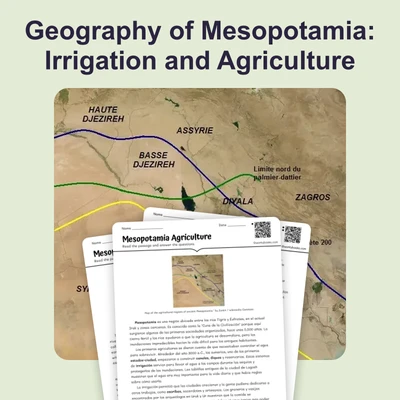
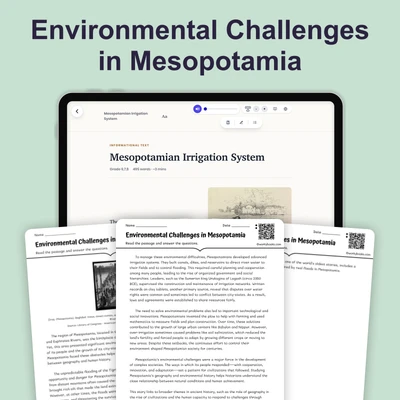
One key reason rivers were essential was their ability to support farming. The ancient Egyptians settled along the Nile River around 3100 BCE. Each year, the Nile flooded its banks, leaving behind rich, fertile soil called silt. This natural irrigation made it possible for Egyptians to grow wheat and barley, which formed the basis of their diet and economy. Similarly, the people of Mesopotamia built canals to redirect water from the Tigris and Euphrates Rivers to their fields. Archaeologists have found clay tablets from 2500 BCE describing how these canals worked. These systems allowed civilizations to increase food production and support larger populations.
Rivers also connected people and places through transportation and trade. Boats carried goods such as grain, pottery, and textiles up and down rivers, linking distant villages and cities. In the Indus Valley, evidence from the ancient city of Mohenjo-Daro (circa 2500 BCE) shows that the Indus River helped people move heavy building materials and exchange goods with neighboring regions. This trade encouraged the growth of new technologies and ideas.
Rivers influenced social organization and daily life. Access to water allowed early societies to develop urban centers with specialized jobs, such as farmers, artisans, and priests. Control of river water often led to the rise of powerful rulers or dynasties. For example, Pharaohs in Egypt claimed the authority to control the Nile's floods, strengthening their power. In Mesopotamia, laws about irrigation and water use were written in the Code of Hammurabi, one of the oldest known legal documents. These examples show how rivers shaped not only the environment but also the structure of ancient societies.
Over time, river civilizations adapted to challenges such as droughts, floods, and invasions. Their success depended on maintaining the delicate balance between people and their environment. The legacy of river civilizations can be seen in the lasting impact of their inventions, writing systems, and government structures on world history.
The study of ancient rivers helps us understand how geography and environment influence human progress. It also connects to the broader theme of how humans adapt to and change their surroundings over time.
Interesting Fact: Some ancient Mesopotamian cities, like Uruk, had populations of more than 40,000 people by 2900 BCE, making them among the world's first true cities.
Comprehension quiz (8 questions)
1. Which river helped Egyptian civilization thrive?
2. What did the Mesopotamians build for farming?
3. Which ancient city was in the Indus Valley?
4. Why were rivers important for trade?
5. How did rulers gain power in Egypt?
6. What did the Code of Hammurabi include?
7. The Nile flooded every year. (True/False)
8. What does 'silt' mean?
Perfect for the way you teach
- Build comprehension skills
- Auto-graded quiz
- Differentiated reading
- Read together at home
- Improve fluency
- Quiet reading time
- Reading curriculum support
- Independent practice
- Track Lexile growth