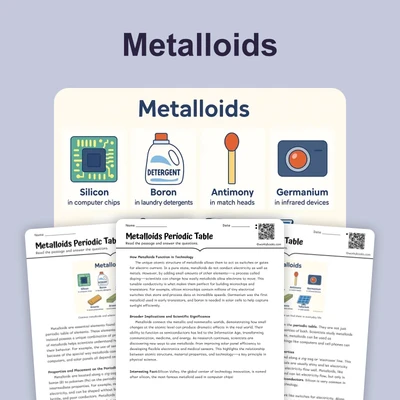
This learning resource is available in interactive and printable formats. The interactive worksheet can be played online and assigned to students. The Printable PDF version can be downloaded and printed for completion by hand.
This informational science passage for grades 6-8 aligns with NGSS MS-PS1-1 and explores Groups 13-16 of the periodic table, focusing on the unique transition from metals to nonmetals. Students will learn how metalloids, such as silicon, bridge the properties of metals and nonmetals, and how elements like aluminum, carbon, nitrogen, and oxygen play essential roles in technology, environment, and life processes. The passage uses observable phenomena and mechanistic explanations to show systems and interactions between elements, with real-world examples including electronics, photosynthesis, and industrial materials. Activities include comprehension questions, writing prompts, a glossary, and graphic organizers. The content is audio integrated and features English and Spanish versions, as well as a differentiated, simplified reading level. This resource is ideal for students building foundational knowledge in physical science and chemical properties.
CONTENT PREVIEW
Expand content preview
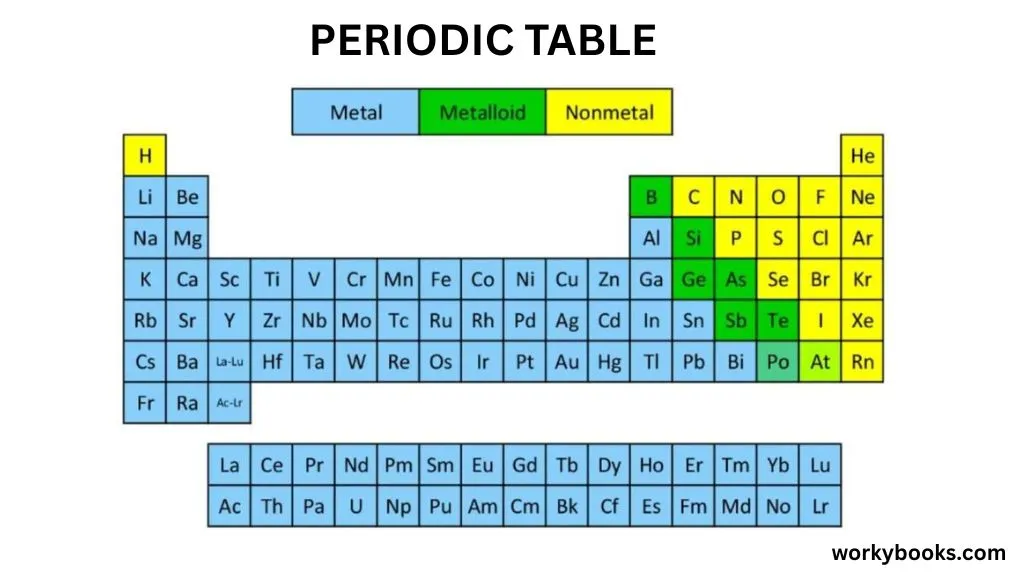
Metalloids are found along the zigzag line between metals and nonmetals
On the periodic table, Groups 13 through 16 reveal a remarkable shift in the properties of elements, moving from metals to nonmetals with the presence of metalloids. This transition is key to understanding why materials behave differently and how they are used in technology, nature, and industry. Scientists have identified this pattern by observing how elements in these groups react and combine with other substances. The study of these groups helps explain both the structure of matter and how it interacts in real-world systems.
How Groups 13-16 Show a Transition in Properties
Elements in Groups 13–16 are arranged in a way that demonstrates a gradual change from mostly metallic properties on the left to mostly nonmetallic properties on the right. For example, Group 13 contains aluminum, a lightweight metal widely used in cans and airplanes due to its strength and resistance to corrosion. However, as you move to Group 14, you encounter both carbon, a nonmetal essential for life, and silicon, a metalloid. Silicon is especially important in electronics because it can conduct electricity under certain conditions, a property known as semiconductivity. This ability allows silicon to be used in computer chips that power modern devices. The presence of metalloids like silicon and germanium marks the boundary where metallic and nonmetallic behaviors blend.
Interactions and Real-World Applications
Group 15 includes elements such as nitrogen and phosphorus. Nitrogen makes up about 78% of Earth’s atmosphere and is crucial for the formation of proteins in living things. Phosphorus is found in DNA and is essential for energy transfer in cells. Group 16 contains oxygen and sulfur. Oxygen supports life through respiration and is involved in oxidation reactions, such as rusting and combustion. Sulfur is used in fertilizers and is vital for certain amino acids. These groups illustrate how elements interact in both natural and human-made systems, influencing processes from breathing to electronics.
Scientific Thinking and Broader Implications
The gradual change in properties across Groups 13-16 is a result of how atoms are structured, particularly the number of valence electrons they have. This affects how elements bond and form compounds. For example, the ability of silicon to act as a semiconductor is due to its four valence electrons, which allows controlled electron flow. Understanding these patterns helps scientists design new materials and predict element behavior in reactions. This knowledge connects to larger scientific principles, such as the organization of matter and the conservation of mass in chemical reactions. The study of these groups has led to advances in technology, medicine, and environmental science.
Interesting Fact:
Some of the most advanced solar panels are made from purified silicon, a metalloid found in Group 14, because of its unique electrical properties.
Which groups on the periodic table contain metalloids and show a transition from metals to nonmetals?
Groups 13-16Groups 1-4Groups 7-10Groups 17-18
What role does silicon play in electronics?
It is used in computer chips as a semiconductorIt is used to make cansIt forms proteinsIt is found in DNA
Which element makes up about 78% of Earth's atmosphere?
OxygenNitrogenSulfurAluminum
What does the term 'semiconductivity' mean as used in the passage?
The ability to conduct electricity only under certain conditionsThe process of creating new elementsBeing shiny and bendableAbility to combine with oxygen
What is the main reason aluminum is used in airplanes?
It is heavy and strongIt is lightweight and resists corrosionIt is a nonmetalIt is found in DNA
Based on the passage, why are metalloids important in technology?
They have properties of both metals and nonmetals, useful for semiconductorsThey combine with oxygenThey are always shinyThey are found in the atmosphere
If you needed an element for making fertilizer, which from Groups 15 or 16 would you choose?
AluminumSulfurSiliconGermanium
How does the number of valence electrons affect an element's properties?
It determines how the element bonds and reactsIt makes elements heavierIt changes their colorIt affects their melting point only
True or False: Group 16 elements like oxygen are important for respiration and oxidation reactions.
TrueFalse
True or False: All elements in Groups 13-16 are metalloids.
TrueFalse
Perfect For:
👩🏫 Teachers
• Reading comprehension practice
• Auto-graded assessments
• Literacy skill development
👨👩👧👦 Parents
• Reading practice at home
• Comprehension improvement
• Educational reading time
🏠 Homeschoolers
• Reading curriculum support
• Independent reading practice
• Progress monitoring
Reading Features:
📖
Reading Passage
Engaging fiction or nonfiction text
❓
Comprehension Quiz
Auto-graded questions
📊
Instant Feedback
Immediate results and scoring
📄
Printable Version
Download for offline reading
🔊
Read Aloud
Voice-over with word highlighting
Reviews & Ratings
No reviews yet. Be the first to share your experience!
Related Content
Atomic Structure
This reading passage on Atomic Structure provides middle school students with an accessible explanation of the fundament...
MS-PS1-1RI.6.3RI.7.1
Parts of an Atom
This reading passage on Parts of an Atom provides middle school students with a structured and accessible explanation of...
MS-PS1-1RI.6.3RI.7.1
Chemical Bonds
This reading passage on Chemical Bonds provides middle school students with a clear explanation of how and why atoms con...
MS-PS1-1RI.6.3RI.7.1
The Freezing Point of Water
This science reading passage, titled 'The Freezing Point of Water', introduces students to a key physical science concep...
MS-PS1-1RI.6.3RI.7.1
Physical Properties of Matter
This comprehensive reading passage introduces grades 6-8 students to the concept of physical properties of matter, perfe...
MS-PS1-1
Mixtures and Pure Substances
This middle school science passage provides an in-depth exploration of mixtures and pure substances, directly aligned to...
MS-PS1-1
Types of Mixtures
This comprehensive science passage for grades 6-8 introduces students to the concept of mixtures, focusing on distinguis...
MS-PS1-1
Solutions, Suspensions, and Colloids
This comprehensive science passage explores the differences between solutions, suspensions, and colloids, focusing on ho...
MS-PS1-1
The Nature of Science
This passage explores the nature of science for middle school students, aligning with NGSS standards MS-ETS1-4, MS-PS1-1...
MS-ETS1-4MS-PS1-1MS-LS1-1
Scientific Theories
This reading passage for grades 6-8 introduces students to the concept of scientific theories, emphasizing that these ar...
MS-PS1-1MS-PS1-4MS-PS3-4SCIENCE AND ENGINEERING PRACTICES
Particle Model of Matter
This comprehensive science reading passage for grades 6-8 explores the particle model of matter, aligning with NGSS stan...
MS-PS1-1MS-PS1-4
Valence Electrons
This middle school science passage introduces students to the concept of valence electrons, the outermost electrons that...
MS-PS1-1
The Idea of the Atom
This informational science passage introduces middle school students (grades 6-8) to the concept that all matter is made...
MS-PS1-1
Protons, Neutrons, and Electrons
This comprehensive middle school science passage explores the roles of protons, neutrons, and electrons, the three main ...
MS-PS1-1
What are Ions
This passage introduces middle school students to the concept of ions, explaining the processes by which atoms gain or l...
MS-PS1-1
Nucleus of the Atom
This comprehensive passage for grades 6-8 introduces students to the nucleus of the atom, the dense center that contains...
MS-PS1-1
How Atoms Differ
This middle school science reading passage, aligned with NGSS standard MS-PS1-1, explores the fundamental differences am...
MS-PS1-1
Isotopes
This middle school science passage explores the concept of isotopes, which are atoms of the same element with different ...
MS-PS1-1
Compounds vs. Mixtures
This educational passage for grades 6-8 explores the fundamental differences between compounds and mixtures, aligning wi...
MS-PS1-1
Organizing the Elements
This passage for middle school science explores how scientists organized the elements as more were discovered, leading t...