This learning resource is available in interactive and printable formats. The interactive worksheet can be played online and assigned to students. The Printable PDF version can be downloaded and printed for completion by hand.
This engaging Grade 4-5 science passage introduces students to the fascinating history of Halley's Comet, the most famous comet in our solar system. Students will learn what comets are, how they form, and why Halley's Comet is so important in science and history. The passage explains key scientific terms like nucleus, orbit, tail, and astronomer, making them easy to understand for young learners. It includes real-world examples and ends with an interesting fact to encourage curiosity. The resource includes a glossary of vocabulary, a Spanish translation, a multiple-choice reading quiz, and writing activities that develop science literacy and critical thinking. This passage supports NGSS standards for understanding the solar system and celestial phenomena. It's also audio integrated for diverse learners. Use this lesson to explore comets, learn new science words, and make connections to everyday life and nature.
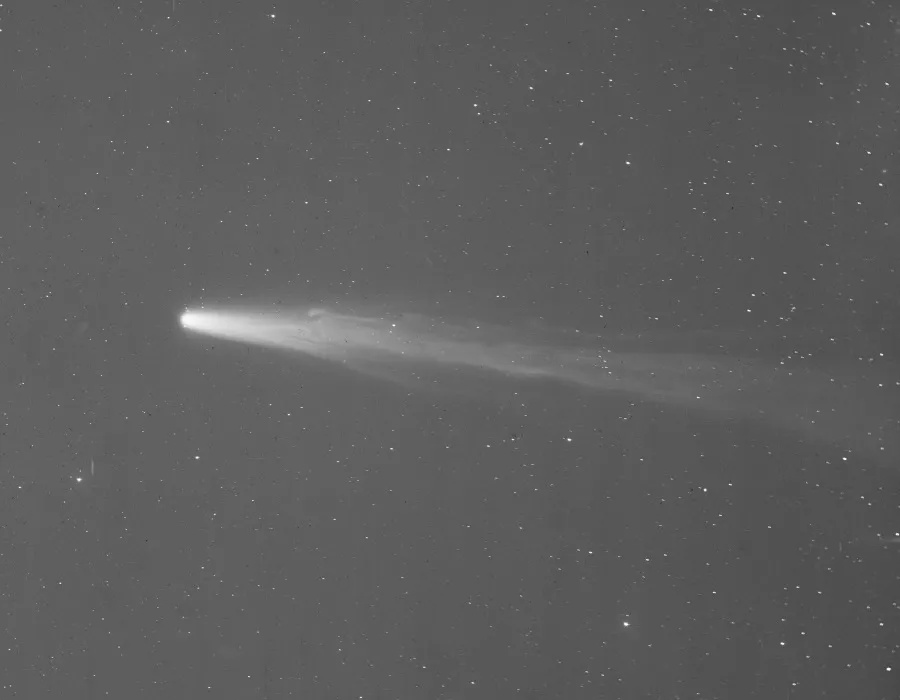
Halley's Comet is one of the most famous comets in our solar system. A comet is a small object made of ice, dust, and rocks. When a comet gets close to the Sun, it heats up and forms a bright glowing tail. This tail always points away from the Sun because of the solar wind, which is a stream of particles from the Sun.
Halley's Comet is special because it can be seen from Earth with just your eyes, and it keeps coming back on a regular schedule. Its orbit around the Sun takes about 76 years. This means people have a chance to see it once or twice in their lives! The last time Halley's Comet visited Earth was in 1986. It will return again in 2061.
The first person to understand that Halley's Comet kept returning was the astronomer Edmond Halley. In 1705, he used math and old records to show that comets seen in 1531, 1607, and 1682 were actually the same comet. After Edmond Halley died, the comet was named after him because of his important discovery.
Comets like Halley's help scientists learn about the early solar system. They are made of ancient materials from when the solar system was formed. By studying comets, scientists can learn what space was like billions of years ago. Some scientists think comets may have brought water and organic molecules to Earth, which could have helped life begin.
Interesting Fact: In 1066, Halley's Comet was seen in the sky before the Battle of Hastings, and it was even shown in an old piece of art called the Bayeux Tapestry!
What is Halley's Comet made of?
Ice, dust, and rocksGas and lightWater and airSand and metal
How often does Halley's Comet return?
Every 76 yearsEvery 10 yearsEvery 2 yearsEvery 100 years
Who was Halley's Comet named after?
Edmond HalleyAlbert EinsteinIsaac NewtonGalileo Galilei
Why does a comet have a tail?
Heats up near the SunIt spins very fastIt is very coldIt crashes into stars
Why does the comet's tail point away from the Sun?
Solar wind pushes itGravity pulls itThe tail glowsIt spins quickly
Halley's Comet will return in 2061.
TrueFalse
What is an astronomer?
A scientist who studies spaceA doctor for plantsA person who flies planesA chef in a restaurant
Perfect For:
👩🏫 Teachers
• Reading comprehension practice
• Auto-graded assessments
• Literacy skill development
👨👩👧👦 Parents
• Reading practice at home
• Comprehension improvement
• Educational reading time
🏠 Homeschoolers
• Reading curriculum support
• Independent reading practice
• Progress monitoring
Reading Features:
📖
Reading Passage
Engaging fiction or nonfiction text
❓
Comprehension Quiz
Auto-graded questions
📊
Instant Feedback
Immediate results and scoring
📄
Printable Version
Download for offline reading
🔊
Read Aloud
Voice-over with word highlighting
Reviews & Ratings
No reviews yet. Be the first to share your experience!
Related Content
Earth: Our Home in Space
This engaging Grade 4-5 science passage, aligned to NGSS, introduces students to Earth's special place in the solar syst...
Tools and Technology in Earth Science
This middle school science reading passage explores the wide range of tools and technologies used in Earth science, from...
MS-ESS2-2MS-ESS3-2MS-ETS1-1MS-PS4-3
Earth's Place in the Universe
This reading passage explains Earth's place in the universe, supporting NGSS 1-ESS1-1. It describes how Earth is one of ...
1-ESS1-1
Scientific Inquiry in Earth Science
This passage explores scientific inquiry in Earth science for grades 6-8, aligned with NGSS standards MS-ESS1-4, MS-ESS2...
MS-ESS1-4MS-ESS2-1MS-ESS3-5SEP
What Is Space Weather and How Does It Affect the Earth?
This NGSS-aligned science passage for middle school explains what space weather is and how it affects Earth. Students le...
MS-ESS2-2
Escape Velocity and Space Travel
This middle school science passage introduces students to the concept of escape velocity—the minimum speed required to b...
MS-ESS1-2MS-PS2-4
Space Stations
This informational science reading passage for grades 6-8 explores the complex systems and technology behind space stati...
MS-ESS1-3MS-ETS1-1
What Is Earth Science?
This engaging middle school science passage introduces students to the field of Earth science, aligning with NGSS standa...
MS-ESS1MS-ESS2MS-ESS3SEP
The Space Garden
This innovative passage combines plant science with space exploration, aligning with NGSS standards for life sciences an...
RL.3.1RL.2.1RL.4.9
Measuring Distances in Space
This middle school science passage explores how astronomers measure the vast distances in space, aligning with NGSS stan...
MS-ESS1-3
Earth: Our Home Planet
This comprehensive science passage for grades 6-8 explores Earth’s unique characteristics and the interconnected systems...
MS-ESS1-2
Meteorite Impacts on Earth
This engaging science reading passage for Grades 4-5 explores meteorite impacts on Earth, aligning with NGSS standards. ...
Exploring Space: Rockets and Spacecraft
Space exploration has been one of humanity's greatest achievements, made possible by rockets and spacecraft. Rockets act...
RI.4.4RI.4.2
Earth's Rotation
This middle school science passage, aligned with NGSS standard MS-ESS1-1, focuses on Earth's rotation—how Earth spins on...
MS-ESS1-1
Facts About Earth
This engaging science reading passage introduces Grade 4 and 5 students to Earth, our home planet. Aligned with NGSS sta...
International Space Station
Discover the wonders of the International Space Station with this informative coloring page showcasing the orbiting outpost where astronauts live and work in space. As children color the complex modul...
Earth's Moon Facts
This engaging science passage, 'The Moon: Earth's Companion,' is designed for Grade 4-5 students and aligns with NGSS ge...
The Space Needle
Students read a passage about the history and features of Seattle's Space Needle, then answer comprehension questions to...
RI.4.2
Earth's Seasons
This comprehensive reading passage for grades 6-8 explains why Earth has seasons, revealing the scientific mechanisms be...
MS-ESS1-1
Venus: Earth's Twin?
This comprehensive science passage for grades 6-8 examines Venus—often called Earth's twin—by exploring its similarities...