This learning resource is available in interactive and printable formats. The interactive worksheet can be played online and assigned to students. The Printable PDF version can be downloaded and printed for completion by hand.
This comprehensive science reading passage introduces middle school students to the fascinating world of halogens, the highly reactive nonmetals found in Group 17 of the periodic table. Aligned to NGSS standard MS-PS1-1, the passage explores the mechanisms behind halogen reactivity, their atomic structure, and their role in forming salts with metals. With real-world examples such as chlorine in pools, fluorine in toothpaste, and iodine in antiseptics, students see the practical importance of halogens in everyday life. The resource includes a grade-appropriate glossary, multiple-choice comprehension quiz, writing prompts for deeper analysis, differentiated text options for struggling readers, and Spanish translations for accessibility. Graphic organizers help reinforce cause-and-effect and comparison skills. The passage and activities are audio-integrated for multimodal learning, supporting diverse student needs and making science both accessible and engaging.
CONTENT PREVIEW
Expand content preview
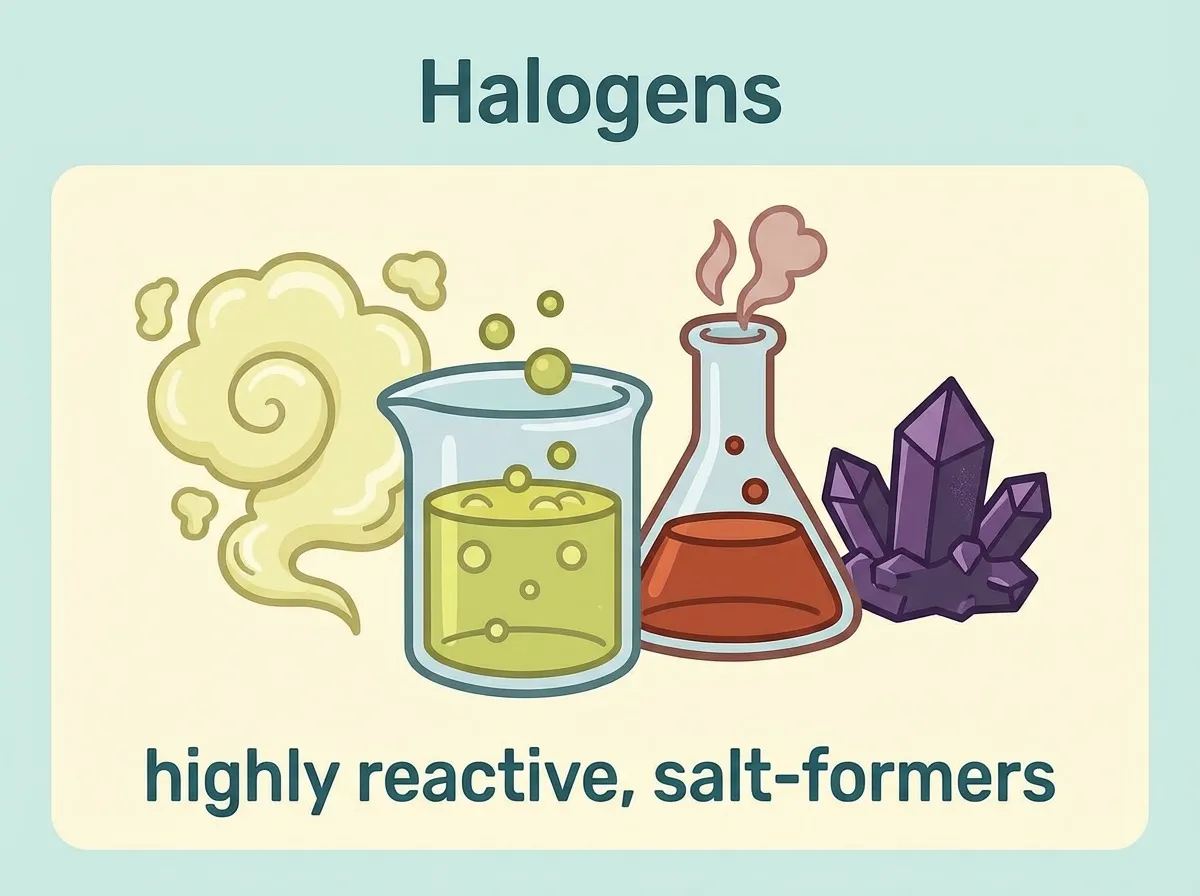
Halogens are a group of highly reactive nonmetals located in Group 17 of the periodic table. Their importance in science and technology comes from how they interact with other elements to form new substances. Halogens are unique because they have seven valence electrons, making them eager to react with other atoms to complete their outer shell. This reactivity leads to the formation of many useful compounds, including salts, disinfectants, and medicines.
The Mechanism of Reactivity Each halogen atom needs just one more electron to achieve a stable, full outer energy level. This drives halogens like fluorine, chlorine, bromine, and iodine to react quickly with metals, such as sodium or potassium. When a halogen reacts with a metal, it gains an electron from the metal, forming a negatively charged ion. The metal becomes a positively charged ion, and the two ions attract each other, forming an ionic compound called a salt. For example, sodium chloride (table salt) is made when sodium and chlorine combine in this way. Halogens exist naturally as diatomic molecules (like Cl2), meaning two atoms bond together. This diatomic form increases their stability until they find a metal or other reactive substance to combine with.
Applications and Patterns in Reactivity Halogens are used in many real-world applications because of their chemical properties. Fluorine is added to toothpaste to help prevent tooth decay by strengthening tooth enamel. Chlorine is commonly used to disinfect swimming pools, killing bacteria and other harmful organisms. Iodine is essential for human health, as it is needed for the production of thyroid hormones and is often used as an antiseptic. Bromine finds use in flame retardants and some medicines. One important pattern is that reactivity decreases as you move down the group: fluorine is the most reactive, while iodine is less so. This is because the outer electrons are farther from the nucleus in larger atoms, making it harder for them to attract new electrons.
Interconnectedness and Broader Implications The reactivity of halogens explains why they are never found in nature as pure elements; instead, they are always combined with other elements in compounds. Their role in forming salts is crucial for biological and chemical systems. For example, table salt (sodium chloride) is vital for nerve function and water balance in living organisms. The study of halogens also demonstrates a fundamental scientific principle: the properties of elements depend on their electron arrangement, which shapes their interactions and the compounds they form. Understanding halogens helps scientists develop safer disinfectants, improve public health, and design new materials.
Interesting Fact: Fluorine is so reactive that it can combine with almost every other element, including some noble gases previously thought to be completely unreactive!
What group of the periodic table do halogens belong to?
Group 17Group 1Group 2Group 18
How many valence electrons do halogens have?
OneSevenEightSix
What is formed when a halogen reacts with a metal?
A gasA saltA baseAn acid
Which halogen is most reactive?
BromineIodineChlorineFluorine
What does the word "diatomic" mean in the context of halogens?
Made of one atomMade of two atomsMade of three atomsMade of four atoms
What is the role of chlorine in swimming pools?
To add flavorTo kill bacteria and disinfectTo make the water blueTo increase temperature
Which of the following is an example of an ionic compound formed by halogens?
Sodium chlorideWaterOxygen gasSugar
Why does reactivity decrease as you move down the group of halogens?
The atoms get smallerThe atoms have fewer electronsThe outer electrons are farther from the nucleusThe atoms have more protons
True or False: Halogens are often found in nature as pure elements.
TrueFalse
True or False: Iodine is used as an antiseptic.
TrueFalse
Perfect For:
👩🏫 Teachers
• Reading comprehension practice
• Auto-graded assessments
• Literacy skill development
👨👩👧👦 Parents
• Reading practice at home
• Comprehension improvement
• Educational reading time
🏠 Homeschoolers
• Reading curriculum support
• Independent reading practice
• Progress monitoring
Reading Features:
📖
Reading Passage
Engaging fiction or nonfiction text
❓
Comprehension Quiz
Auto-graded questions
📊
Instant Feedback
Immediate results and scoring
📄
Printable Version
Download for offline reading
🔊
Read Aloud
Voice-over with word highlighting
Reviews & Ratings
No reviews yet. Be the first to share your experience!
Related Content
Atomic Structure
This reading passage on Atomic Structure provides middle school students with an accessible explanation of the fundament...
MS-PS1-1RI.6.3RI.7.1
Parts of an Atom
This reading passage on Parts of an Atom provides middle school students with a structured and accessible explanation of...
MS-PS1-1RI.6.3RI.7.1
Chemical Bonds
This reading passage on Chemical Bonds provides middle school students with a clear explanation of how and why atoms con...
MS-PS1-1RI.6.3RI.7.1
The Freezing Point of Water
This science reading passage, titled 'The Freezing Point of Water', introduces students to a key physical science concep...
MS-PS1-1RI.6.3RI.7.1
Physical Properties of Matter
This comprehensive reading passage introduces grades 6-8 students to the concept of physical properties of matter, perfe...
MS-PS1-1
Mixtures and Pure Substances
This middle school science passage provides an in-depth exploration of mixtures and pure substances, directly aligned to...
MS-PS1-1
Types of Mixtures
This comprehensive science passage for grades 6-8 introduces students to the concept of mixtures, focusing on distinguis...
MS-PS1-1
Solutions, Suspensions, and Colloids
This comprehensive science passage explores the differences between solutions, suspensions, and colloids, focusing on ho...
MS-PS1-1
The Nature of Science
This passage explores the nature of science for middle school students, aligning with NGSS standards MS-ETS1-4, MS-PS1-1...
MS-ETS1-4MS-PS1-1MS-LS1-1
Scientific Theories
This reading passage for grades 6-8 introduces students to the concept of scientific theories, emphasizing that these ar...
MS-PS1-1MS-PS1-4MS-PS3-4SCIENCE AND ENGINEERING PRACTICES
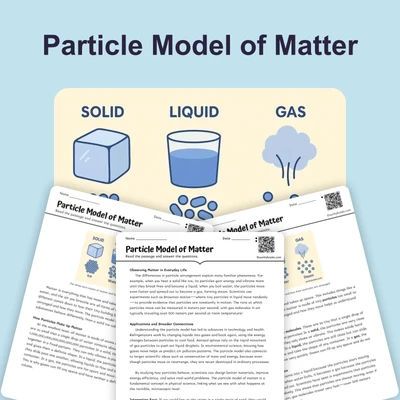
Particle Model of Matter
This comprehensive science reading passage for grades 6-8 explores the particle model of matter, aligning with NGSS stan...
MS-PS1-1MS-PS1-4
Valence Electrons
This middle school science passage introduces students to the concept of valence electrons, the outermost electrons that...
MS-PS1-1
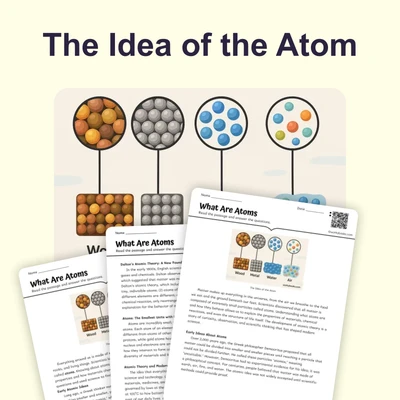
The Idea of the Atom
This informational science passage introduces middle school students (grades 6-8) to the concept that all matter is made...
MS-PS1-1
Protons, Neutrons, and Electrons
This comprehensive middle school science passage explores the roles of protons, neutrons, and electrons, the three main ...
MS-PS1-1
What are Ions
This passage introduces middle school students to the concept of ions, explaining the processes by which atoms gain or l...
MS-PS1-1
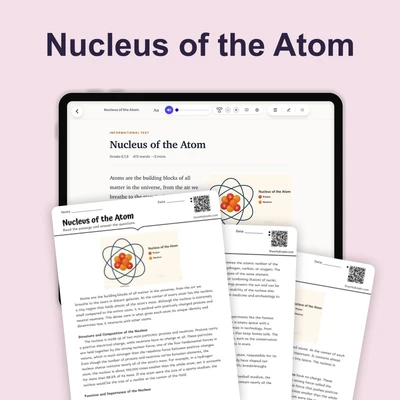
Nucleus of the Atom
This comprehensive passage for grades 6-8 introduces students to the nucleus of the atom, the dense center that contains...
MS-PS1-1
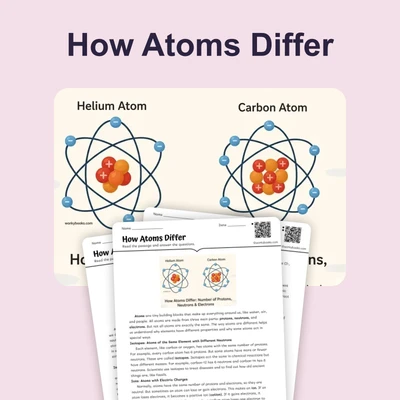
How Atoms Differ
This middle school science reading passage, aligned with NGSS standard MS-PS1-1, explores the fundamental differences am...
MS-PS1-1
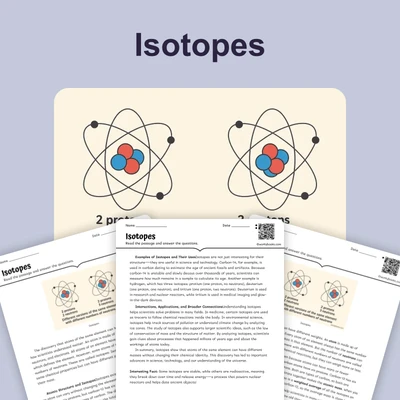
Isotopes
This middle school science passage explores the concept of isotopes, which are atoms of the same element with different ...
MS-PS1-1
Compounds vs. Mixtures
This educational passage for grades 6-8 explores the fundamental differences between compounds and mixtures, aligning wi...
MS-PS1-1
Organizing the Elements
This passage for middle school science explores how scientists organized the elements as more were discovered, leading t...