Hot and Cold Deserts
Interactive passage with audio narration, comprehension questions, and printable PDF.
By completing this purchase you agree to our Terms of Use and Privacy Policy. Your subscription renews automatically until you cancel. You can cancel anytime from your account settings. All sales are final and non-refundable. Digital content is available for download in your account immediately upon purchase.
What's included
Hot and Cold Deserts preview and details
About this printable Hot and Cold Deserts science reading passage, NGSS-aligned (Grades 5-8)
Sample passage and quiz from Hot and Cold Deserts
Reading passage and comprehension quiz preview
Hot and Cold Deserts
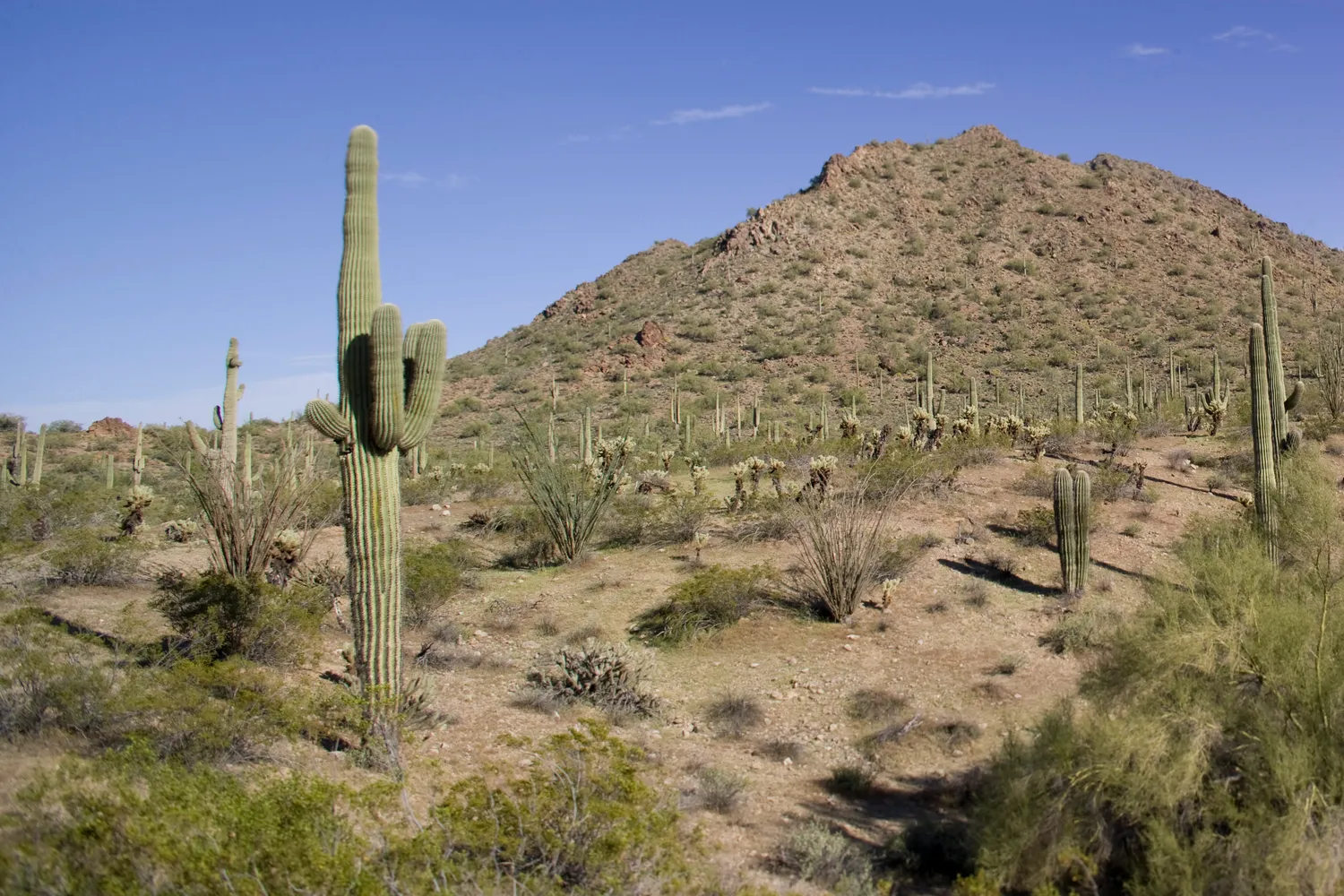
Sonoran Desert National Monument by BLMArizona / Wikimedia Commons
Deserts cover about one-third of Earth’s land surface, but not all deserts are scorching hot. Some, like the vast Gobi and Antarctic deserts, are cold for most of the year. The main characteristic that defines a desert is not temperature, but extremely low precipitation—usually less than 25 centimeters per year. This means that both hot and cold deserts share very dry conditions, but their temperatures and seasonal patterns can be very different. Understanding the mechanisms behind these differences reveals important connections between Earth’s atmosphere, geography, and climate systems.
How Latitude and Elevation Shape Desert Temperatures
The temperature of a desert depends on its latitude—how far it is from the equator—and its elevation—how high it is above sea level. Hot deserts, such as the Sahara in Africa and the Sonoran Desert in North America, are typically found at low latitudes near the Tropic of Cancer and Capricorn, where sunlight is most direct. These regions receive intense solar energy, leading to average summer temperatures often above 38°C (100°F). In contrast, cold deserts like the Gobi in Asia and the Antarctic Desert are located at higher latitudes or high elevations, where sunlight is weaker and temperatures remain much lower. For example, the Antarctic Desert is the coldest place on Earth, with average annual temperatures well below freezing. Elevation also plays a key role: the Gobi Desert, for instance, sits over 900 meters above sea level, which contributes to its cold climate despite being far from the poles.
Seasonal Variations in Hot and Cold Deserts
Both hot and cold deserts experience seasonal changes, but the patterns are different due to their locations and physical features. In hot deserts like the Sahara and Sonoran, summers are extremely hot and dry, while winters are milder but still warm, with little rainfall. Temperatures can swing dramatically between day and night—sometimes by more than 20°C—because dry air holds little heat. Cold deserts, such as the Gobi and Patagonia, have long, harsh winters with temperatures often below freezing and short, cool summers. The Antarctic Desert barely warms above -20°C, even in summer. Precipitation in both types remains very low all year, but in cold deserts, much of it falls as snow rather than rain. Scientists have measured that less than 2% of the Antarctic Desert’s surface receives more than 5 centimeters of precipitation annually.
Desert Systems and the Science of Low Precipitation
Deserts are created by global wind and weather patterns that limit moisture. For example, many hot deserts lie in the path of subtropical high-pressure zones, where sinking dry air prevents cloud formation and rain. Cold deserts often form in the rain shadow of mountain ranges or at the poles, where cold air holds little moisture and precipitation is scarce. Both types of desert are fragile systems—small changes in climate can have large impacts on their ecosystems. Studying deserts helps scientists understand how Earth’s systems interact, and how climate change could affect water supplies and biodiversity in the future.
In summary, deserts are defined by their dryness, not by temperature. The interplay of latitude, elevation, and atmospheric circulation explains why some deserts are baking hot and others icy cold. Learning about these unique environments deepens our understanding of Earth’s dynamic systems and the importance of conserving limited water resources.
Interesting Fact:
About 70% of the world’s deserts are cold deserts, including the largest—Antarctica!
Comprehension quiz (10 questions)
1. What is the main characteristic that defines a desert?
2. Which of the following is a cold desert?
3. What does 'elevation' mean in the context of deserts?
4. What causes most hot deserts to have high temperatures?
5. Which statement best describes cold deserts?
6. In both hot and cold deserts, precipitation is usually less than how many centimeters per year?
7. Why do deserts have large temperature swings between day and night?
8. True or False: All deserts are hot and sandy.
9. True or False: The Antarctic Desert receives less precipitation than most rainforests.
10. Which of the following best explains why cold deserts often form behind mountain ranges?
Perfect for the way you teach
- Build comprehension skills
- Auto-graded quiz
- Differentiated reading
- Read together at home
- Improve fluency
- Quiet reading time
- Reading curriculum support
- Independent practice
- Track Lexile growth